Key event
Archduke Franz Ferdinand assassinated in Sarajevo
- Category:
- Politics
- Date:
- 28 June 1914
- Author:
- Łukasz Skowroń
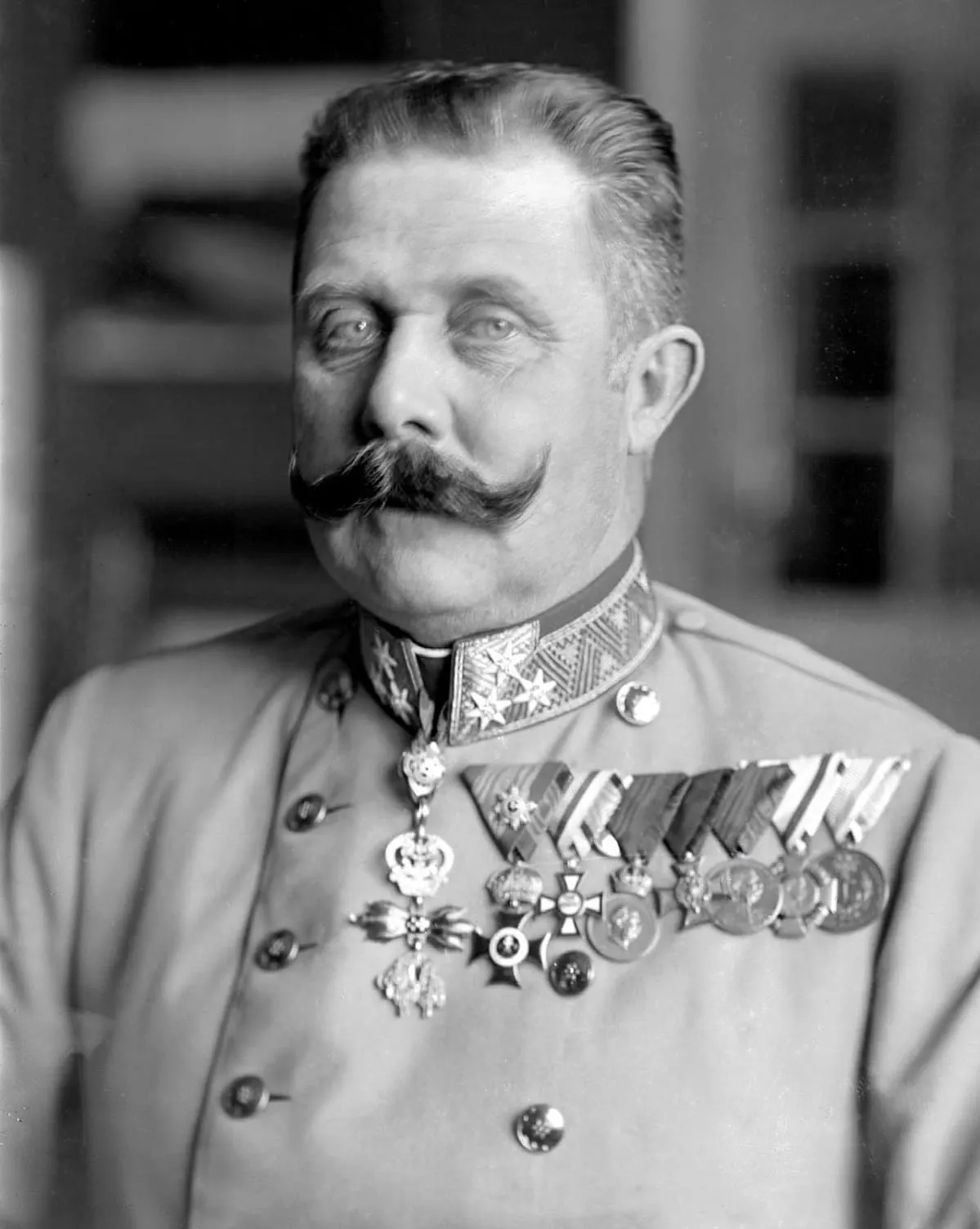
On 28 June 1914, in Sarajevo, Archduke Franz Ferdinand, heir to the Austro-Hungarian throne, and his wife Sophie, Duchess of Hohenberg, were killed. The assassin was Gavrilo Princip, a nineteen-year-old Bosnian Serb linked to the Young Bosnia movement. The assassination itself was not yet the formal beginning of the world war, but it became the immediate trigger of the July Crisis, which within five weeks led Europe from a local political killing to a war between the great powers.
Why Sarajevo mattered so much
The background to the assassination cannot be understood without the situation of Bosnia and Herzegovina. After the Congress of Berlin in 1878, Austria-Hungary obtained the right to occupy and administer the province, which formally still remained part of the Ottoman Empire. In 1908 Vienna fully annexed Bosnia and Herzegovina, which provoked a serious international crisis and particularly strong outrage in Serbia. For many South Slav nationalists the Habsburgs were a foreign power, and Bosnia itself was to become part of a future common state of the South Slavs.
It was in this milieu that the Young Bosnia movement grew up: a loose and ideologically varied network of young conspirators, students and nationalists. They were united by opposition to Austro-Hungarian rule, although not all of them imagined the region’s future in the same way. At the same time more radical circles were active in Serbia, including the secret organisation known as the Black Hand, connected with Serbian military intelligence. From today’s perspective an important distinction must be made: the assassins were subjects of the Austro-Hungarian monarchy, but some of the logistical support, weapons and help in crossing the border came from people linked to Serbian conspiratorial and military structures. That is not, however, the same as saying that the Serbian government as a whole stood behind the assassination. This very point would later become one of the most important political disputes of the summer of 1914.
Why Franz Ferdinand was the target
Franz Ferdinand was not the emperor but the heir to the throne. In the eyes of many contemporaries he was not an easy figure to categorise. On the one hand he represented the empire whose presence in Bosnia and Herzegovina the nationalists wanted to destroy. On the other he was sometimes seen as a supporter of restructuring the Habsburg monarchy, perhaps in a more federal direction, which could have strengthened the position of the Slav peoples within the state. To some Serbian and South Slav radicals this was a threat: a reformed Austria-Hungary might become more durable and harder to break apart.
The archduke’s visit to Sarajevo was also symbolically sensitive. He had come to Bosnia to observe manoeuvres of the Austro-Hungarian army. To the nationalists this was a show of strength by the occupier. Moreover, the day of the visit, 28 June, fell on Vidovdan, an especially important date in Serbian historical memory, associated with the Battle of Kosovo of 1389. This heightened the emotional and propaganda dimension of the planned assassination.
The conspirators and the preparations
The team of assassins posted along the route that day consisted of six conspirators: Gavrilo Princip, Nedeljko Čabrinović, Trifko Grabež, Vaso Čubrilović, Cvjetko Popović and Muhamed Mehmedbašić. They were coordinated by Danilo Ilić. The assassins had pistols, hand grenades and cyanide capsules, which they were to use to kill themselves once the task was done. The weapons and organisational help reached them through a conspiratorial network running from Serbia into Bosnia.
The plan was not a one-day improvisation. The conspirators had been preparing since the spring of 1914, with the support of people connected with Serbian nationalist and intelligence circles, especially the entourage of Dragutin Dimitrijević, known as Apis. Historians have long debated the extent of this help and the degree of responsibility of particular individuals and institutions. What remains well documented is that the assassins received weapons, training and help in crossing the border. Far less well documented, by contrast, is any direct, conscious approval of the operation by the Serbian government as a whole.
The day of the assassination: the first attack fails
On the morning of 28 June the archducal couple travelled from Ilidža to Sarajevo. The motorcade followed a route announced in advance along the Appel Quay embankment. Security was weak for a visit of such rank. No troops lined the route, and protection was left mainly to the local police. This was one of the cardinal weaknesses of the whole organisation of the visit.
The first assassins did nothing. Mehmedbašić and Čubrilović let the archduke’s car pass. At about 10:10 a.m. Nedeljko Čabrinović threw a bomb at the open car. The device bounced off the folded roof of the car and exploded under the next vehicle in the motorcade. Franz Ferdinand and Sophie were not seriously hurt at that point, but more than a dozen people were wounded. Čabrinović swallowed cyanide and jumped into the Miljacka river. Neither the poison nor the jump worked as planned: the cyanide only made him vomit, and the river was too shallow. He was seized by the police and the crowd.
The motorcade drove on to the town hall. There a tense scene followed. The archduke, visibly shaken, interrupted the mayor’s speech of welcome, remarking that he had come on a visit and had been received with bombs. After a moment he calmed down and the ceremony was completed. It was then decided that, instead of continuing with the programme, he would visit the wounded in hospital.
Princip’s shots
On leaving the town hall it was decided that the archduke’s car would drive straight along the embankment to avoid the crowded centre. The problem was that not all the drivers had been properly informed of this change. When the car carrying Franz Ferdinand reached the area of the Latin Bridge, the driver turned into a side street in accordance with the earlier route. Then the mistake was noticed. The car stopped, and as it tried to reverse, the engine stalled almost exactly in front of Gavrilo Princip.
It was a moment of pure chance that passed into history. Princip came up very close and fired two shots from an FN Model 1910 pistol. One bullet hit Franz Ferdinand in the neck, the other struck Sophie in the abdomen. Both were mortally wounded. According to contemporary accounts, the archduke kept repeating to his wife words to the effect of: “Sophie, don’t die, live for our children.” Sophie died very quickly, and Franz Ferdinand a few minutes later, at around 11 a.m. Princip also tried to poison himself and take his own life, but was overpowered and arrested.
Many myths later grew up around the scene itself. The best known says that before the assassination Princip was eating a sandwich in Schiller’s shop and so happened by chance to be in the right place. The story is popular, but it has no basis in reliable sources from 1914 and is now regarded as a later legend rather than an established fact.
What happened immediately after the assassination
In the hours and days that followed, Austria-Hungary opened an investigation, and violent anti-Serb feeling erupted in Sarajevo and elsewhere in the monarchy. There were riots, assaults, looting and destruction of Serbian property. At the same time, in Vienna and in the monarchy’s ruling circles, a decision began to take shape to use the assassination to settle accounts with Serbia.
This is where the historical weight of Sarajevo lies. The assassination did not automatically make war inevitable. It did, however, become a political and emotional pretext on which a much broader strategy could be built. Among the Austro-Hungarian elites there had long been a conviction that Serbia was a mortal threat to the monarchy’s stability, because it supported South Slav nationalism and undermined the loyalty of the Slav population within the Habsburg borders. After 28 June this conviction began to translate into concrete decisions of state.
From the assassination to the July Crisis
Most importantly, Vienna had no intention of confining itself to an ordinary investigation and condemnation of the perpetrators. Austria-Hungary decided to present Serbia with an ultimatum worded so harshly that accepting it in full would be very difficult. Before that, it sought Berlin’s backing. On 5 and 6 July 1914 Germany gave Austria-Hungary the so-called “blank cheque”, an assurance of full support even in the event of serious international complications. This was one of the key links leading from the assassination to a general European war.
On 23 July Serbia received the ultimatum with a 48-hour deadline for a reply. Belgrade accepted most of the demands, but not all of them, especially those that infringed the state’s sovereignty and allowed wide-ranging interference by Austro-Hungarian officials and investigators on Serbian territory. For Vienna this was enough to deem the reply unsatisfactory. On 28 July 1914, exactly a month after the assassination, Austria-Hungary declared war on Serbia.
Then the machinery of alliances, mobilisation plans and miscalculations was set in motion. Russia began mobilising in defence of Serbia. Germany backed Austria-Hungary and declared mobilisation. It then declared war on Russia and France, and went on to violate Belgian neutrality. Britain entered the war on the side of France and Russia. That is why the Sarajevo assassination is often called the “spark” that set Europe alight, but it was not the only cause of the fire. Deeper tensions already existed: great-power rivalry, the alliance system, nationalisms, fear of losing position and ready-made war plans.
Responsibility and historical debates
On the question of responsibility, precision is needed. Princip and his fellow conspirators were responsible for the killing itself. In organisational terms there is strong evidence pointing to the involvement of people connected with Serbian military intelligence and conspiratorial circles, especially those of the Black Hand. It is much harder to prove that the Serbian government as a whole planned the assassination or fully controlled it. Contemporaries were already arguing about who knew, when they knew, and whether the warnings passed to Austria-Hungary were a genuine attempt to prevent the tragedy or merely a half-measure.
A second distinction is also important: responsibility for the assassination is not the same as responsibility for the outbreak of the world war. The fact that shots were fired in Sarajevo did not yet decide that all the great powers would go to war. The decisions taken in Vienna, Berlin, St Petersburg, Paris and London in the following weeks had their own dynamics. The assassination created a crisis; it was the great states that turned it into a general war.
Significance of the event
The Sarajevo assassination occupies a unique place in history because it combines the local with global consequences. It was the work of a small group of conspirators acting in a particular province of a multinational empire, but its consequences reached far beyond the Balkans. Within a few weeks it was not only the heir to the throne and his wife who had died: the European order, which despite its crises had lasted for decades, collapsed. That is why 28 June 1914 remains one of the most important days in modern European history.
If this project is to tell the story of the Great War in chronological order, this is exactly where it must begin: not with the first great battle, but with two shots fired in Sarajevo, which set off a crisis that Europe’s leaders were no longer able to stop.
Remember the articles you have read? Only in this browser; nothing is sent anywhere.How it works
Read ·
Spotted a mistake?Report an error
Related events
(04)The same battle, people or subject.
- 14 July 1914 · PoliticsVienna decides on action against SerbiaOn 14 July 1914 Vienna took the political decision on a hard line towards Serbia and on preparing an ultimatum that would lead to war.
- 19 July 1914 · PoliticsAustro-Hungarian council of ministers approves the draft ultimatum to SerbiaOn 19 July 1914 Vienna approved the draft ultimatum to Serbia, completing preparations for a diplomatic step meant to open the way to war.
- 23 July 1914 · DiplomacyAustria-Hungary delivers an ultimatum to SerbiaOn 23 July 1914 Austria-Hungary handed Serbia an ultimatum with a 48-hour deadline, making demands that struck at its sovereignty.
- 25 July 1914 · DiplomacyAustria-Hungary breaks off diplomatic relations with SerbiaOn 25 July 1914 the Austro-Hungarian minister, Baron Giesl, judged Serbia's reply inadequate, broke off diplomatic relations and left Belgrade.