1914: The first invasion of Serbia
Serbian campaign of 1914
- Dates:
- 12 August – 15 December 1914
- Front:
- Balkan Front
- Location:
- Western and north-western Serbia, from the Drina and the Sava through Mačva, the Jadar valley and the mountains above the Drina to the Kolubara valley, Suvobor and Belgrade; also Austro-Hungarian Syrmia and eastern BosniaOn the battle map →
- Sides:
- Serbia and MontenegroRadomir Putnik, Stepa Stepanović, Petar Bojović, Živojin Mišić, Pavle Jurišić ŠturmAustria-HungaryOskar Potiorek, Liborius von Frank
- Result:
- Serbian victory. All three Austro-Hungarian invasions ended in retreat, the border remained unchanged and Potiorek lost his command. Both sides, however, suffered enormous losses.
- Author:
- Łukasz Skowroń
The Serbian campaign of 1914 was the first campaign of the First World War and one of the greatest defeats of the Habsburg monarchy. The war began with a conflict between Austria-Hungary and Serbia, and Vienna counted on punishing its small neighbour within a few weeks. Instead, between August and December 1914 the troops of General Oskar Potiorek entered Serbia three times and three times had to withdraw. In August the Serbs routed them on Mount Cer, in September they halted them in the mountains above the Drina, and in December, when the Austro-Hungarians had already taken Belgrade, they counter-attacked on the Kolubara and drove the invaders out of the entire country. The victory, however, cost exhausted Serbia so much that for most of 1915 it was unable to undertake any offensive operations.
Name and dates
Polish, Serbian and German historiography divides the operations of 1914 into three offensives, that is, three Austro-Hungarian invasions: in August, in September and in November–December. German studies call the whole the “Serbian campaign of 1914” (Serbienfeldzug 1914), while the Austrian official history, “Österreich-Ungarns letzter Krieg”, describes it as the campaign against Serbia and Montenegro. The Serbs remember above all its great battles, Cer and the Kolubara. The British chronology of the war, kept as events unfolded, counted only two invasions, because for it the September fighting on the Drina merged with the subsequent operations. On our site we keep to the division into three invasions.
We adopt the dates 12 August – 15 December 1914. On 12 August Austro-Hungarian troops crossed the Drina and the Sava, and on 15 December the Serbs returned to Belgrade, with not a single enemy unit left on their soil. The war had admittedly been going on since 28 July, and on the night of 28–29 July Austro-Hungarian monitors and batteries shelled Belgrade, but for the first two weeks both armies were still completing mobilisation and concentration, and on the border there was only shelling and skirmishing. Serbian dates, recorded in the Julian calendar, are 13 days earlier: by them the invasion began on 30 July and Belgrade was liberated on 2 December.
Background
Austria-Hungary declared war on Serbia on 28 July 1914, a month after the Sarajevo assassination. The Chief of the General Staff, Franz Conrad von Hötzendorf, had prepared two variants: a war against Serbia alone, in which three armies would march against it, and a war against Russia, in which only the forces needed for defence and a limited offensive would remain in the Balkans. When Russia announced mobilisation, the monarchy had to choose the second variant, but some troops were already travelling south. As a result the Second Army of General Eduard von Böhm-Ermolli, concentrated in Syrmia and the Banat, could take part in the first fighting against the Serbs only until mid-August, after which it was to leave for Galicia.
Command of the Balkan forces went to Potiorek, governor of Bosnia and Herzegovina, who in June had been responsible for the safety of Archduke Franz Ferdinand in Sarajevo. Under his orders stood the Fifth Army of General Liborius von Frank on the lower Drina and the Sixth Army, which he commanded personally, in Bosnia. According to tables based on the Austrian official history, at the start of the campaign the three armies together numbered about 320 battalions and 744 guns, and after the departure of the Second Army about 240 battalions remained, or roughly 260,000 men. Potiorek wanted to strike not from the north, across the Sava and the Danube, where the Serbs expected him, but from the west, from Bosnia, into the mountainous country along the Drina.
Serbia had only just emerged from the two Balkan Wars, in which it had lost tens of thousands of men and most of its ammunition stocks. It mobilised about 420,000 men, of whom eleven infantry divisions and a cavalry division, more than 250,000 soldiers in all, stood in the first line. It lacked guns, rifles, uniforms and boots, and its arms industry was limited to the arsenal at Kragujevac. The Supreme Commander was formally the Regent Alexander, but the army was directed by the Chief of Staff, Vojvoda Radomir Putnik. The outbreak of war had found him taking a cure in Austria-Hungary. Detained in Budapest, he was released on the Emperor’s orders and managed to return home. Putnik had three armies: the First Army of General Petar Bojović, the Second Army of General Stepa Stepanović and the Third Army of General Pavle Jurišić Šturm, as well as the Užice Group in the west and the Belgrade defence troops. He kept most of his forces deep inside the country, in Šumadija, so as to be able to send them wherever the main blow fell. Serbia’s ally was the Kingdom of Montenegro, which declared war on Austria-Hungary on 5 August and fielded about 40,000–50,000 men.
The first invasion and the Battle of Cer
On 12 August the Fifth Army began forcing the Drina near Loznica, and units of the Second Army crossed the Sava and took Šabac. A few days later the Sixth Army also set off from the upper Drina, but its corps moved slowly and far from the field of the main battle. The Austro-Hungarian columns advanced through heat, forests and ravines without supporting one another. Putnik at first took the attack from the west for a feint, but when he recognised it as the main thrust, he sent Stepanović’s Second Army there by forced march.
On the night of 15–16 August Serbian units clashed with the enemy on the slopes of Mount Cer and in the Jadar valley. So began the Battle of Cer, also called the Battle of the Jadar. After several days of fighting in the forests and on the ridges, often at night and with the bayonet, on 19 and 20 August the Fifth Army broke and began to retreat in disorder across the Drina. In the north the Serbs surrounded Šabac, which the Austro-Hungarian garrison abandoned on the night of 23–24 August. By 24 August there were no longer any of Potiorek’s troops on the Serbian bank. It was the first Allied victory of the war, and Stepanović was promoted to vojvoda for it.
The invasion left a trail of atrocities behind it. Austro-Hungarian soldiers, convinced they were fighting partisans, shot and hanged villagers in Mačva and around Šabac, including women, old people and children. According to historians’ estimates, between 3,500 and 4,000 civilians were killed in less than two weeks. The crimes were investigated, at the invitation of the Serbian government, by the Swiss criminologist Archibald Reiss, and his reports had a wide resonance in the Entente countries.
The Syrmia expedition and the second invasion
Russia and France pressed the Serbs to carry the war onto enemy territory and tie down troops that might otherwise have gone to Galicia. On 6 September Bojović’s First Army crossed the Sava and entered Syrmia, a Hungarian region inhabited largely by Serbs. A subsidiary crossing by the Timok Division near Sremska Mitrovica ended in disaster and the loss of about 6,000 men, but the main forces advanced, and on 10 September the Belgrade defence troops took Zemun, which lies opposite the capital. The offensive in Syrmia, however, lasted little more than a week.
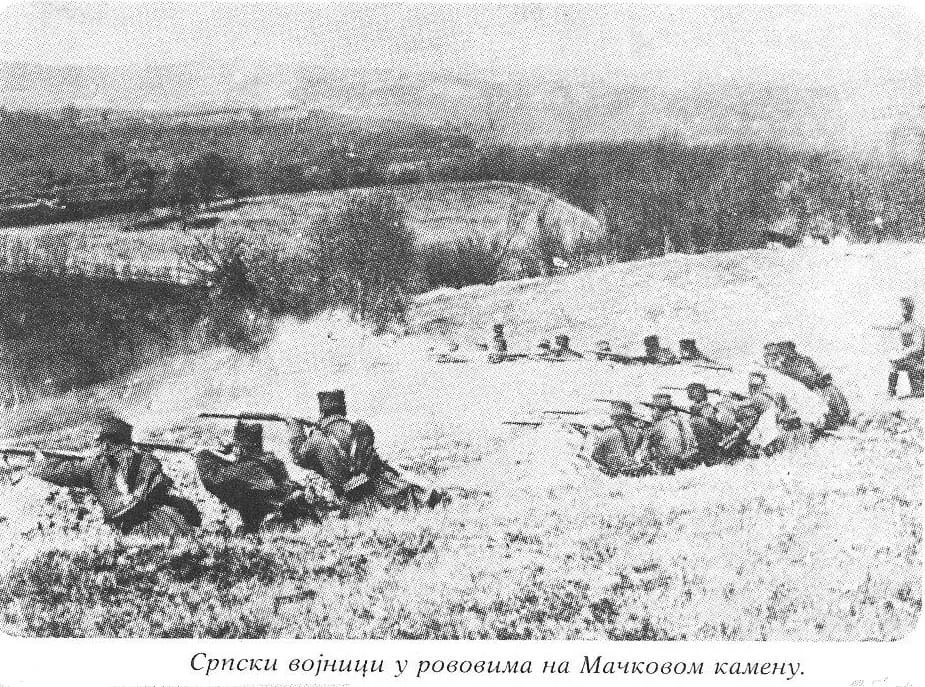
On the night of 7–8 September Potiorek crossed the Drina for the second time, this time with both armies. In Mačva the Fifth Army ran into the prepared defences of the Second Army and held only small bridgeheads. Further south the Sixth Army surprised the weaker Serbian Third Army and broke onto the ridges of the mountains running along the river: Gučevo above Loznica, Boranja and Jagodnja. On 11 September Putnik, against the objections of the Regent and some commanders, broke off the Syrmia expedition and sent the divisions of the First Army to the Drina front. So began the Battle of the Drina. Serbian counter-attacks recovered some of the ridges but did not push the enemy back to the river. The bloodiest fighting took place on 20–22 September for the summit of Mačkov Kamen in the Jagodnja range, which changed hands several times and cost both sides thousands of killed and wounded.
At the same time the Serbian Užice Group and the Montenegrin Sanjak Army of General Janko Vukotić struck deep into eastern Bosnia. On 14 September they took Višegrad, and at the end of the month they reached the Romanija plateau, on the approaches to Sarajevo. Their forces, however, were too weak. The Austro-Hungarians drove them back, and in October the Serbs and Montenegrins withdrew from Bosnia.
At the beginning of October the larger attacks died down and the Drina front froze. On Gučevo, Boranja and Jagodnja the opponents dug in a few dozen, in places a few, metres apart and fought with grenades and mines laid under the enemy’s trenches. The Serbs call this fighting the first trench battle of the war. For Serbia this kind of war was deadly: its artillery fell almost silent for lack of shells, while the Austro-Hungarian guns fired more and more. At the end of October the Fifth Army attacked in Mačva, and on the night of 30–31 October the Serbian Second Army, having nothing with which to answer the hurricane bombardment, abandoned its trenches on the lower Drina.
The third invasion and the Battle of the Kolubara
On 6 November, after a heavy artillery preparation, both of Potiorek’s armies launched the third and largest offensive. Deprived of ammunition, the Serbs could not hold the mountains above the Drina for which they had fought since September. Putnik ordered a retreat into the interior. The army marched along sodden roads, in rain and snow, followed by fleeing civilians who remembered the August atrocities. On 15 November the Austro-Hungarians took Valjevo, and the Serbian army stood on prepared positions behind the Kolubara river, its tributary the Ljig, and in the Maljen and Suvobor mountains. The wounded Bojović handed command of the First Army to General Živojin Mišić.
On 16 November the Austro-Hungarian troops reached the Kolubara and the Battle of the Kolubara began. For two weeks, in flooded trenches, in frost and snow, the Serbs gave up one hill after another. On 28 November the Austro-Hungarians broke through the First Army’s front and reached the ridge of Suvobor. Mišić then decided to fall back a dozen or so kilometres, beyond Gornji Milanovac, let his soldiers rest and only then counter-attack. The Supreme Command accepted his plan and shortened the whole front, even though this meant giving up the capital. On 30 November the units defending Belgrade left the city, and on 2 December, the 66th anniversary of the accession of Franz Joseph I, Potiorek reported the capture of Belgrade to the Emperor. In doing so he directed the main forces of the Fifth Army northwards, towards the capital, instead of after the retreating Serbs.
Potiorek’s troops, meanwhile, were at the end of their strength, with supply lines stretching for dozens of kilometres along sodden mountain roads. The Serbs, on the other hand, received ammunition. French shells, brought in through Salonika, turned out to be too long for the Serbian guns and had to be hastily reworked in workshops in Niš and Kragujevac, but by the end of November the front had received tens of thousands of French, Greek, Russian and Serbian shells. The divisions were brought up to strength with recruits, among them about 1,300 young volunteers, largely students, hastily trained as corporals. At dawn on 3 December Mišić’s First Army attacked the Sixth Army, and during the day the remaining Serbian armies joined the offensive. On 5 December the Serbs retook Suvobor, and on 6 December Potiorek ordered the Sixth Army to retreat, which quickly turned into flight. By mid-December its remnants had withdrawn across the Drina and the Sava. The Fifth Army, which still tried to defend itself on the hills south of Belgrade, was pushed back towards the city by the Serbs. On the night of 14–15 December it crossed back over the Sava, and on 15 December Serbian cavalry entered the capital. Mišić was promoted to vojvoda for the Kolubara.
Losses
According to the Austrian official history, from the beginning of the war until mid-December about 462,000 soldiers and officers were sent to the Balkan front, counting lines-of-communication units and fortress garrisons. Losses, compiled at the beginning of 1915, amounted to about 274,000 men: more than 28,000 killed, about 122,000 wounded, almost 47,000 sick and nearly 77,000 missing and taken prisoner. The same history notes that most of the wounded and sick returned to service after recovering. The August fighting alone cost Austria-Hungary, according to this source, about 23,000 killed and wounded, although some studies, counting prisoners, give more than 40,000 for the Battle of Cer.
Serbian losses are less certain. According to tables based on Serbian data, the army lost about 163,000 men in 1914, including more than 22,000 killed, about 96,000 wounded and about 45,000 missing. The Serbs took several tens of thousands of prisoners, by Austrian reckoning even more than 70,000, and in December captured more than a hundred guns. To this must be added thousands of civilians killed and enormous destruction in Mačva, in the Kolubara valley and in Belgrade, which was shelled from across the river all autumn.
Significance
The 1914 campaign was a humiliation for Austria-Hungary. A great power had failed to defeat a small neighbour with which it had itself started the war, and the joy at the capture of Belgrade lasted less than two weeks. The defeat weakened the monarchy’s prestige in the Balkans and made the hope of winning over Bulgaria more remote. On 22 December Potiorek was recalled, and command of all forces in the Balkans, combined into a single Fifth Army, was taken over by Archduke Eugen. General Frank was also recalled. Calm settled over the Serbian front, and Austria-Hungary was able to send some of its troops to the Carpathians and later to the Isonzo.
Serbia had defended its territory but was exhausted. On 7 December, while the counter-offensive was still under way, the government of Prime Minister Nikola Pašić presented in Niš, and the Skupština adopted, a declaration that the aim of the war was the liberation and unification of all Serbs, Croats and Slovenes. In the winter an epidemic of typhus swept the country, full of wounded, refugees and prisoners. According to various estimates, by the spring of 1915 it had killed from several tens of thousands to more than a hundred thousand people – soldiers, civilians and Austro-Hungarian prisoners – as well as about a third of Serbia’s doctors. The Serbian army did not recover before the autumn of 1915, when Germany, Austria-Hungary and Bulgaria attacked Serbia simultaneously. The victories at Cer and on the Kolubara nevertheless remained in Serbian memory as proof that a small army, well led and fighting for its own country, could defeat a great power.
Spotted a mistake?Report an error
Battles and phases
(04)- 15–24 August 1914Battle of CerThe first Allied victory of the First World War. The Serbian army routed Austro-Hungarian forces on Mount Cer and the Jadar and drove them out of the country.
- 6–14 September 1914Serbian offensive in SyrmiaIn September 1914 the Serbian army crossed the Sava into Austro-Hungarian Syrmia. A week later it had to withdraw to defend the country on the Drina.
- 7 September – 4 October 1914Battle of the DrinaIn September 1914 Austria-Hungary again struck Serbia across the Drina. The Serbs halted the offensive in the mountains and the front turned to trench war.
- 16 November – 15 December 1914Battle of KolubaraIn autumn 1914 Austria-Hungary invaded Serbia for the third time and took Belgrade. In December a Serbian counter-offensive from Suvobor drove it out.