Austria-Hungary · The Central Powers
Eduard von Böhm-Ermolli
Commander of the Second Army (1914–1918) and of an army group on the Eastern Front (1915–1918), field marshal
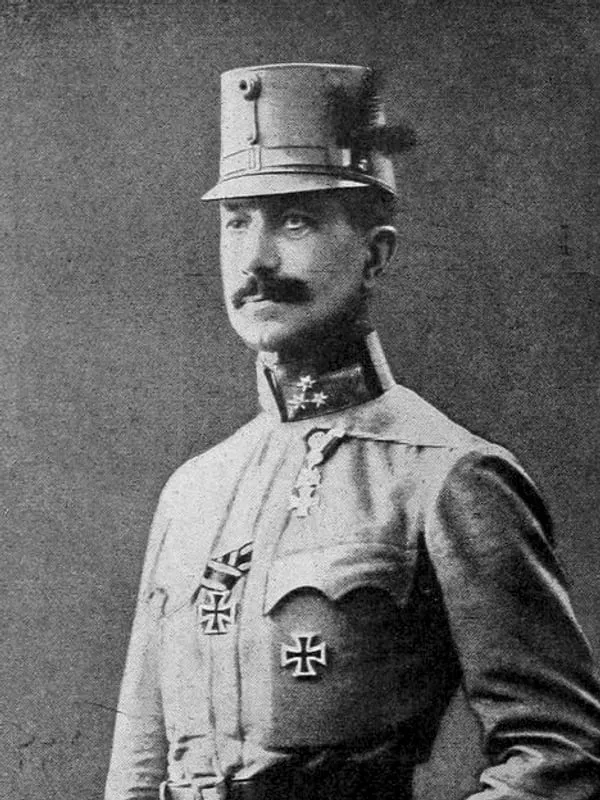
- Born:
- 12 February 1856, Ancona (Papal States)
- Died:
- 9 December 1941, Opava
- Author:
- Natalia
- Photo:
- Popscreen, domena publiczna, Wikimedia Commons

Eduard von Böhm-Ermolli commanded the Austro-Hungarian Second Army from the first month of the war until May 1918. Few generals of this war stayed so long in one post. His army fought first on the Serbian border, then in Galicia, in Congress Poland and in the Carpathians, and on 22 June 1915 it entered recaptured Lviv. From the autumn of 1915 Böhm-Ermolli commanded an army group in Eastern Galicia which came through the Brusilov offensive better than others, and in July 1917 it repulsed the Kerensky offensive and threw the Russians back to the Zbruch. He was not a strategist of Conrad’s calibre nor a press hero like Dankl, but he was regarded as one of the most solid generals of the monarchy. The Germans, under whose authority he spent much of the war, valued him particularly highly.
Before the war
He was born on 12 February 1856 in Ancona, then in the Papal States, where an Austrian garrison was stationed. His father, Georg Böhm, who came from Moravia, was a non-commissioned officer who had been promoted to officer for bravery at the Battle of Novara in 1849. His mother, Maria Josepha Ermolli, was Italian. In 1885 his father, by then a retired major, was ennobled and given the right to add his wife’s surname to the family name. The family lived in the garrison town of Opava (Troppau) in Austrian Silesia, with which Eduard remained connected all his life.
He graduated from the cadet school in St. Pölten and the Theresian Military Academy in Wiener Neustadt, became a second lieutenant of dragoons in 1875, and after the war school in Vienna served on staffs and in the cavalry. He spent many years in Galicia. He was a brigade staff officer in Lviv, commanded a squadron of uhlans in Brzeżany and uhlan regiments in Brody and Gródek, and from 1905 a cavalry division and then the 12th Infantry Division in Kraków. In 1911 he took over I Corps in Kraków, and in 1912 he became General of Cavalry. He therefore knew Galicia, where he was to fight, better than most of the monarchy’s generals.
1914: Serbia, Lviv, Poland
After mobilisation Böhm-Ermolli took over the Second Army. In the war plans it was a reserve that was to go to the Balkans in a war with Serbia alone, and to Galicia in a war with Russia. The Chief of the General Staff, Franz Conrad von Hötzendorf, sent it first to the Sava and the Danube, and when Russia entered the war the transports could not be turned back at once. Some of the Second Army’s troops took part in the first fighting of the Serbian campaign, among other places at Šabac. The army command did not leave the Balkans until 21 August, and its corps were still arriving in Galicia until the end of the month.
Meanwhile in Eastern Galicia the Russians had routed the Third Army and the group of Hermann Kövess, which was to become the core of Böhm-Ermolli’s army, and on 3 September they took Lviv. In the Battle of Gródek and Rawa Ruska the Second Army attacked from the Wereszyca from 8 September alongside the Third Army, and for a moment the Austrian staff believed that Lviv was within reach. The attack collapsed within a few days, however, and on 11 September Conrad ordered the whole front to retreat. In October Böhm-Ermolli’s army advanced from the Carpathians in the Battle of Chyrów and retook the Uzsok Pass, but could not break the Russian Eighth Army of Aleksei Brusilov.
In November, at the Germans’ request, the Second Army command with two corps was moved by rail to Silesia. During the Battle of Łódź the army covered the Germans’ southern flank on the Warta, and in the winter it waged positional warfare near Bełchatów and Piotrków, next to the Prussian Landwehr Corps of General Remus von Woyrsch. Böhm-Ermolli got on well with his German neighbours, something Conrad often failed to do.
1915: the Carpathians and Lviv
In February 1915 Conrad moved the Second Army to the Carpathians, for the winter battle that was meant to relieve besieged Przemyśl. On 27 February its troops set off towards Baligród and Lesko, in snow and frost, against well-entrenched Russians. The attack stalled the very next day, and further attempts ended in heavy losses. On 22 March Przemyśl capitulated, and for the following weeks Böhm-Ermolli defended himself on the Carpathian ridges against a Russian counter-offensive.
After the breakthrough at Gorlice the Second Army came down from the mountains. In May and June it fought to recapture Przemyśl and in the Battle of Mościska and Lubaczów, and then on the Gródek positions. When the German Eleventh Army of August von Mackensen broke through the defences in the north, Böhm-Ermolli’s corps took the fortifications on the western approaches to Lviv, and on 22 June 1915 entered the city. In the afternoon Böhm-Ermolli himself arrived in Lviv with his staff, welcomed by the inhabitants, who had lived under Russian occupation for 293 days. Soon afterwards his army fought on the Gniła Lipa.
In September 1915, during the unsuccessful offensive in Volhynia and on the Sereth, Böhm-Ermolli took command of an army group made up of his Second Army and neighbouring troops. In the Battle of Tarnopol the Russians halted the advance, and on 11 September Böhm-Ermolli called off the attack on Zbaraż. The front settled on the Brody–Złoczów–Strypa line and stayed there for almost two years.
1916–1917: Brusilov and Kerensky
On 1 May 1916 Böhm-Ermolli became Colonel General. During the Brusilov offensive, when the neighbouring Austro-Hungarian armies at Lutsk and in Bukovina collapsed in the first days, the Second Army east of Brody and on the upper Ikva held most of its positions, although at the end of July the Russians took Brody. At the end of July the northern part of the front, as far as the Brody area, was taken over by Paul von Hindenburg, who at the beginning of August visited Böhm-Ermolli in Lviv together with Erich Ludendorff. For the Germans he was a general with whom it was easy to work.
In the summer of 1917 the front from Brody to the Carpathians was held by his army group: the Austro-Hungarian Second Army in the north and the German-Austrian South Army on the Złota Lipa. On 1 July the Kerensky offensive struck it. At Koniuchy and Zborów the Russians, with a Czechoslovak brigade fighting at their side, routed two Austro-Hungarian divisions, but at Brzeżany the South Army repulsed the attack, and the whole offensive soon petered out. On 19 July came the reply. German divisions brought from the west, together with Böhm-Ermolli’s troops, broke through the front at Złoczów, took Tarnopol and threw back the shattered Russian armies. On 27 July Böhm-Ermolli ordered permanent positions to be occupied on the Zbruch. For this campaign he received the Commander’s Cross of the Military Order of Maria Theresa and the hereditary title of baron, and on 31 January 1918 he became a field marshal.
1918: Ukraine
After the conclusion of peace with the Ukrainian People’s Republic and the breakdown of talks with the Bolsheviks, the Germans advanced deep into Ukraine. Emperor Charles I at first did not want to take part, but on 24 February he gave way, because the monarchy desperately needed Ukrainian grain. On 27–28 February troops of the Second Army entered Podolia, in March they took Zhmerynka, and on 13 March, together with the Germans, they entered Odessa. At the beginning of April Böhm-Ermolli moved his headquarters to Odessa. His main task was to extract food for starving Austria. In March the Emperor instructed him to carry out requisitions ruthlessly, and if necessary by force.
In Ukraine disputes with the Germans soon arose over occupation zones, railways and the division of the spoils. In May 1918 Böhm-Ermolli lost his command and his army group was dissolved. The troops in Odessa, renamed the Eastern Army, were taken over at the end of May by General Alfred Krauss. Böhm-Ermolli received no further command until the end of the war.
After the war
After the collapse of the monarchy he settled in Opava, which became part of Czechoslovakia. The Czechoslovak state paid him a pension and gave him the rank of general in retirement, in 1928 that of army general, although he had never served in its army. After the Munich Agreement and the occupation of the Sudetenland in 1938 he became a citizen of the Reich. In 1940, as the only surviving field marshal of the former monarchy, he received the honorary rank of field marshal of the Wehrmacht and the honorary colonelcy of an infantry regiment in Opava. He died in Opava on 9 December 1941, aged 85. He was given a state funeral in Vienna, at which the German army was represented by Field Marshal Wilhelm Keitel. He was buried in Opava.
Assessment
There is little literature on Böhm-Ermolli. Military historians regard him as one of the most capable and most reliable army commanders of the monarchy, and a British encyclopaedia of 1922 wrote that in numerous battles he had shown ability as a commander and was highly regarded by the Germans. His chief virtue was his ability to cooperate. He did not get into quarrels with the ally and calmly carried out plans that were often drawn up by others, and his army group twice, in 1916 and 1917, withstood great Russian offensives.
Critics note that his greatest successes, such as the capture of Lviv in 1915 or the counter-offensive in Galicia in 1917, were largely due to German troops and plans, and that the Second Army’s independent operations, especially in the Carpathians in the winter of 1915, ended in heavy losses with no result. The occupation of Ukraine in 1918, carried out by his troops with the ruthlessness ordered by Vienna, made enemies for the monarchy and yielded less grain than had been expected. A shadow is also cast on his biography by the honours he accepted in old age from the Third Reich.
Sources
Spotted a mistake?Report an error
Commanded in battles
(13)- 23 August – 11 September 1914Battle of GaliciaEastern Front
- 8–11 September 1914Battle of Gródek and Rawa RuskaEastern Front
- 13 October – 2 November 1914Battle of ChyrówEastern Front
- 23 January – 15 April 1915Winter Battle in the CarpathiansEastern Front
- 24 May – 3 June 1915Recapture of PrzemyślEastern Front
- 12–15 June 1915Battle of Mościska and LubaczówEastern Front
- 17–22 June 1915Recapture of LvivEastern Front
- 27 June – 1 July 1915Battle of the Gniła LipaEastern Front
- 7–16 September 1915Battle of TarnopolEastern Front
- 4 June – 20 September 1916Brusilov offensiveEastern Front
- 1–16 July 1917Kerensky OffensiveEastern Front
- 19–28 July 1917Counter-offensive in Eastern GaliciaEastern Front
- 18 February – 3 March 1918Operation FaustschlagEastern Front
Mentioned in battles
(01)Often appears with
People who appear in the same events.