Russian Empire · The Entente
Nikolai Ivanov
Commander of the Russian Southwestern Front (1914–1916), General of Artillery
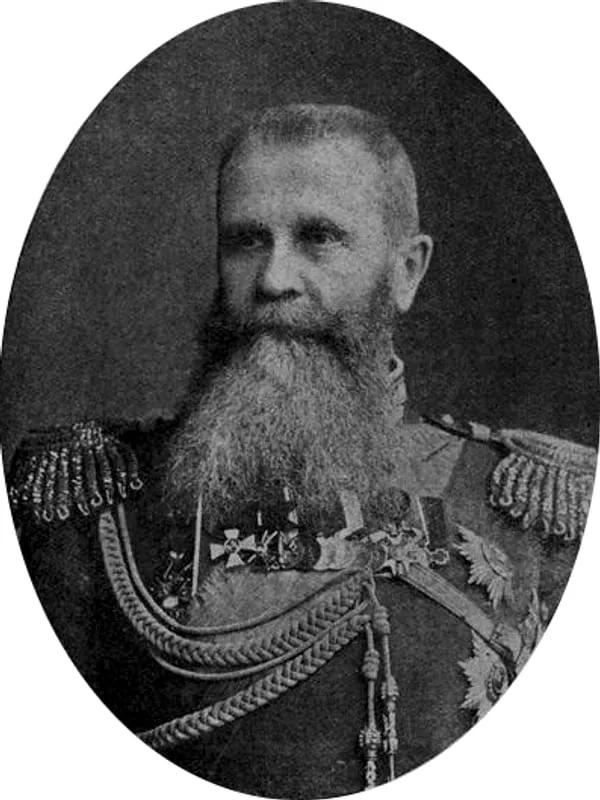
- Born:
- 3 August 1851
- Died:
- 27 January 1919
- Author:
- Łukasz Skowroń
- Photo:
- autor nieznany, domena publiczna, Wikimedia Commons

General of Artillery Nikolai Ivanov commanded the Russian Southwestern Front, which fought against Austria-Hungary, from the first day of the war until the spring of 1916. Under his command the Russians won the Battle of Galicia in 1914, took Lviv and besieged Przemyśl, and he himself became one of the most popular generals at home and among the Allies. In 1915, however, his armies were driven out of Galicia, and in March 1916 he was replaced by Aleksei Brusilov. Ivanov, who enjoyed the trust of the Tsar and the Empress, moved to Headquarters. In March 1917 it was to him that Nicholas II entrusted the task of crushing the revolution in Petrograd, a task that ended before it had begun.
Before the war
He was born on 3 August 1851 (22 July in the Julian calendar). According to official records he came from the nobility of Kaluga Governorate and was the son of a captain who had risen from the ranks. Other versions circulated, however: the army chaplain Georgy Shavelsky recorded that before his death the general revealed to his adjutant that he had been born in Chita as the son of an exile, and that his real surname was different. He graduated from the Mikhailovsky Artillery School in 1869 and fought in the Russo-Turkish War. For almost ten years he commanded the fortress artillery at Kronstadt, and during the Boxer Rebellion he directed the artillery of the Russian expeditionary corps in China. He was regarded as an expert in practical gunnery.
In the Russo-Japanese War, after the death of General Fyodor Keller, he took over the Eastern Detachment, later converted into the III Siberian Corps. He made his name in defence, especially at Mukden, for which he received the Order of St George, 4th and 3rd Class. After the war, as chief commander of Kronstadt, he harshly suppressed unrest in the garrison there, which won him the personal trust of Nicholas II. In 1907 he became an adjutant general to the Tsar, and in 1908 commander of the Kiev Military District, whose troops formed the core of his front in 1914. He was a modest, devout man with a long beard, more an administrator than a strategist.
1914: Galicia
At the start of the war Ivanov took command of the Southwestern Front: four armies that were to defeat the Austro-Hungarians in Galicia. His chief of staff was General Mikhail Alekseyev, one of the authors of the war plan against Austria. The campaign began with defeats in the north, at Kraśnik and Komarów, where Franz Conrad von Hötzendorf had thrown his main forces. In the east, however, the armies of Ruzsky and Aleksei Brusilov routed the weaker Austrian forces on the Złota Lipa, and on 3 September the Russians took Lviv. That same day Ivanov ordered a general advance which, after the battle of Gródek and Rawa Ruska, forced the Austro-Hungarians to retreat behind the San and the Dunajec. The Battle of Galicia cost the Habsburg army, according to the Austrian official history, about 250,000 men out of the million with which it had begun the campaign. The Russians besieged Przemyśl, and Ivanov received the Order of St George, 2nd Class.
In the autumn three armies of his front were moved to the Vistula, where they took part in the Battle of Warsaw and Dęblin, and around 10 October the Warsaw sector was placed under the commander of the Northwestern Front, Nikolai Ruzsky. In November Ivanov’s armies approached Kraków, but at the beginning of December the Austrians stopped them at Limanowa.
1915: the Carpathians and the retreat
Ivanov and Alekseyev argued to the Stavka that the shortest road to victory led across the Carpathians to Hungary and Budapest. In January 1915 Ivanov ordered an offensive, which collided with the Austrian offensive to relieve Przemyśl. The Winter Battle in the Carpathians brought the capitulation of the fortress on 22 March, but the crossing of the mountains failed, and both sides lost hundreds of thousands of men, many of them frozen or sick. On 15 April Ivanov halted the offensive. In the spring Alekseyev left for the Northwestern Front.
Ivanov expected further fighting in the Carpathians and underestimated the German preparations in western Galicia. When at the beginning of May the Germans and Austrians broke through the front at Gorlice, he did not reinforce General Radko Dimitriev’s 3rd Army in time, despite his requests. Over the following weeks he manoeuvred between the Stavka, which forbade retreat, and the reality at the front. On 14 May, on his own responsibility, he ordered a retreat to the line of the San, and then several times ordered the evacuation of Przemyśl and cancelled it, because the Stavka wanted to hold the fortress. In June the Russians lost Przemyśl and Lviv, and after a conference at Baranovichi on 24 June two armies and a group of corps of the front were placed under Alekseyev’s orders. The retreat through Podolia and Volhynia stopped only in the autumn, after a failed counter-offensive at Tarnopol.
In June 1915 Ivanov instructed the authorities of the Kiev Military District to take hostages from among the German colonists, in the proportion of one per thousand inhabitants, mainly teachers and pastors, and to hold them until the end of the war under threat of the death penalty. Russian historians call this a rare example of taking hostages from among a state’s own citizens.
At the turn of 1915 and 1916 his 7th and 9th Armies launched an offensive on the Strypa and at Czernowitz, which was meant to encourage Romania to enter the war. It ended in bloody failure, and on 26 January 1916 Alekseyev ordered it halted. Ivanov concluded that his troops were not capable of attacking.
At the Tsar’s side
Empress Alexandra Feodorovna valued Ivanov for his loyalty, and from the autumn of 1915 urged her husband in her letters to bring him to Headquarters, where he would keep an eye on Alekseyev, or to make him Minister of War. At the end of March 1916 the Tsar settled on a compromise: Brusilov took command of the front, and Ivanov was appointed a member of the State Council and transferred to Headquarters, where he was to remain at the Tsar’s side. Brusilov recalled that when he arrived to take over the post, the old general burst into tears and kept repeating that he did not understand why he had been removed. Later Ivanov reported to the Empress on the mood at Headquarters.
The expedition to Petrograd
When the Petrograd garrison mutinied on 12 March 1917, the Tsar appointed Ivanov commander of the Petrograd Military District with extraordinary powers and sent him to the capital at the head of a battalion of Knights of the Cross of St George. Infantry and cavalry regiments from the Northern and Western Fronts were to follow him. Ivanov left Mogilev on 13 March. On the way, at Dno station, he arrested several suspects and disarmed soldiers, but the revolution proved faster. The reinforcements got stuck on the railway, and some of them were disarmed by revolutionaries at Luga. On the evening of 14 March Ivanov reached Tsarskoye Selo and spoke with the Empress during the night. Meanwhile Alekseyev, counting on a political agreement with the Duma, was holding back the dispatch of troops. During the night of 14–15 March Ivanov received a telegram from the Tsar asking him to take no action until his arrival. His train was stopped at Susanino station, and in the evening he was relieved of his post. The day after the Tsar’s abdication he returned to Mogilev.
After the war
In Kiev Ivanov was arrested by the local soviet and sent to Petrograd, where on the orders of Alexander Kerensky he was released on account of his age and health. After the October Revolution he joined the Whites in southern Russia. In the autumn of 1918 the ataman of the Don Cossacks, Pyotr Krasnov, gave him command of the Southern Army, which, however, had only a few thousand soldiers at the front and suffered heavy losses. Ivanov died of typhus in the winter of 1919. Most sources give the date as 27 January, but Russian biographical encyclopedias also cite 11 February, New Style. There is also no agreement on the place of his death: some sources name Novocherkassk, others Odessa.
Assessment
In 1914 Ivanov was a hero in Russia, and his orders were quoted in the press and later in scholarly works. General Anton Denikin, however, claimed that Ivanov’s career was the work of chance and that the real author of the Galician victories was Alekseyev. Historians judge him similarly, seeing him as a conscientious but cautious commander with little independence, reliant on his chiefs of staff.
Most of the criticism concerns 1915: underestimating the threat at Gorlice, indecision in the first days of the breakthrough and passivity in the months that followed. In his defence, the Stavka long forbade retreat, the army lacked ammunition and heavy artillery, and in May 1915 it was he who, against Headquarters, decided to withdraw the troops behind the San. His role in March 1917 showed above all how little loyalty to the Tsar could still achieve once the monarch’s own generals had turned away from him.
Sources
Spotted a mistake?Report an error
Commanded in battles
(15)- 23 August – 11 September 1914Battle of GaliciaEastern Front
- 26–30 August 1914Battle of the Złota LipaEastern Front
- 8–11 September 1914Battle of Gródek and Rawa RuskaEastern Front
- 28 September – 8 November 1914Battle of Warsaw and DęblinEastern Front
- 15–28 November 1914Battle of KrakówEastern Front
- 1–12 December 1914Battle of LimanowaEastern Front
- 23 January – 15 April 1915Winter Battle in the CarpathiansEastern Front
- 1–5 May 1915Battle of GorliceEastern Front
- 16–23 May 1915Battle of the SanEastern Front
- 24 May – 11 June 1915Battle of the StryjEastern Front
- 24 May – 3 June 1915Recapture of PrzemyślEastern Front
- 12–15 June 1915Battle of Mościska and LubaczówEastern Front
- 17–22 June 1915Recapture of LvivEastern Front
- 27 June – 1 July 1915Battle of the Gniła LipaEastern Front
- 7–16 September 1915Battle of TarnopolEastern Front
Mentioned in battles
(01)Often appears with
People who appear in the same events.