Russia · The Entente
Radko Dimitriev
Commander of the Russian Third Army (1914–1915) and Twelfth Army (1916–1917), General of Infantry
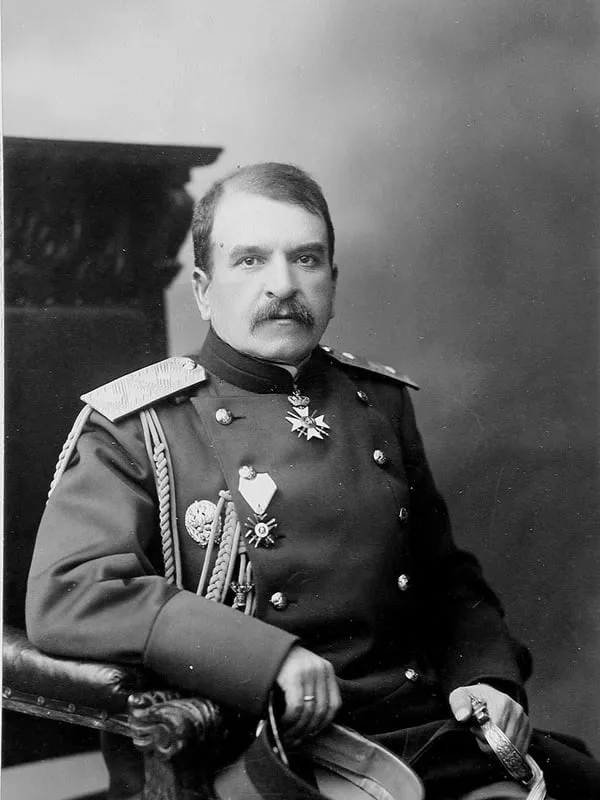
- Born:
- 6 October 1859, Gradets (Bulgaria)
- Died:
- 1 November 1918, Pyatigorsk
- Author:
- Łukasz Skowroń
- Photo:
- autor nieznany, domena publiczna, Wikimedia Commons

Radko Dimitriev was one of the most famous Bulgarian generals, the victor over the Turks in the First Balkan War, and during the First World War a general of the Russian army. When war broke out in 1914 he gave up his post as Bulgaria’s envoy in St Petersburg and joined the army that he regarded as the army of his country’s liberators. For more than half a year he commanded the Russian Third Army: he besieged Przemyśl, approached Kraków and fought in the Carpathians. In May 1915 it was his army that took the main blow of the Germans and Austrians at Gorlice and was shattered, and he himself lost his command. When a few months later Bulgaria sided with the Central Powers, Dimitriev remained in Russian service. He was killed in 1918 as a hostage of the Bolsheviks.
Before the war
He was born on 24 September 1859 (according to the Julian calendar then used by the Bulgarians) in the village of Gradets near Kotel, in what was then the Ottoman Empire, the son of a teacher, Dimitar Ruskov. As a teenager he belonged to the conspirators preparing the April Uprising of 1876, and in the Russo-Turkish War he served as an interpreter in a Guards uhlan regiment of the Russian army. He was in the first intake of the military school in Sofia, and in 1884 he graduated with distinction from the Nicholas General Staff Academy in St Petersburg. In the Serbo-Bulgarian War of 1885 he distinguished himself as one of the young captains who defeated the Serbs at Slivnitsa and Pirot.
He was an ardent Russophile. In August 1886 he was among the conspirators who forced Prince Alexander of Battenberg to abdicate. After Stefan Stambolov took power he had to flee, and after a failed officers’ mutiny in Silistra in 1887 he joined the Russian army and served in the Caucasus for more than ten years. He returned to Bulgaria in 1898, after Sofia’s reconciliation with St Petersburg. From 1904 to 1907 he was chief of the Bulgarian general staff.
In the First Balkan War he commanded the Bulgarian Third Army, which in the autumn of 1912 routed the Turks at Lozengrad (Kırklareli) and Lüleburgaz. These victories made him a national hero, although the assault on the lines at Çatalca, which he directed, ended in failure. In the Second Balkan War in 1913 he replaced General Savov as de facto commander-in-chief, but did not reverse the defeat. Bulgarian historians accuse him of rash decisions that worsened the army’s position. In the autumn of 1913 he became envoy in St Petersburg. In the summer of 1914, at the urging of the Russian foreign minister Sergey Sazonov, he tried to persuade the government in Sofia to side with Russia and Serbia.
1914: Galicia
The government of Vasil Radoslavov declared neutrality and leaned towards Germany. Dimitriev resigned from his post and from the Bulgarian army, and in a letter published in the Russian press wrote that as a Bulgarian he could not stand aside at that moment and considered it his sacred duty to give his strength to Russia, to which Bulgaria owed its existence. At the beginning of August 1914 he was accepted into the Russian army with the rank of lieutenant-general and given VIII Corps in the Eighth Army of Aleksei Brusilov.
His corps fought successfully on the Gniła Lipa, where according to Russian accounts Dimitriev himself led his staff and escort into the attack at a critical moment, and then took Mikołajów on the Dniester. Next he halted the advance of the Austro-Hungarian Second Army in the fighting at Gródek. For both successes he received, in quick succession, the Order of St George of the 4th and 3rd class. In mid-September he was promoted to general of infantry and took over the Third Army from Nikolai Ruzsky, who moved to the North-Western Front.
The Third Army closed the ring around Przemyśl. Dimitriev wanted to take the fortress before the Austrians went over to the counter-offensive. He called on the garrison to surrender, and after its refusal, on 5–8 October, he threw his infantry against the forts without heavy siege artillery. The attack brought heavy losses and achieved nothing, and a few days later the Austrian relief force arrived. In the autumn Dimitriev’s army fought on the San, and in November, after the retreat of the Central Powers, it advanced westwards from Tarnów and came up to Kraków, taking Wieliczka. At the beginning of December the Austrians struck its flank and rear from the south and in the Battle of Limanowa drove it back from the city. The army was not destroyed, however. It received new divisions and at the end of December counter-attacked from the Dunajec to the Carpathians, among other places at Łowczówek, where the 1st Brigade of the Legions fought against it.
1915: Gorlice
In winter the left wing of the Third Army fought in the Low Beskids in the Winter Battle in the Carpathians, in snow and frost that cost it tens of thousands of sick and frostbitten men. In the spring of 1915 its front stretched from the Vistula near Tarnów to the Łupków Pass, and some of its corps already stood on the Hungarian slopes of the mountains. According to Russian biographers, Dimitriev saw the danger of such an extended line and proposed shortening it, but was refused. The trenches were shallow, the rear positions weak, and the artillery short of ammunition. The Russians knew from prisoners about the enemy’s preparations, but the front command expected a blow in the Carpathians instead. The commander of the South-Western Front, Nikolai Ivanov, did not reinforce the Third Army in time, although Dimitriev asked him to.
On 2 May 1915 the new German Eleventh Army of General August von Mackensen struck at Gorlice on a sector defended by five understrength Russian divisions. After a bombardment of several hours from hundreds of guns the first line fell. Dimitriev did not immediately grasp the scale of the threat. In the evening he ordered the positions to be held and promised a counter-attack once the III Caucasian Corps arrived from reserve. The reserves went into battle piecemeal and were destroyed. The front staff asked Headquarters for permission to make a deeper retreat, but Grand Duke Nicholas Nikolaevich categorically refused. Nevertheless, on the evening of 5 May Dimitriev’s staff issued an order to retreat behind the Wisłoka.
On the new line the army was to stand to the last. On 8 May an envoy of the Grand Duke brought an order to hold the positions at all costs, and Dimitriev passed it on to the troops in an even harsher form: the soldiers were to die but not to retreat. Yet the front broke again. Dimitriev reported that his army had bled itself white, and on 10 May he ordered a retreat behind the San. Within two weeks the Third Army had lost the whole of Western Galicia and tens of thousands of prisoners. Fighting continued on the San. The Germans crossed the river near Jarosław, and when the Russian counter-attack collapsed on 19 May, Dimitriev reported that the situation was worsening by the hour, demanded permission for the Third and Eighth Armies to retreat, and even urged Brusilov to withdraw his corps without waiting for the commander-in-chief’s order. Earlier still, the Grand Duke had suggested to Ivanov that the commander of the Third Army be replaced.
The command looked for someone to blame. According to Russian service records, Dimitriev was removed from command in the second half of May, and the official order was issued at the beginning of June. The Third Army was taken over by General Leonid Lesh, and Dimitriev was given II Siberian Corps and, in the autumn, VII Siberian Corps.
Bulgaria on the other side
In the autumn of 1915 Bulgaria joined the Central Powers and attacked Serbia, and Russia declared war on it. Dimitriev, the hero of the Balkan Wars, remained in Russian uniform. According to contemporary accounts he sent his Bulgarian decorations back to Tsar Ferdinand and renounced his Bulgarian allegiance.
Riga
In the spring of 1916 Dimitriev took over the Twelfth Army, which defended the Riga bridgehead on the Northern Front. From August that front was once again commanded by Ruzsky. In July his VI Siberian Corps attacked near Bauska without success and with heavy losses. At the beginning of January 1917 the Twelfth Army struck from Riga towards Mitau. The Latvian Riflemen broke through the German lines in the frost, but the success was not exploited, and at the end of January a German counter-attack took most of the gains back from the Russians. Even so, Dimitriev received the Russian Order of the White Eagle with swords.
After the February Revolution the Twelfth Army, the one closest to Petrograd, quickly succumbed to agitation, and soldiers’ committees shared power in it with the commanders. Dimitriev tried to cooperate with them and gave way to them. His superiors concluded that the army was unfit for offensive operations and that he himself was unable to restore discipline in it. At the beginning of August 1917 (20 July according to the Julian calendar) he was recalled “owing to illness” and transferred to the reserve. A month later the Twelfth Army, now under another commander, gave up Riga.
After the war
Dimitriev went for treatment to Yessentuki in the North Caucasus, and that is where the October Revolution found him. He joined neither the Whites nor the Reds. In September 1918 the Bolsheviks arrested him together with his son and other officers as hostages. According to a White investigative commission, when he was offered a command in the Red Army he replied that he had left his homeland to serve great Russia, but would rather die than serve the rabble. After the mutiny of the Red commander Ivan Sorokin, the local Cheka murdered more than a hundred hostages in reprisal. Dimitriev was hacked to death with sabres in the cemetery at Pyatigorsk on 1 November 1918 (19 October according to the Julian calendar), together with General Ruzsky. Some sources give the date as 18 October, counted in the Old Style.
In Bulgaria his memory has survived. The village of Radko-Dimitrievo bears his name, and at the turn of 2012 and 2013 he was posthumously awarded the highest Bulgarian order, the Stara Planina, 1st class.
Assessment
Dimitriev was a brave, energetic and ambitious commander, brought up in the Russian military school. The British historian Bernard Pares, who met him at the front, described a short, stocky general with a Napoleonic profile, who spoke quickly and briefly and whose watchword was “forward”. This offensive attitude brought him success in the Balkan Wars and in 1914, but it could also be costly, as in the assault on Przemyśl.
Opinions of his role at Gorlice are divided. Critics, including some Western historians, accuse him of failing to prepare a proper defence despite news of the Germans’ arrival, and of believing in a counter-attack in the first days of the breakthrough instead of saving the army by retreating. Others stress that his army was stretched over too long a front, deprived of ammunition and reserves, and that the retreat was long blocked by Ivanov and the Grand Duke’s Headquarters. In 1915 Dimitriev became one of the convenient scapegoats for a defeat for which the whole Russian command system was responsible. His life also remains an example of the drama experienced by Balkan Russophiles when their countries and Russia found themselves on opposite sides of the front.
Sources
Spotted a mistake?Report an error
Commanded in battles
(07)- 24 September – 9 October 1914First siege of PrzemyślEastern Front
- 15–28 November 1914Battle of KrakówEastern Front
- 1–12 December 1914Battle of LimanowaEastern Front
- 22–25 December 1914Battle of ŁowczówekEastern Front
- 23 January – 15 April 1915Winter Battle in the CarpathiansEastern Front
- 1–5 May 1915Battle of GorliceEastern Front
- 16–23 May 1915Battle of the SanEastern Front
Mentioned in battles
(03)Often appears with
People who appear in the same events.
On the timeline
(18)1913
1914
1915
May
- 14
- Central Powers take JarosławIn mid-May 1915 the German Guard and the Austro-Hungarian VI Corps took the Russian bridgehead at Jarosław and reached the San. The town suffered from shelling.
- End of the battle of Sanok and RzeszówIn mid-May 1915 the Russians withdrew from western Galicia behind the San. The Central Powers took Sanok and Rzeszów and 130,000–140,000 prisoners.