Russia · The Entente
Nikolai Ruzsky
Commander of the North-Western Front (1914–1915) and the Northern Front (1915–1917), general of infantry
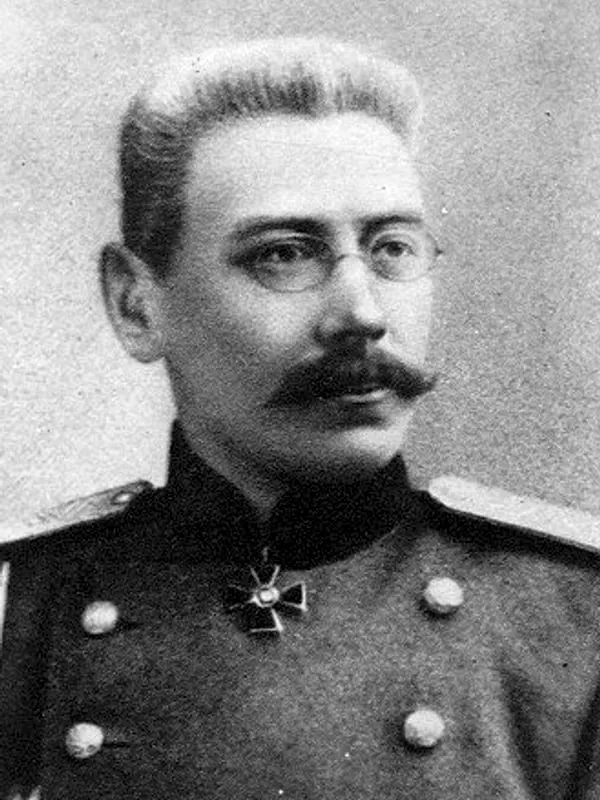
- Born:
- 18 March 1854
- Died:
- 1 November 1918, Pyatigorsk
- Author:
- Łukasz Skowroń
- Photo:
- autor nieznany, domena publiczna, Wikimedia Commons

General of Infantry Nikolai Ruzsky was one of the most important Russian commanders of the First World War, although his fame came early and faded quickly. In August 1914 his 3rd Army routed the Austrians east of Lviv and took the city, which made him a hero in Russia, “the conqueror of Galicia”. In the autumn he took over the North-Western Front and fought the Germans in the Kingdom of Poland, at Warsaw, Łódź and on the Bzura, and in the winter of 1915 his troops suffered defeat in Masuria. In poor health, he gave up and regained command several times. He went down in history, however, above all as commander of the Northern Front, at whose headquarters in Pskov Tsar Nicholas II renounced the throne in March 1917.
Before the war
He was born on 18 March 1854 (6 March in the Julian calendar) into a noble family from Kaluga Governorate. His father, a minor official, died when the boy was one year old. Ruzsky completed the military gymnasium in St Petersburg and a military school, served in a Guards grenadier regiment and, as a company commander, fought in the Russo-Turkish War, in which he was wounded. In 1881 he graduated with distinction from the Nicholas General Staff Academy.
He spent most of his career on staffs, for many years in the Kiev Military District, where he was regarded as one of the ablest officers. In the Russo-Japanese War he was chief of staff of the 2nd Manchurian Army and fought at Sandepu and Mukden. He then commanded XXI Corps, but in 1909, because of poor health, he moved to the Military Council attached to the Minister of War. He was one of the authors of the 1912 field regulations. In the same year he became deputy commander of the Kiev Military District. Under the mobilisation plan the district commander, General Nikolai Ivanov, was to take over the South-Western Front in the event of war, and Ruzsky an army formed from the district’s troops. Contemporaries remembered him as a tall, thin general in spectacles who spoke little, but clearly and with great self-assurance.
1914: Lviv
At the outbreak of war Ruzsky took command of the 3rd Army, which was to strike from Volhynia into eastern Galicia. When the Austrians threw their main forces north, against the Russian 4th and 5th Armies at Kraśnik and Komarów, Ruzsky, together with the 8th Army of Aleksei Brusilov, pushed towards Lviv against the weaker Austro-Hungarian 3rd Army. At the end of August the two armies routed it on the Złota Lipa and the Gnila Lipa, and on 3 September the Russians entered Lviv, which the Austrians had abandoned without a fight. In the following days Ruzsky’s army wheeled north-west and took part in the fighting at Rawa Ruska, which decided the Austro-Hungarian retreat behind the San.
For Lviv Ruzsky received the Order of St George, 4th and 3rd class, at the same time, and soon afterwards the 2nd class for the Battle of Galicia as a whole. He was one of only a handful of Russian commanders in this war to receive such a high decoration. The press and the opposition in the Duma praised him to the skies. Critics, however, including some Russian military historians, accused him of stubbornly pressing on towards Lviv even though news was arriving of the difficulties of the armies fighting in the north, and of advancing too cautiously, so that the beaten Austrian army managed to slip away from him.
North-Western Front
In mid-September 1914, after the defeat at Tannenberg, Ruzsky replaced General Yakov Zhilinsky at the head of the North-Western Front, which was fighting the Germans. The 3rd Army was taken over from him by Radko Dimitriev. At the end of September Ruzsky’s troops repulsed a German advance on the Niemen. In October the commander-in-chief, Grand Duke Nicholas Nikolaevich, placed under him the armies assembled on the middle Vistula. Under his command the Russians won the Battle of Warsaw and Dęblin and forced the Germans to retreat to Silesia. The citation for the Order of St George, 2nd class, referred precisely to the “victorious repulse of the German and Austrian armies advancing on Warsaw”.
In November Ruzsky’s front was to advance deep into Germany, but Paul von Hindenburg forestalled him with a blow from Thorn. In the Battle of Łódź the German 9th Army almost encircled the Russian 2nd Army, and then part of its own forces found themselves surrounded at Brzeziny and broke out. The Russian command attributed this to poor coordination of the three armies, for which the front staff was largely responsible. Ruzsky put the blame on the army commanders. Paul von Rennenkampf and the commander of the 2nd Army, Sergei Scheidemann, lost their posts. The commission investigating the Rennenkampf affair later concluded, according to Russian studies, that serious mistakes had been made by Ruzsky himself. At a conference in Siedlce at the end of November Ruzsky argued for withdrawing to a shorter line, and the Grand Duke agreed. At the beginning of December the Russians abandoned Łódź, and after the fighting on the Bzura the front came to a halt on the Bzura and the Rawka.
In February 1915 the Germans struck the Russian 10th Army in East Prussia in a snowstorm. Ruzsky, who wanted to cover the concentration of the 12th Army forming on the Narew, ordered it to hold its positions for a long time. The retreat began too late, and in the Winter Battle of Masuria XX Corps capitulated in the Augustów Forest. Some historians attribute the main blame for this defeat precisely to the front command. A few days later Ruzsky’s troops won a success in the First Battle of Przasnysz, where they retook the town in a counter-attack. In March the general fell ill and handed the front over to the chief of staff of the South-Western Front, General Mikhail Alekseyev. He became a member of the State Council.
Northern Front
In the summer of 1915, during the Great Retreat, Ruzsky returned to service as commander of the 6th Army, which covered Petrograd and the Baltic coast. At the end of August the enlarged North-Western Front was split in two, and Ruzsky took over the new Northern Front, which was to defend the road to the capital. A few days later the Tsar himself assumed supreme command. In the autumn the front’s troops stopped the Germans on the line of the Dvina, at Riga and at Dvinsk. In December 1915 Ruzsky fell ill again and command passed to General Pavel Plehve, and after him to General Aleksei Kuropatkin.
In August 1916 the Tsar restored Ruzsky to the head of the Northern Front. The general commanded it cautiously and avoided major operations. The only serious attempt at an offensive was the attack by Radko Dimitriev’s 12th Army from Riga towards Mitau at the beginning of January 1917. The Latvian Riflemen broke through the German lines, but the success was not exploited, and at the end of January the Germans recovered most of the lost ground. During this time Ruzsky maintained contacts with Duma politicians and made no secret of his view that autocracy was obsolete.
Pskov, March 1917
When revolution broke out in Petrograd on 12 March 1917, the Tsar left General Headquarters at Mogilev for Tsarskoye Selo. Mutinous soldiers barred his way, and on the evening of 14 March his train reached Pskov, the headquarters of the Northern Front. For many hours Ruzsky tried to persuade Nicholas that he must appoint a government responsible to the Duma. The Tsar refused for a long time, but during the night he gave way and halted General Ivanov’s expedition against the capital. At about half past three in the morning Ruzsky spoke by telegraph with the President of the Duma, Mikhail Rodzianko, who declared that the concession had come too late and that the only way out was abdication. In the morning Alekseyev circulated the record of this conversation to the front commanders.
Before noon on 15 March Ruzsky presented the Tsar with the record of the conversation and Alekseyev’s telegram, and in the afternoon replies began to arrive from the front commanders, who unanimously came out in favour of abdication. Between two and three o’clock Ruzsky entered the saloon car with the front’s chief of staff, General Yuri Danilov, and General Sergei Savich. The Tsar asked them for their frank opinion, and they too came out in favour of renouncing the throne. Nicholas decided to abdicate, and in the evening he handed the Duma’s envoys, Alexander Guchkov and Vasily Shulgin, the act of abdication in favour of his brother. In his diary he wrote: “All around is treason, cowardice and deceit!”
Ruzsky’s role in those days remains controversial to this day. In monarchist circles the image took hold of a general who had all but forced the Tsar’s signature out of him. Second-hand accounts circulated on the subject, among them a scene attributed to the Minister of the Court, Count Fredericks, in which Ruzsky was supposed to have held the Tsar’s hand over the manifesto. According to another account, Nicholas, already in exile, is said to have remarked that he could forgive all his enemies except General Ruzsky. Historians treat these stories with caution. Documents and eyewitness accounts suggest rather that Ruzsky, convinced that concessions were necessary, put strong pressure on the Tsar, but that the decision to abdicate was settled by the opinions of all the front commanders and Alekseyev, as well as by the stance of the Duma. In 1917 Ruzsky himself was proud of this role; later he reportedly regretted having broken his oath.
After the war
After the revolution Ruzsky argued for maintaining discipline in the army, which set him at odds with the Minister of War, Guchkov, and with Alekseyev. In May 1917 (25 April in the Julian calendar) he was dismissed “on grounds of illness”, although his letters show that the dismissal was not voluntary. He went for treatment to Kislovodsk in the North Caucasus. After the October Revolution he lived in Yessentuki. In September 1918 the Reds took him hostage, together with Radko Dimitriev. According to a White commission of inquiry he refused to take a command in the Red Army, saying that he would not take part in a war of Russians against Russians.
After the mutiny of the commander of the Red forces in the North Caucasus, Ivan Sorokin, who at the end of October 1918 had the leaders of the local Soviet republic shot, the Cheka murdered more than a hundred hostages in reprisal. Ruzsky was led out to the cemetery in Pyatigorsk and hacked to death on 1 November 1918 (19 October in the Julian calendar, which is why some sources give an October date). He was one of the victims of the Red Terror. His recollections of the days in Pskov were published only after his death.
Assessment
Ruzsky had a reputation as an outstanding staff officer, intelligent and well educated, and the protopresbyter of the army, Georgy Shavelsky, praised his calm, dignity and clarity of judgement. As a commander, however, he aroused mixed feelings. The victory at Lviv and the defence of Warsaw in the autumn of 1914 made him famous, but even then he was accused of excessive caution, difficulty in coordinating several armies and a tendency to shift the blame onto subordinates, as the Rennenkampf affair showed. The defeat of the 10th Army in Masuria weighs heavily on his decisions. On top of this came poor health, which forced him to leave his post several times, sometimes at important moments.
The most contested chapter of his biography remains March 1917. To some he was a patriot who wanted to save the war effort and the state through reform, and then through a change of monarch. To others, especially historians sympathetic to the last Tsar, he was one of the generals who abandoned their sovereign. Most scholars agree that Ruzsky did not plan the abdication, but that at the critical moment, as host to a Tsar cut off from the world, he played a greater part in it than anyone else apart from Alekseyev.
Sources
Spotted a mistake?Report an error
Commanded in battles
(09)- 23 August – 11 September 1914Battle of GaliciaEastern Front
- 26–30 August 1914Battle of the Złota LipaEastern Front
- 8–11 September 1914Battle of Gródek and Rawa RuskaEastern Front
- 28 September – 8 November 1914Battle of Warsaw and DęblinEastern Front
- 11 November – 6 December 1914Battle of ŁódźEastern Front
- 30 November – 17 December 1914Battle of the BzuraEastern Front
- 7–22 February 1915Winter Battle in MasuriaEastern Front
- 22–27 February 1915First Battle of PrzasnyszEastern Front
- 9 September – 1 November 1915Battle of DvinskEastern Front
Mentioned in battles
(01)Often appears with
People who appear in the same events.