1915: Masuria and Przasnysz
Winter Battle in Masuria
- Dates:
- 7–22 February 1915
- Front:
- Eastern Front
- Location:
- Masuria and the eastern part of East Prussia, the Suwałki region and the Augustów Forest, from Johannisburg (Pisz) and Gumbinnen to Augustów, Grodno and the BiebrzaOn the battle map →
- Sides:
- German EmpirePaul von Hindenburg, Erich Ludendorff, Otto von Below, Hermann von EichhornRussian EmpireNikolai Ruzsky, Thadeus von Sievers, Pavel Bulgakov
- Result:
- German victory. The Russian Tenth Army was driven out of East Prussia and its XX Corps surrendered. The rest of the army escaped encirclement and manned the Grodno–Biebrza line.
- Author:
- Natalia
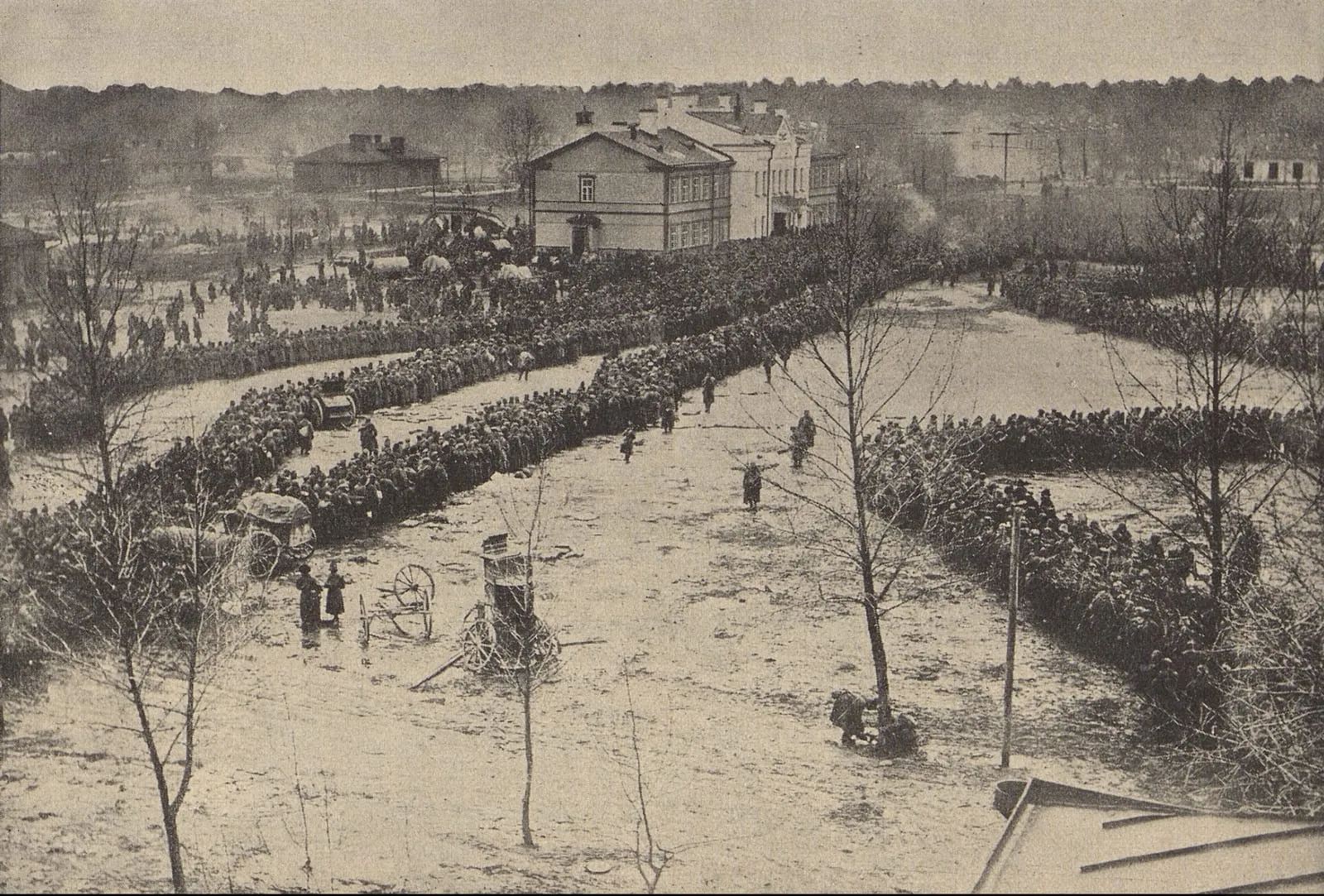
The Winter Battle in Masuria, also called the Second Battle of the Masurian Lakes and in Russian literature the Augustów operation, was fought in February 1915 on the border of East Prussia and the Suwałki Governorate, in lands most of which belong to Poland today. Two German armies, under Field Marshal Paul von Hindenburg and his chief of staff Erich Ludendorff, attacked the Russian Tenth Army in blizzards and frost and drove it out of the last corner of the German province. Surrounded in the Augustów Forest, the Russian XX Corps had to lay down its arms. The Germans did not, however, manage to destroy the whole of the enemy army, and their victory did not change the situation on the Eastern Front.
Name and dates
This page takes the dates of the battle as 7–22 February 1915. On 7 February the German Eighth Army went over to the attack, and a day later, or according to some studies only on 9 February, the Tenth Army. On 21 February XX Corps surrendered, and on 22 February the German Supreme Army Command announced the end of the battle, at the moment when Russian counter-attacks from Grodno halted any further German advance. These are the limits used by the German Wikipedia. The Polish historian Stanisław Czerep ends the operation on 21 February, with the surrender of XX Corps, while other studies extend it to 25, 26 or even 28 February, counting the fighting on the Biebrza and at Grodno. Russian authors give dates in the Julian calendar, 13 days earlier: 25 January – 13 February.
The British chronology of the war puts the start of the battle on 4 February. On that day the German troops were only completing their concentration, and the first attack began three days later. The name “Winter Battle in Masuria”, in German Winterschlacht in Masuren, comes from German communiqués of 1915. It distinguishes it from the Battle of the Masurian Lakes of September 1914.
Background
In the autumn of 1914, after the failed German advance across the Niemen, General Thadeus von Sievers’s Russian Tenth Army entered East Prussia again and occupied its eastern edges, with Lyck and Goldap. The weak German Eighth Army stopped it only on the line of the Masurian Lakes and the river Angerapp. At the turn of 1914 and 1915 the Russians were planning another offensive into East Prussia. It was to be carried out by the Tenth Army from the east and by the Twelfth Army, then being formed, from the south, from the Narew. The Quartermaster-General of the Russian Stavka, General Yuri Danilov, assumed that the Germans had no forces in East Prussia capable of threatening the Tenth Army.
The Germans forestalled this plan. In January 1915 the Chief of the German General Staff, Erich von Falkenhayn, preferred to use the newly formed corps in the west, but Hindenburg and Ludendorff, backed by the Austro-Hungarians, obtained them for the Eastern Front. Four corps were sent to East Prussia: three newly raised reserve corps and XXI Corps. Three of them formed a new Tenth Army under General Hermann von Eichhorn, deployed in the north, between Gumbinnen and the Niemen. The fourth, General Karl Litzmann’s XL Reserve Corps, reinforced General Otto von Below’s Eighth Army, which held the front along the Masurian Lakes. Together the two armies numbered about 250,000 men, roughly as many as Sievers’s army, but they had the advantage in artillery.
The plan was simple: a double envelopment. The Eighth Army was to strike the Russian left wing from the direction of Johannisburg, and the Tenth Army the right wing from the north. The two arms of the pincers were to meet near Augustów, behind the Russian Tenth Army. To divert the Russians’ attention, the Ninth Army attacked on the Rawka at the end of January, in the Battle of Bolimów.
Russian forces
The Russian Tenth Army was subordinate to the commander of the North-Western Front, General Nikolai Ruzsky. It numbered about eleven infantry divisions and several cavalry divisions, spread over a front some 170 kilometres long, from the Niemen in the north to the old Russo-Prussian border south of the lakes. On the right wing stood General Nikolai Yepanchin’s III Corps; in the centre, facing the lakes, General Pavel Bulgakov’s XX Corps and General Aleksandr Gerngross’s XXVI Corps; and on the left wing General Yevgeny Radkevich’s III Siberian Corps. The Russian trenches were shallow and poorly fortified, and reconnaissance failed. Sievers voiced his concerns, but his superiors brushed them aside.
Course of the battle
7–10 February. On 7 February, in a thick snowstorm, Litzmann’s corps struck from the Johannisburg area through the Johannisburg Forest towards Lyck and routed an advanced Russian reserve division. The next day, or according to some sources on 9 February, Eichhorn’s Tenth Army set off in the north, advancing towards Wirballen and Kalvarija. Surprise was complete. The Russian right wing, III Corps and the cavalry covering it, was thrown back. On 10 February the German forces in the centre joined the attack, advancing on Marggrabowa, today’s Olecko. For a long time the Russian command did not grasp the scale of the German offensive and took it for attacks on Osowiec and Kovno.
11–14 February. Snow buried the roads, temperatures fell to more than ten degrees below zero, and the infantry of both sides floundered in the drifts. In the south the III Siberian Corps defended itself fiercely for several days at Lyck. On 14 February the Germans took the town, and Kaiser Wilhelm II arrived at Lyck and watched the fighting at close range. In the north the Tenth Army passed the Kalvarija–Mariampol line on 12 February, and on 14 February the Germans reached the line Rajgród–Suwałki–Sejny. Ruzsky, who wanted to cover the concentration of the Twelfth Army, ordered Sievers to hold the line Kovno–Sejny–Augustów–Osowiec. Only around 14 February did the Russians begin to retreat, but by then the Germans controlled some of the roads by which the corps of the centre were to fall back.
15–21 February. In mid-February a thaw set in and the roads turned to mud. Sievers hesitated over which way to withdraw XX Corps, and Bulgakov left Suwałki only on the morning of 16 February. That day his leading 27th Division beat scattered units of the German 42nd Division at Macharce and captured several guns, but the corps did not exploit the success. On 17 February the Eighth Army took Augustów. The III Siberian Corps and XXVI Corps fought their way across the Biebrza and slipped out of the pincers. XX Corps retreated through the forests along the Augustów Canal towards Sopotskin, but the Germans closed its road. For several days the encircled divisions tried to break through to Grodno. On the night of 20–21 February they made a last attempt, and on 21 February, after an unequal fight, XX Corps surrendered.
22 February. The Russians brought new corps up to Grodno and went over to counter-attacks, which halted the German pursuit. On 22 February the German Supreme Army Command announced the end of the battle. The same day, in the south, at Przasnysz, fighting began with the Russian Twelfth Army. German attempts to take Osowiec Fortress on the Biebrza, begun in mid-February, went on until early March and ended in failure.
Losses
Estimates of the losses vary widely. The German Supreme Army Command’s communiqué of 22 February spoke of more than 100,000 prisoners, seven generals and more than 150 captured guns. Ludendorff repeated the figure of 100,000 prisoners. Russian and some Western authors put the total losses of the Tenth Army at about 56,000 men and consider the German figures inflated. XX Corps suffered most: according to various sources, between 12,000 and 30,000 of its soldiers were taken prisoner.
German losses were many times smaller. According to official German figures the Eighth Army alone lost about 1,400 killed, 9,500 wounded and nearly 1,000 missing, and more than 10,000 soldiers fell sick during the winter marches.
Significance
The battle ended in a clear German tactical victory. The last Russian troops were driven out of East Prussia and never returned there for the rest of the war. In Germany the victory was celebrated as a “second Tannenberg”, and Hindenburg’s fame grew.
Ludendorff, however, had hoped for much more: the complete destruction of the Tenth Army and a march deep into Russia. Three of Sievers’s four corps escaped encirclement and, with reinforcements, manned a new defensive line from Grodno to the Biebrza. The resistance of XX Corps in the Augustów Forest gave them the time to do so. The German attacks at Grodno, Osowiec and Przasnysz brought no decision, and the front in the north stabilised near the East Prussian border. The Russians had to abandon their plan for an offensive into East Prussia, but they did not suffer a strategic defeat. Sievers lost command of the Tenth Army in April 1915 and was succeeded by Radkevich.
Spotted a mistake?Report an error