1914: The fighting in East Prussia
First Battle of the Masurian Lakes
- Dates:
- 5–15 September 1914
- Front:
- Eastern Front
- Location:
- Masuria and north-eastern East Prussia, from Lötzen (Giżycko) and Arys (Orzysz) to Wehlau (Welawa) and GoldapOn the battle map →
- Sides:
- German EmpirePaul von Hindenburg, Erich LudendorffRussian EmpirePaul von Rennenkampf
- Result:
- German victory. The Russian First Army suffered heavy losses and withdrew from East Prussia, but escaped encirclement.
- Author:
- Natalia
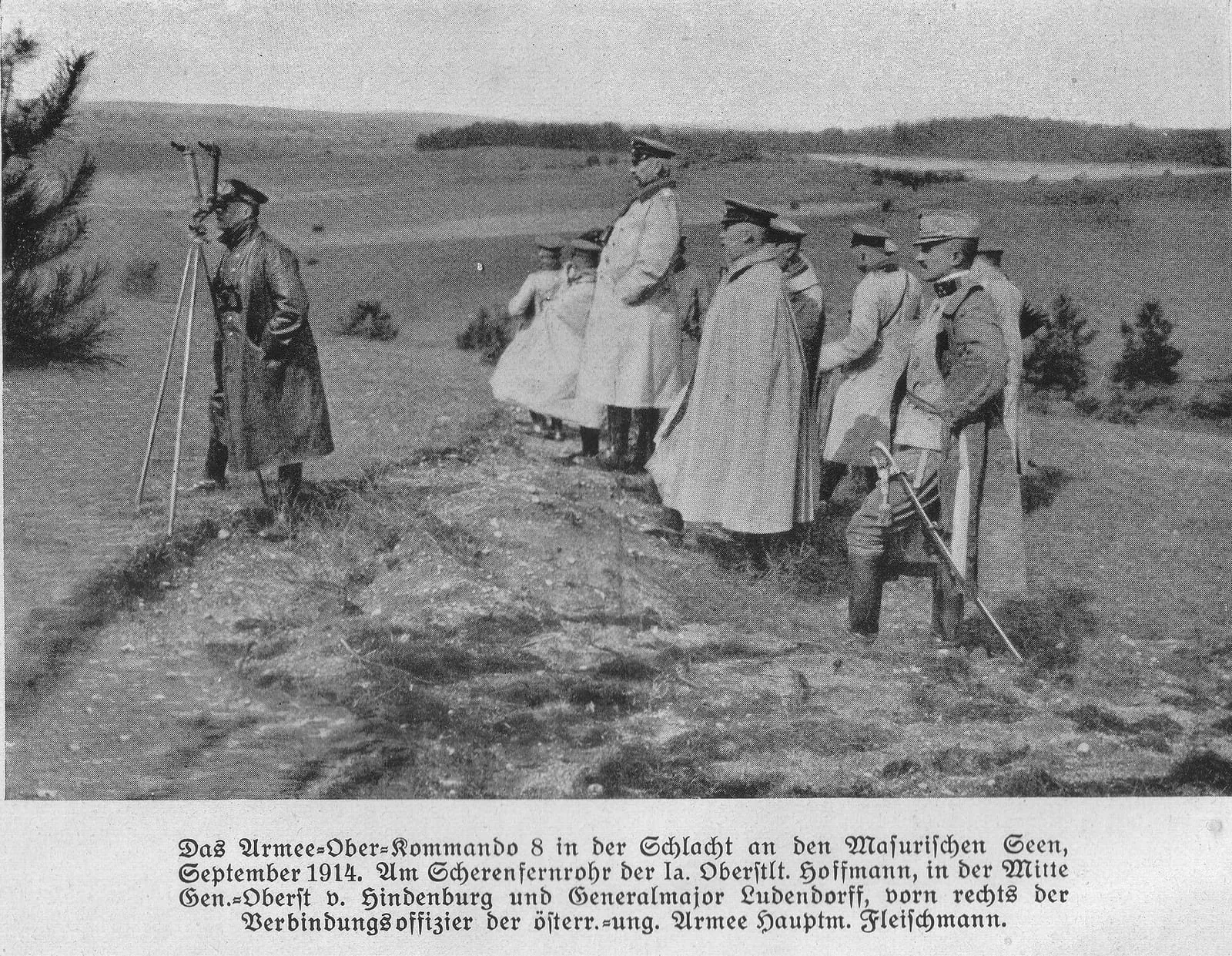
The First Battle of the Masurian Lakes was fought in September 1914 in East Prussia, in what is today Warmia and Masuria and the Kaliningrad Oblast. In it the German Eighth Army of General Paul von Hindenburg beat the Russian First Army of General Paul von Rennenkampf and drove it out of East Prussia. It was the Germans’ second great victory on the Eastern Front in 1914, after Tannenberg.
Dates of the battle
Sources differ on how long the battle lasted. Polish literature usually gives 8–15 September, many Western studies 7–14 or 9–14 September, and some include the whole German operation from the first days of September. On this page the battle is taken to begin on 5 September, in line with the British chronicle of the war. On that day the German corps were already regrouping into their starting positions against Rennenkampf, and there were clashes on the wings. The main attack began on 7 and 8 September, and the Germans ended their pursuit of the Russians on 15 September.
After Tannenberg
At the end of August 1914 the Germans encircled and destroyed the Russian Second Army of General Samsonov. The other Russian army, Rennenkampf’s First Army, which during that battle had been advancing slowly towards Königsberg and had not come to Samsonov’s aid, nevertheless remained in East Prussia. After Samsonov’s defeat Rennenkampf halted and dug in on a line running from the Deime valley in the north, through the Wehlau and Nordenburg area, to Lake Mauer near Angerburg, today’s Węgorzewo. To the south of him, in the area of Lyck, a new Russian Tenth Army was assembling, still far from ready.
On 31 August Hindenburg was ordered to clear East Prussia of Rennenkampf’s troops. For this he received reinforcements from the Western Front: the Guards Reserve Corps, XI Corps and the 8th Cavalry Division. Their dispatch to the east on the eve of the Battle of the Marne weakened the German right wing in France.
The plan
Hindenburg and his chief of staff Erich Ludendorff decided to pin the Russians frontally in the north, while on the southern wing they would pass through the gaps between the lakes and outflank Rennenkampf’s army from the Masurian side. A key role was played by the Boyen fortress at Lötzen, today’s Giżycko, which commanded one of the most important passages and remained in German hands throughout. The thrust through the lakes was led by I Corps of General Hermann von François, supported by XVII Corps and cavalry. On the far right wing General Curt von Morgen’s 3rd Reserve Division covered the attack against the Russian Tenth Army.
The Russians, though more numerous, were stretched out along a long front and not concentrated. The commander of the North-Western Front, General Yakov Zhilinsky, was planning his own offensive only for the middle of September, when the Tenth Army and the re-forming Second Army would be ready. The Germans, on the other hand, had a clear superiority in artillery, especially heavy artillery.
Course of the battle
5–7 September. The German corps took up their starting positions, making use of the dense East Prussian railway network. On 7 September the 3rd Reserve Division attacked Russian units at Bialla and took several hundred prisoners.
8 September. On the southern wing I Corps seized the passages between the lakes and took Arys. XVII Corps pushed the Russians back at Kruglanken but did not break through their defences. In the north the Germans were only just approaching the Russian positions.
9 September. XVII Corps broke through the Russian defences in the area of Possessern and Kruglanken. In the north the Guards Reserve Corps met stubborn resistance on the Alle. Rennenkampf realised that his left wing was being outflanked. In the evening, or according to some sources only the following day, he ordered a retreat.
10–11 September. A Russian counter-attack from Goldap collapsed under German artillery fire, and the Germans took the town. German cavalry entered the gap between the Russian First and Tenth Armies, threatening Rennenkampf’s rear. The Russian corps of the centre and right wing put up a stubborn defence on the Angerapp, which allowed the rest of the army to escape encirclement.
12–15 September. In places the Russian retreat turned into flight. Rennenkampf briefly lost contact with his corps. By 14 September East Prussia had been cleared of Russian troops, and the remnants of the First Army withdrew behind the Niemen. The Germans entered Russian territory and took, among other places, Suwałki and Augustów. On 15 September the German command ended the pursuit.
Losses
The staff of the Russian North-Western Front estimated the losses of the First Army at about 100,000 men, roughly half of them prisoners, and about 150 guns. The Germans announced the capture of more than 30,000 prisoners. The losses of the German Eighth Army in the whole of September 1914, including fighting outside this battle, amounted according to German figures to about 13,500 killed, wounded and missing.
Significance
The Russian offensive in East Prussia ended in complete defeat. The two armies that had entered the province a month earlier had been beaten and driven out. Zhilinsky lost his post, and Rennenkampf, though he kept his for the time being, was recalled after further failures at the end of 1914.
The Germans, however, were unable to repeat Tannenberg. Rennenkampf’s army escaped encirclement and quickly made good its losses. Hindenburg and Ludendorff soon had to shift their main effort south to rescue the Austrians retreating in Galicia. The fighting in Masuria returned in February 1915, when the Germans destroyed the Russian Tenth Army in the Second Battle of the Masurian Lakes.
Spotted a mistake?Report an error