1914: The fighting in East Prussia
Battle of Tannenberg
- Dates:
- 23–30 August 1914
- Front:
- Eastern Front
- Location:
- Southern East Prussia, between Hohenstein (Olsztynek), Neidenburg (Nidzica) and Tannenberg (Stębark)On the battle map →
- Sides:
- Russian EmpireAlexander Samsonov, Yakov ZhilinskyGerman EmpirePaul von Hindenburg, Erich Ludendorff, Hermann von François
- Result:
- German victory. The Russian Second Army was encircled and destroyed, and its commander took his own life.
- Author:
- Łukasz Skowroń
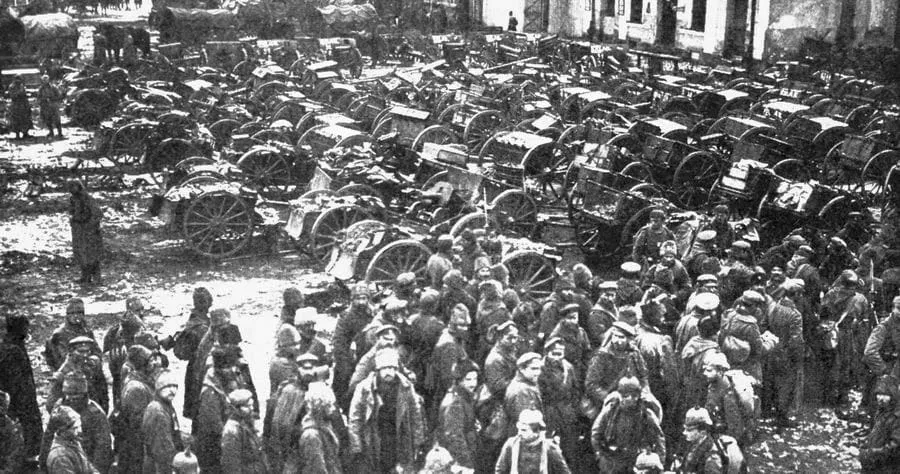
The Battle of Tannenberg was fought at the end of August 1914 in the south of East Prussia, in what is today Warmia and Masuria. The first clashes took place on 23 August, and the main battle was fought on 26–30 August. It ended with the encirclement and destruction of the Russian Second Army and was Germany’s greatest victory on the Eastern Front in the first year of the war.
Two Russian armies
Russia attacked East Prussia with two armies. From the east came the First Army of General Paul von Rennenkampf, which on 20 August had repulsed the Germans at Gumbinnen. From the south, from the Kingdom of Poland, came the Second Army of General Alexander Samsonov. The two armies were to catch the Germans in a pincer, but they were separated by the Masurian Lakes and their commanders cooperated poorly.
Samsonov pushed forward in haste. His soldiers were exhausted by marching along sandy roads, and they were short of food and communications. Russian staffs sent orders by radio in clear, without encryption, and the Germans intercepted them.
New command
On 23 August the new commanders arrived at the headquarters of the German Eighth Army in Marienburg: General Paul von Hindenburg and his chief of staff, Erich Ludendorff. They adopted a plan prepared by a staff officer, Lieutenant-Colonel Max Hoffmann. Only a weak screen was left facing Rennenkampf, and most of the forces were moved by rail and on foot to the south, against Samsonov. That same day Russian corps clashed with the German XX Corps of General Friedrich von Scholtz near Neidenburg.
Encirclement
On 26 August the Germans struck both wings of the Russian army. I Corps under General Hermann von François attacked from the west, and corps arriving from the north struck from the east. The Russian centre kept pressing forward while the wings collapsed and fell back. By 29 August the German pincers had closed behind Samsonov’s main forces, in the forests between Hohenstein and Neidenburg. Rennenkampf, who could have come to the rescue, did not move in time.
The encircled units tried to break out to the south, but most of them had to surrender. Samsonov, unable to come to terms with the defeat, took his own life in the forest during the night of 29–30 August.
Toll
The Russians lost about 30,000 killed and wounded, and more than 90,000 soldiers were taken prisoner. The Germans also captured several hundred guns. Their own losses were many times smaller.
Grunwald and Tannenberg
The battle was fought mainly around Hohenstein, but Ludendorff (according to other accounts Hoffmann) proposed naming it after the nearby village of Tannenberg, today Stębark. In German tradition this name referred to the Battle of Grunwald of 1410, and the new victory was presented as revenge for the defeat of the Teutonic Order. Between the wars an imposing memorial to the victory was erected near Hohenstein, and Hindenburg was buried there in 1934. In 1945 the retreating Germans removed Hindenburg’s coffin and blew up part of the memorial, and its ruins were dismantled after the war.
Significance
Tannenberg made Hindenburg and Ludendorff national heroes, which opened their way to taking over the German Supreme Army Command in 1916. At the beginning of September the Germans attacked Rennenkampf’s army in the First Battle of the Masurian Lakes and drove it out of East Prussia. The Russian offensive ended in defeat, but it fulfilled its purpose towards Russia’s allies: it induced the Germans to transfer two corps from the Western Front to the east, on the eve of the Battle of the Marne.
Spotted a mistake?Report an error