1914: First clashes and the Battles of the Frontiers
Battle of Mons
- Dates:
- 23 August 1914
- Front:
- Western Front
- Location:
- Mons and the Mons–Condé Canal, BelgiumOn the battle map →
- Sides:
- United KingdomJohn French, Horace Smith-Dorrien, Douglas HaigGerman EmpireAlexander von Kluck
- Result:
- German tactical victory. The British inflicted heavy losses but were forced to withdraw.
- Author:
- Łukasz Skowroń
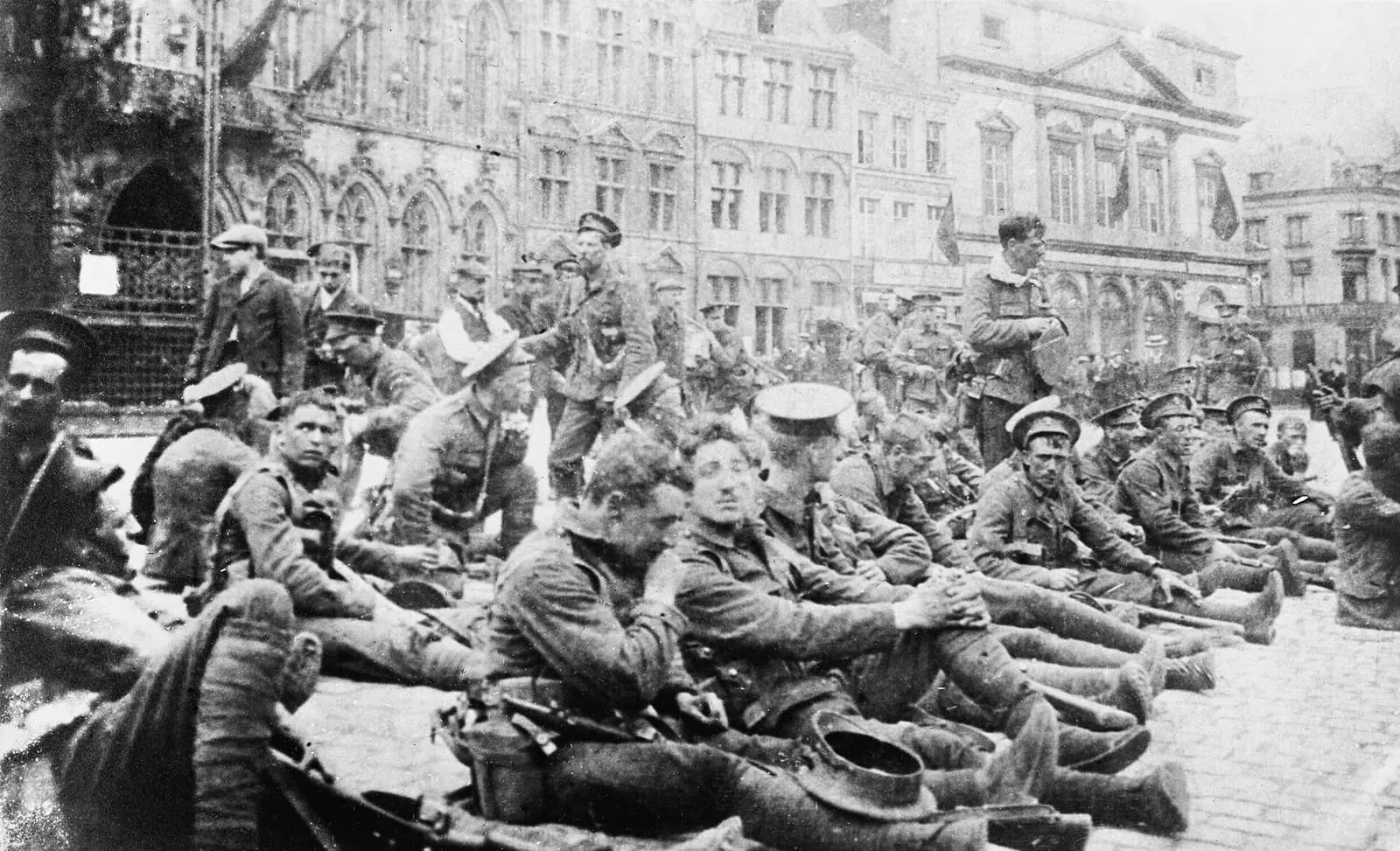
The Battle of Mons, fought on 23 August 1914, was the first battle of the British Expeditionary Force in the First World War. It was the first time the British had fought in Western Europe since the Battle of Waterloo in 1815, which had in fact been fought not far away. For one day two British divisions held the line of the Mons–Condé Canal against the far more numerous German First Army. They inflicted heavy losses on it, but in the evening, when it became clear that their French neighbours were falling back, they had to begin a retreat.
Name and dates
The battle took its name from the Belgian town of Mons in the province of Hainaut, around which the canal ran. The fighting proper lasted one day, 23 August, and that is how this page dates it. The British Battles Nomenclature Committee adopted wider dates in 1921, 23–24 August, and also counted as part of the battle the rearguard fighting of the following day, the first day of the retreat. It was a small part of the Battle of the Frontiers.
Background
Under pre-war arrangements between the British and French staffs, the Expeditionary Force was to take its place on the left wing of the French army. Its commander was Field Marshal John French. I Corps went to General Douglas Haig, II Corps to General James Grierson, who, however, died suddenly on 17 August on the train on his way to the front. In his place the Secretary of State for War, Lord Kitchener, sent General Horace Smith-Dorrien. The force completed its landing in France in mid-August and assembled around the fortress of Maubeuge. It consisted of four infantry divisions and a cavalry division under General Edmund Allenby. To its right stood General Charles Lanrezac’s French Fifth Army.
Meanwhile the far right wing of the German offensive was marching through Belgium. Furthest west marched General Alexander von Kluck’s First Army, the largest of the German armies. Until 27 August inclusive it was subordinated to the commander of the neighbouring Second Army, General Karl von Bülow. Neither side knew exactly where the enemy was. Kluck believed that the British had landed at Ostend, Dunkirk and Calais, and expected them rather on his western flank. Only on 22 August did he learn that a British cavalry squadron had been met at Casteau (PL), north-east of Mons. A patrol of the 4th Dragoon Guards had fired there that morning, according to the British official history, the first shots of the British Army on the Continent.
The Expeditionary Force was to push on northwards, towards Soignies (PL). On the evening of 22 August, however, French learned that the Fifth Army had fallen back from the Sambre, and called off the advance. At about 11 p.m. an officer of Lanrezac’s staff brought a request that the British strike the flank of the German columns. French refused, but agreed to hold the line of the canal for 24 hours.
The position on the canal
The British had halted in the middle of a wheel to the north-east, so their front formed an obtuse angle. One arm, about 16 kilometres long, ran from the Sambre to Mons facing north-east, and was held mainly by I Corps. II Corps held the apex of the angle and the other arm, the line of the canal from Mons west to Condé, about 27 kilometres long. On the extreme left stood the independent 19th Infantry Brigade. Around Mons the canal formed a salient bulging northwards, across which seven roads radiated from the town to seven bridges. It was held by the 4th Battalion of the Middlesex Regiment on the side of Obourg (PL) and the 4th Battalion of the Royal Fusiliers at the bridges in Nimy. West of the town stretched a coalfield: mining villages, slag heaps more than thirty metres high, canals and ditches. The official history called it “close and blind” country.
The disparity of forces was great. According to the British official history, the Germans put eight divisions against four, and in the infantry fight six divisions against two, stretched along a front of about 21 kilometres. The main weight fell on the 3rd and 5th Divisions of II Corps, which together numbered just under 36,000 men, not many more than Wellington’s army at Waterloo. The line looked more like a chain of outposts than a defensive position.
The fight in the salient
23 August was a Sunday. In the morning mist and rain gave way to fine weather, church bells rang, and villagers in their Sunday best walked to church. At about 6 a.m. German cavalry exchanged shots with the 4th Middlesex near Obourg. Kluck, still unsure where the British were, halted his whole army for two hours, from 8.30 to 10.30 a.m., on news of troops detraining at Tournai. Before nine German guns were already shelling the salient, and the infantry of IX Corps had enveloped it from Obourg to Nimy.
At first the Germans advanced in dense masses. Under fire from the front and the flank they suffered heavy losses and switched to attacking in small groups. Shortly after noon they crossed the canal west of Obourg and began to work round the defending battalions. At the bridges in Nimy the crews of two Royal Fusiliers machine guns were shot down to the last man. For this fight Lieutenant Maurice Dease and Private Sidney Godley received some of the first Victoria Crosses of the war. Dease, wounded several times, died of his wounds, and Godley, who covered his comrades’ withdrawal, was taken prisoner.
At 2 p.m. the Royal Fusiliers withdrew from Nimy south through Mons, having lost just over a hundred men. At about 3.15 p.m. the Germans worked round both flanks of the 2nd Battalion of the Royal Irish Regiment, which fell back with the Middlesex to the hill of Bois la Haut, south-east of the town. There the 8th Brigade beat off attacks until late in the evening. A German General Staff monograph later admitted: “Well entrenched and completely hidden, the enemy opened a murderous fire… the rushes became shorter, and finally the whole advance stopped.”
West of Mons
At about eleven the German III Corps joined the fight. At Jemappes (PL) and at the bridge at Mariette the first attacks of the German infantry broke down short of the canal. The Brandenburg Grenadier Regiment, attacking at Saint-Ghislain (PL), ran into the fire of the 1st Battalion of the Royal West Kents and the machine guns of neighbouring battalions. The official history says that the Germans believed they were facing nothing but machine guns everywhere. At the railway bridge at Les Herbières, at about 1.30 p.m., two battalions of the German 52nd Regiment advanced in close order across open ground and were cut to pieces by the 1st Battalion of the East Surreys, which itself suffered trifling losses.
One of the Brandenburg Grenadiers’ company commanders, the writer Walter Bloem, recalled that he had lost all five of his company’s officers and half his men. “Our first battle is a heavy, unheard-of heavy defeat, and against the English, the English we laughed at,” he wrote.
In the afternoon, with the salient already lost, II Corps began to fall back to a second line. At about three the Scots of the Royal Scots Fusiliers left Jemappes, and the Germans, who crossed the canal after them, attacked them among the slag heaps near Frameries (PL). At Mariette the sapper Captain Theodore Wright tried under fire, hanging beneath the bridge, to connect the explosive charges, and tried again despite a head wound, though without success. Lance-Corporal Charles Jarvis spent an hour and a half under heavy fire preparing the demolition of the bridge at Jemappes and fired the charges. Both received the Victoria Cross. Some battalions held on at the canal until nightfall, and at dusk the Royal West Kents were still in their positions.
The night and the decision to retreat
The Germans did not exploit their success in the salient. At dusk the British heard German bugles sound the “cease fire”, as at the end of a manoeuvre day. Kluck, after such stubborn resistance, expected the British to defend themselves again the next day on the high ground south of Mons, and decided to envelop their left flank.
At 8.40 p.m. French was still announcing that he would accept battle on the ground he held. In the evening and just before midnight, however, news came from the French: Lanrezac’s Fifth Army, beaten on the Sambre, was falling back south, and new German columns were approaching from the west. The force’s forward position had become untenable. French decided to retreat at once. The decision was in line with the intentions of General Joseph Joffre, whose instructions reached the British the next day.
Casualties
According to the British official history, the British lost just over 1,600 killed, wounded and missing. All but 40 of them belonged to II Corps, and almost half the losses were suffered by the two battalions defending the salient: the 4th Middlesex lost more than 400 men and the 2nd Royal Irish more than 300. Only two guns were lost.
German losses are not known exactly. The 75th Regiment from Bremen alone lost 5 officers and 376 men in a single attack, and the Brandenburg Grenadiers 25 officers and more than 500 men. Estimates for the whole First Army at Mons range from no more than 2,000, according to Terence Zuber’s research based on regimental histories, to about 5,000, as given by some British historians.
Significance
The Germans took the line of the canal and forced the British to retreat, but they paid a high price for it. The British held up Kluck’s army for a whole day: the positions it was to reach on 23 August it reached only on 24 August. On 24 August the Expeditionary Force began the great retreat, which lasted almost two weeks. On 26 August II Corps fought another hard battle at Le Cateau.
Compared with the clashes of the French and German armies at the time, the Battle of Mons was small, but in British memory it became a legend. At the end of September the Welsh writer Arthur Machen (PL) published a short story in a London newspaper about phantom bowmen from Agincourt who were supposed to have routed the Germans pursuing the British during the retreat from Mons. Many readers took it for fact, and by the spring of 1915 the story of the Angels of Mons was circulating in Britain.
Mons has a special resonance in British history for another reason too. In the nearby St Symphorien cemetery lie the men regarded as the first and the last British soldier killed in the war. The first, Private John Parr of the 4th Middlesex, was killed near Mons on 21 August 1914, two days before the battle. The second was killed near Mons on the morning of 11 November 1918, in the last hours before the Armistice.
Sources
Spotted a mistake?Report an error