1914: First clashes and the Battles of the Frontiers
Battle of the Frontiers
- Dates:
- 7–25 August 1914
- Front:
- Western Front
- Location:
- The Franco-German and Franco-Belgian borderlands and southern Belgium, from Alsace and Lorraine through the Belgian Ardennes to the Sambre and Meuse valleys and the area around MonsOn the battle map →
- Sides:
- France, United Kingdom and BelgiumJoseph Joffre, Auguste Dubail, Noël de Castelnau, Pierre Ruffey, Fernand de Langle de Cary, Charles Lanrezac, Paul Pau, John French, Albert IGerman EmpireHelmuth von Moltke, Alexander von Kluck, Karl von Bülow, Max von Hausen, Albrecht, Duke of Württemberg, Crown Prince Wilhelm, Rupprecht, Crown Prince of Bavaria, Josias von Heeringen
- Result:
- German victory. The French offensives in Alsace, Lorraine and the Ardennes collapsed, and the French left wing and the British, threatened with envelopment through Belgium, began the Great Retreat towards the Marne.
- Author:
- Łukasz Skowroń
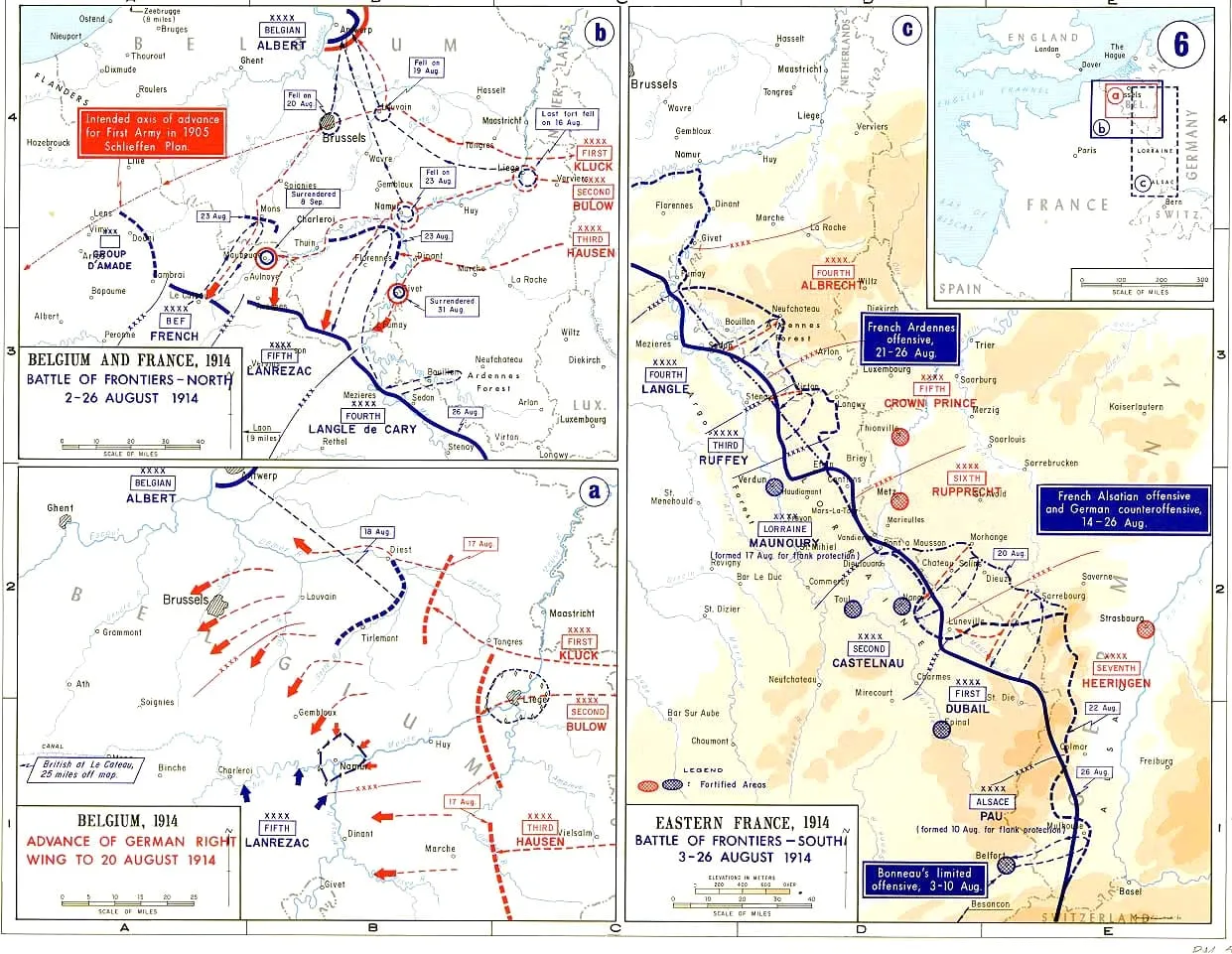
The Battle of the Frontiers is the name given to the series of clashes fought in August 1914 along the borders of France, from Alsace to Belgium. It was not a single battle but a collision of two war plans on a front several hundred kilometres long. France, true to its doctrine of the offensive, struck east into Alsace and Lorraine, lost in 1871, and then north through the Ardennes. At the same time Germany was sending its strong right wing through Belgium to outflank the French fortifications and attack the French from the north. In less than three weeks the French attacks broke down one after another at Mulhouse, Morhange, Sarrebourg, in the Ardennes and on the Sambre, and the British, after the first battle of Mons, had to fall back. On 25 August the commander-in-chief Joseph Joffre ordered a general retreat. The French army paid the highest price in its history for those few weeks: 22 August was the bloodiest day in its history.
Name and dates
The name comes from the French term bataille des Frontières. German historiography speaks in the plural of the “frontier battles” (Grenzschlachten), and the German official history gave this title to its entire first volume, devoted to the fighting in the west in August 1914. The British use the name Battle of the Frontiers. The term covers battles that each side described separately: at Mulhouse in Alsace, at Morhange and Sarrebourg in Lorraine, in the Ardennes, on the Sambre at Charleroi and at Mons. The Belgian fighting at Liège and Namur belongs to the same phase of the war.
On this page we adopt the dates 7–25 August 1914. The start is marked by the entry of the French VII Corps into Alsace, the French army’s first offensive of the war. Contemporary war chronicles recorded the beginning of the Battle of the Frontiers as early as 6 August, but no fighting took place that day. The end falls on 25 August. On that day Joffre issued the order for a general retreat and for the formation of a new army on the left wing, the last forts of Namur fell, and the Germans retook Mulhouse. French accounts often end the battle on 23 August, when the French armies began to fall back in the Ardennes and on the Sambre. Some English-language literature sometimes extends the name to the whole retreat up to the beginning of September, that is, to the Battle of the Marne.
Background
The German plan for a two-front war was based on the concept of Alfred von Schlieffen, chief of the General Staff from 1891 to 1906, later called the Schlieffen Plan. Most of the army was to defeat France quickly, before Russia completed its mobilisation. Because the Franco-German border was covered by a belt of fortresses from Verdun to Belfort, the main forces were to bypass it through neutral Belgium and Luxembourg. Schlieffen’s successor, Helmuth von Moltke, chief of staff of the field army from 2 August, changed the plan: he gave up the march through the Netherlands, which meant he had to take the fortress of Liège quickly, and he strengthened the left wing in Lorraine. In the west the Germans fielded seven armies. On the right wing, intended to march through Belgium, stood the 1st Army of General Alexander von Kluck, the 2nd Army of General Karl von Bülow and the 3rd Army of General Max von Hausen. In the centre, facing the Ardennes and Luxembourg, deployed the 4th Army of Duke Albrecht of Württemberg and the 5th Army of Crown Prince Wilhelm. Lorraine and Alsace were defended by the 6th Army of the heir to the Bavarian throne, Crown Prince Rupprecht, and the 7th Army of General Josias von Heeringen, both under Rupprecht’s joint command.
The French concentration plan, known as Plan XVII, was drawn up in 1913 in Joffre’s staff and was in force from the spring of 1914. It was above all a plan for the deployment of the armies rather than a ready plan of operations. Five armies were to concentrate facing the German border: the 1st Army of General Auguste Dubail in the Épinal area, the 2nd Army of General Noël de Castelnau near Nancy, the 3rd Army of General Pierre Ruffey near Verdun, the 5th Army of General Charles Lanrezac further north, as far as Mézières, and the 4th Army of General Fernand de Langle de Cary in reserve behind them. The French staff reckoned with a German march through Belgium, but assumed that the Germans would pass only through its southern part, south of the Meuse and the Sambre. It believed they did not have enough troops for a wider envelopment, and it underestimated the German reserve divisions, which in August 1914 fought in the front line. Pre-war doctrine, headed by the idea of the offensive “to the utmost” (offensive à outrance), relied on infantry attacking with the bayonet, supported by light field artillery. To the left of the French was to stand the British Expeditionary Force of Field Marshal Sir John French, four infantry divisions and a cavalry division, concentrated in the area of Maubeuge.
The first shots on the French border were fired on 2 August at Joncherey, and on the same day German troops entered Luxembourg. On 4 August German troops crossed the Belgian border and attacked Liège. The resistance of the Belgian forts, which held out until 16–17 August, did not halt the German concentration, but it gave the French and British a few days.
Alsace and Belgium, 7–19 August
The French made the first move. On 7 August General Louis Bonneau’s VII Corps set out from Belfort into Alsace-Lorraine, a German province since the Franco-Prussian War, and on 8 August entered Mulhouse. The advance was above all symbolic and was not backed by larger forces. When the German 7th Army struck on 9 August, Bonneau withdrew towards Belfort and was one of the first generals to lose his command. Joffre then formed from VII Corps and several reserve divisions the Army of Alsace under General Paul Pau, which on 19 August took Mulhouse for the second time.
At the same time French intelligence saw ever more clearly that German columns were passing through Belgium, including north of the Meuse. On 12 August German cavalry was repulsed by the Belgians at Haelen, and on 15 August the French I Corps of General Louis Franchet d’Espèrey held the bridge over the Meuse at Dinant. Lieutenant Charles de Gaulle was wounded there. Lanrezac had been warning for several days that he was in danger of being outflanked from the north. Only on 15 August did Joffre agree to shift the 5th Army north-west, into the angle of the Sambre and the Meuse. He still believed, however, that German strength on the wings meant weakness in their centre, and he was preparing his main blow there. After heavy fighting on the Gete, the Belgian army of King Albert I withdrew on 18–20 August into the fortress of Antwerp, and on 20 August the Germans occupied Brussels. The road west and south lay open before the armies of Kluck and Bülow.
Lorraine, 14–25 August
The main French offensive began on 14 August in Lorraine, south of the German fortified zone of Metz–Thionville. Dubail’s 1st Army advanced on Sarrebourg and the passes of the Vosges, and Castelnau’s 2nd Army on Morhange. The two armies moved in diverging directions, while the Germans fell back before them to prepared positions. On 18 August the French entered the abandoned Sarrebourg, and in the following days Dieuze and Château-Salins. On 20 August Rupprecht went over to the counter-offensive with the whole of the 6th and 7th Armies. At Morhange heavy artillery and machine guns shattered the corps of the 2nd Army, among them the XX Corps of General Ferdinand Foch. General Castelnau’s son was killed there. After the fighting at Sarrebourg on 20 and 21 August the 1st Army also had to withdraw.
The French fell back across the border, behind the Meurthe and onto the heights of the Grand Couronné in front of Nancy, and on 22–23 August the Germans occupied Lunéville. Moltke agreed to let Rupprecht pursue the beaten enemy instead of transferring troops to the right wing. The German advance was directed at the Trouée de Charmes, the gap between the fortresses of Toul and Épinal. By 25 August both French armies had reorganised on a new line, and on 25 August they counter-attacked. The new battle on the Mortagne ended in a German defeat.
The Ardennes, 21–24 August
In Joffre’s view, if the Germans were strong in Belgium and in Lorraine, their centre in the Ardennes and Luxembourg had to be weak. That was where he decided to strike his main blow. To free the 3rd Army for the attack, its right wing, made up of reserve divisions facing Metz, was detached on 19 August as the Army of Lorraine under General Michel-Joseph Maunoury. On 21 August Ruffey’s 3rd Army moved off towards Arlon and Longwy, and Langle de Cary’s 4th Army crossed the river Semois towards Neufchâteau. The French had poor reconnaissance and bad maps, and dense forests and morning mists limited visibility. Instead of a weak screen they ran into two full German armies, the 4th and 5th, which were themselves advancing to attack.
On 22 August the columns collided in many places at once: at Longwy, Virton and Ethe in the 3rd Army’s sector, at Rossignol, Neufchâteau, Bertrix and Maissin in the 4th Army’s sector. The French lost most of these clashes. At Rossignol the Colonial Corps lost, according to Robert Doughty, more than 11,600 men, and its 3rd Colonial Division was almost destroyed. On 23 August both French armies returned to their start lines, and on 24 August Joffre ordered the 4th Army to retreat behind the Meuse. Ruffey’s army fell back towards Verdun.
The Sambre, Namur and Mons, 20–24 August
On the left wing Lanrezac’s 5th Army, after a march of up to a hundred kilometres, took up positions from 19 August in the angle of the Sambre and the Meuse. On its right wing stood the fortress of Namur, which on 20 August was surrounded by a group from Bülow’s army, and heavy mortars began to batter it on 21 August. On the same day the Guard and X Corps of the 2nd Army seized the crossings over the Sambre between Namur and Charleroi before the French could occupy them. On 22 August the French counter-attacks broke down with heavy losses. On 23 August Hausen’s 3rd Army crossed the Meuse at Dinant and threatened Lanrezac’s right wing, and the Belgians abandoned Namur. On the evening of 23 August Lanrezac, without fully agreeing it with the British, ordered a retreat. In these days the Germans committed mass atrocities against the civilian population. At Tamines on 22 August and at Dinant on 23 August they shot more than a thousand inhabitants in all, which went down in history as part of the “Rape of Belgium”.
On 22 August the British Expeditionary Force took up position along the Mons–Condé canal at Mons, to the left of the French. The commander of its II Corps, General James Grierson, had died suddenly on a train on 17 August and was replaced by General Horace Smith-Dorrien. On 23 August Kluck’s army attacked the British. The fire of the professional infantry inflicted heavy losses on the Germans and delayed them by a day, but in the evening, on news of the 5th Army’s retreat, French also ordered a retreat. According to the British official history, the Force lost just over 1,600 men at Mons, almost all of them in II Corps. On 24 August its rearguards fought hard actions at Elouges and Audregnies, and the losses that day proved greater than in the battle itself.
The crisis of 24–25 August
On the morning of 24 August Joffre admitted in a report to the Minister of War that the offensive had failed along the whole front. He laid the blame on commanders and soldiers who, in his view, had not shown the expected offensive qualities in the field. Historians such as Robert Doughty consider this judgement unfair: the defeat was caused by the mistaken assumptions of the high command itself about the strength and deployment of the Germans, and by the dispersal of the French effort in several directions. On the same day the armies went over to the defensive. As early as 23 August Ruffey had admitted in an order that his troops’ attacks had failed because the infantry had gone forward without artillery preparation.
On 25 August Joffre issued General Instruction No. 2. The left wing and centre were to fall back to a line from Verdun through Reims to Amiens, destroying railways behind them and delaying the pursuit. In the Amiens area a new army was to be formed from troops brought from the east, which later, as Maunoury’s 6th Army, would outflank the German right wing on the Marne. A large part of the Army of Alsace was also handed over to form the new forces, and on 25 August the Germans retook the abandoned Mulhouse. The last forts of Namur capitulated, and at the same time the siege of Maubeuge began. On that day Moltke too, convinced that the decision in the west had already been reached, resolved to send to East Prussia two corps from the right wing, released after the fall of Namur.
The Great Retreat lasted almost two weeks. On 26 August the British fought the battle of Le Cateau, and on 29 August Lanrezac halted to strike at Guise. At the beginning of September the Allied armies stopped on the Marne and went over to the counter-offensive.
Losses
The exact losses of the Battle of the Frontiers cannot be given, because the armies counted them for the whole month rather than for individual battles. According to French high command figures, cited in the French official history, in August 1914 the French army lost more than 206,000 soldiers, including more than 20,000 killed and nearly 108,000 missing, among whom were also the dead left on the battlefield and prisoners. Later estimates, cited among others by Holger Herwig and David Stevenson, speak of about 260,000 killed, wounded and missing in the first month of the war, including about 75,000 killed. According to the same estimates, about 27,000 Frenchmen were killed on 22 August, in the Ardennes, on the Sambre and in Lorraine.
German losses were clearly smaller. The German medical report, cited in French studies, gives about 136,000 killed, wounded and missing for August 1914. The 6th and 7th Armies alone, fighting in Lorraine and Alsace, lost according to Herwig about 66,000 men in all in August. The British lost just over 1,600 men at Mons, and the Belgians about 15,000 at Namur.
Significance
The Battle of the Frontiers wrecked the French war plan. The offensives in Alsace, Lorraine and the Ardennes brought nothing but enormous losses, and the German right wing passed through Belgium almost as the German planners had foreseen. The defeat laid bare the weaknesses of the French army: overreliance on the bayonet charge, poor cooperation between infantry and artillery, a lack of heavy guns and poor reconnaissance. Joffre looked for culprits among his subordinates. By 6 September he had removed two army commanders, Ruffey and Lanrezac, ten corps commanders and 38 division commanders. Many of them were sent to Limoges, from which the French coined the word limoger, “to dismiss”.
The Germans, however, won a victory, not a decision. The French army withdrew beaten but not broken, and in Lorraine it held the line in front of Nancy and Épinal, which allowed Joffre to shift divisions from east to west. The retreat from Mons and the Sambre, though exhausting, did not turn into a rout. Moltke’s conviction of victory, which led him to send two corps east and to pursue in Lorraine, weakened the German right wing just before the decisive battle. A few days later, on the Marne, the French and British armies that had survived the Battle of the Frontiers stopped the German advance.
Spotted a mistake?Report an error
Battles and phases
(06)- 7–25 August 1914Battle of MulhouseThe first French offensive of the war. The French twice entered Mulhouse in Alsace and twice had to withdraw from it.
- 14–25 August 1914Battle of LorraineThe main French offensive of August 1914 collapsed at Morhange and Sarrebourg. The Germans drove the French back as far as Nancy.
- 20–25 August 1914Siege of NamurIn August 1914 German heavy artillery took the Belgian fortress of Namur, where the Sambre meets the Meuse, in five days. The last forts fell on 25 August.
- 21–24 August 1914Battle of the ArdennesIn the wooded Ardennes the French armies clashed with stronger German forces. 22 August was the bloodiest day in the history of the French army.
- 21–23 August 1914Battle of CharleroiOn the Sambre the French Fifth Army clashed with two German armies. Threatened with encirclement, it began to retreat on 23 August.
- 23 August 1914Battle of MonsThe first British battle in Europe since Waterloo. On 23 August 1914 the British Expeditionary Force held up Kluck's army for one day.