1914: First clashes and the Battles of the Frontiers
Battle of Lorraine
- Dates:
- 14–25 August 1914
- Front:
- Western Front
- Location:
- Lorraine, the Morhange, Sarrebourg and Nancy areaOn the battle map →
- Sides:
- FranceAuguste Dubail, Noël de CastelnauGerman EmpireRupprecht, Crown Prince of Bavaria, Josias von Heeringen
- Result:
- German victory. The French withdrew to the hills in front of Nancy, where they halted the German pursuit.
- Author:
- Łukasz Skowroń
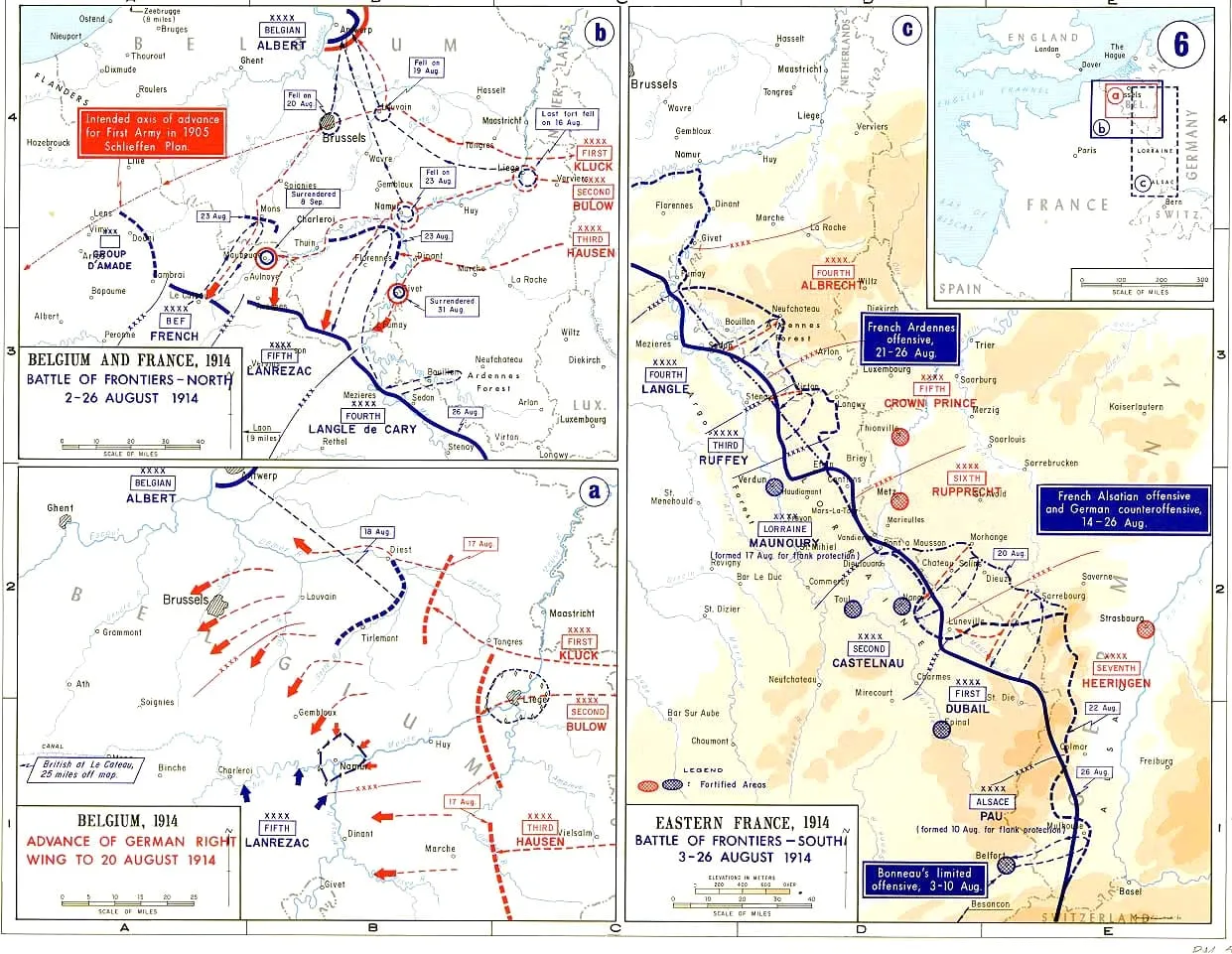
The Battle of Lorraine was the French army’s first great offensive of the First World War and one of the main engagements of the Battle of the Frontiers. On 14 August 1914 two French armies entered the German part of Lorraine, lost by France in 1871. After six days of marching they ran into prepared German positions, and on 20 August they were routed by a counter-attack at Morhange and Sarrebourg. Over the following days they fell back across the border, to the approaches of Nancy and behind the Meurthe.
Name and dates
The French speak of the Battle of Lorraine (bataille de Lorraine) and call the engagements of 20 August the battles of Morhange and Sarrebourg. The British official history uses the same names. The German official history, Der Weltkrieg, describes the fighting of 20–22 August as the “Battle in Lorraine” (Schlacht in Lothringen), and German literature also uses the name Battle of Saarburg and Mörchingen, that is, of Sarrebourg and Morhange.
On this page we use the dates 14–25 August 1914: from the start of the French offensive to the day on which the French halted the German pursuit in front of Nancy and the Charmes gap. The fighting that began on 25 August is described separately as the Battle of the Mortagne. The Polish and English Wikipedias extend the Battle of Lorraine to 7 September, folding into it the fighting on the Mortagne and part of the defence of Nancy.
Background
The French concentration plan of 1913, known as Plan XVII, envisaged an advance eastwards into Alsace and Lorraine. The main forces of this attack were the 1st Army of General Auguste Dubail, assembled around Épinal, and the 2nd Army of General Noël de Castelnau near Nancy. The Commander-in-Chief, Joseph Joffre, counted on a determined attack breaking the German defences. The first attempt in Alsace, the capture of Mulhouse on 8 August, ended in a retreat after two days, and the renewed offensive in Alsace began on the same day as the advance into Lorraine. As early as 9 August Joffre, worried by German movements in Belgium, took two of Castelnau’s five corps, the IX and the XVIII.
The French command underestimated the enemy. According to the German official history, it believed that between Thionville and the Dutch border there were 13 to 15 German corps, when in fact there were 26. In Lorraine and Alsace stood the German 6th Army of the heir to the Bavarian throne, Crown Prince Rupprecht, and the 7th Army of General Josias von Heeringen, both under Rupprecht’s joint command. According to the British official history, together they numbered about 345,000 men and tied down about 456,000 French. Their task was to cover the left flank of the main forces marching through Belgium. Pre-war German studies assumed that if the French attacked in strength, the two armies would fall back behind the Saar (PL) and into the Vosges, and then strike the flanks of an enemy who had walked into this “pocket”.
The march into Lorraine (14–19 August)
On 14 August the 2nd Army crossed the border river Seille, while the 1st Army set off towards Sarrebourg and the passes of the Vosges. The Germans fell back, resisting only with rearguards. Yet on the very first day the fire of entrenched infantry and artillery inflicted heavy losses on the French at Cirey-sur-Vezouze (PL). On 17 August the 2nd Army wheeled north, towards Morhange, and took Château-Salins (PL) and the area around Dieuze. The two armies were advancing in diverging directions, and by evening almost 15 kilometres separated Castelnau’s right wing from Dubail’s left. On 18 August the French VIII Corps occupied Sarrebourg without a fight.
Meanwhile Rupprecht’s staff stopped believing that the French would really walk into the trap, and the retreat was hurting the soldiers’ morale. On 17 August Rupprecht halted his army’s withdrawal. During the night of 17–18 August an envoy of Helmuth von Moltke, Lieutenant-Colonel Wilhelm von Dommes, arrived to recommend further withdrawal and to warn against attacking from the present positions, since the proximity of the French forts would prevent a victory from being exploited. Rupprecht nevertheless chose to attack. On 18 August his chief of staff, General Konrad Krafft von Dellmensingen, was told by the Quartermaster-General, General Hermann von Stein, that the Supreme Army Command would not relieve the army of responsibility, but would not forbid the attack either. At 7 p.m. on 19 August Rupprecht issued the order to attack the next day.
On 19 August the French tried to advance for the last time. The XV Corps passed through Dieuze, but with heavy losses, and the 16th Division of Dubail’s army took the village of Bühl near Sarrebourg but could not cross the Saar.
Morhange and Sarrebourg (20 August)
At 5 a.m. on 20 August the German 6th Army attacked along its whole front, taking the enemy by surprise according to the German official history. The French XVI and XV Corps were just setting off on an attack of their own when they collided with Bavarian columns in the morning mist. The XVI Corps lost village after village and by evening had been pushed back several kilometres. The XV Corps came to a halt at about ten under heavy artillery fire and at midday began to fall back on Dieuze. In Dieuze the retreat turned into a rout.
On the left wing, the XX Corps of General Ferdinand Foch was, under army orders, to stand fast and cover its neighbours. Foch, however, sent his divisions against the heights near Morhange. When Castelnau ordered him to break off the attack, some units were already engaged. According to French accounts quoted in the German official history, the French infantry took the first German trenches, which were manned only by straw dummies, and came under flanking machine-gun fire. In the afternoon the II Bavarian Corps attacked, and the XX Corps fell back to Château-Salins with “cruel” losses. Whether Foch disobeyed Castelnau’s order remains disputed among historians to this day. Among those killed that day was General Castelnau’s son, Xavier.
At Sarrebourg, the VIII Corps of Dubail’s army reached the Saar in the morning, but once the mist lifted it was stopped by German artillery fire. Around midday the German 7th Army went over to the attack. The I Bavarian Corps struck the French units on the Saar in the flank, while the XIV and XV Corps advanced through the forests south of the town, suffering heavy losses. The French XXI Corps repulsed the Germans at Saint-Léon, but in the evening the VIII Corps had to fall back behind the Marne–Rhine canal. Still on 20 August Castelnau ordered the 2nd Army to retreat, first to the line Marsal–Château-Salins and then, late in the evening, further back to the line Lunéville–Dombasle–Saint-Nicolas-de-Port. During the night Joffre also ordered Dubail to withdraw to a new line. To strengthen Castelnau, he halted the departure of part of the IX Corps and gave him two cavalry divisions and two reserve divisions that were detraining near Lunéville.
Retreat and pursuit (21–25 August)
On 21 August both French armies were retreating. The 1st Army took up a line from Cirey through Blâmont (PL) to Fort Manonviller, and the XXI Corps abandoned the Donon contrary to orders. Castelnau moved his headquarters to Nancy and deployed his troops along the Meurthe. That evening Rupprecht reported to the Supreme Army Command that the 6th Army had taken more than 8,000 prisoners and more than 50 guns, and the 7th Army several thousand prisoners and more than 20 guns.
On 22 August the German XXI Corps broke the resistance near Lunéville, and the French XVI and XV Corps passed in disorder through the town to the south bank of the Meurthe. During the night the Germans pushed strong outposts into Lunéville, and on the afternoon of 23 August the German 42nd Division marched into the town. Dubail’s army fell back behind the river Vezouze, and south of Abreschviller the Germans found 48 abandoned French guns. According to the German official history, by the evening of 22 August there could be no doubt that both French armies had been defeated and had fallen back beyond their starting positions of 14 August.
Rupprecht intended to end the pursuit on the Meurthe, and his staff expected that part of his forces would be shifted via Metz to the north, to the armies marching through Belgium. On the afternoon of 22 August Krafft von Dellmensingen asked about this by telephone the head of the operations section, Lieutenant-Colonel Gerhard Tappen. To his astonishment, Moltke’s answer was: “Pursuit in the direction of Épinal”, because “strong French forces are still in the Vosges; they are to be cut off”. On the evening of 23 August the Supreme Army Command demanded an immediate advance “to the point of utter exhaustion”. According to firstworldwar.com, French aircraft spotted the German concentration and Castelnau had time to organise his defence. On 24 August the Germans crossed the Meurthe and advanced towards the Charmes gap, the unfortified opening between the fortresses of Toul and Épinal. On 25 August both French armies went over to the counter-attack. The British official history wrote that the German pursuit then received “a serious check”, because the 1st Army, despite its defeat, returned to the offensive and struck the Germans in the flank.
Casualties
The exact losses of the battle cannot be given. Both sides counted their losses for the whole of August, not for individual battles. According to Holger Herwig, who drew on the German medical reports, the German 6th Army lost 34,598 men in August, including 11,476 killed, and the 7th Army 32,054, including 10,328 killed. These figures also cover the fighting in Alsace and the Vosges and the beginning of the Battle of the Mortagne.
French losses in Lorraine alone were not compiled separately, but reports from both sides show their scale. Rupprecht’s reports of 21 August spoke of more than 10,000 prisoners and more than 70 captured guns. According to Dubail, by the evening of 22 August some units of the VIII Corps had lost more than half their strength, and few officers were left in the infantry. The XIII and XIV Corps suffered particularly heavy losses in artillery.
Significance
The Battle of Lorraine was the first great test of the French doctrine of the offensive, and it ended in that doctrine’s bloody failure. Infantry without adequate artillery support could not break positions defended by machine guns and heavy guns. Yet the German official history called 20 August a victory “won in a purely frontal battle”. Rupprecht drove the French back but did not encircle them, because he struck before they had gone deep into the prepared pocket.
Moltke’s decision to pursue towards Épinal kept the 6th and 7th Armies in Lorraine instead of shifting part of their strength to the right wing marching through Belgium. The French held the line in front of Nancy and Épinal, which soon allowed Joffre to take corps from here and move them west. A few weeks later this proved important during the Battle of the Marne.
Sources
Spotted a mistake?Report an error