France · The Entente
Noël de Castelnau
Commander of the 2nd Army (1914–1915) and of army groups, chief of staff to the commander-in-chief (1915–1916)
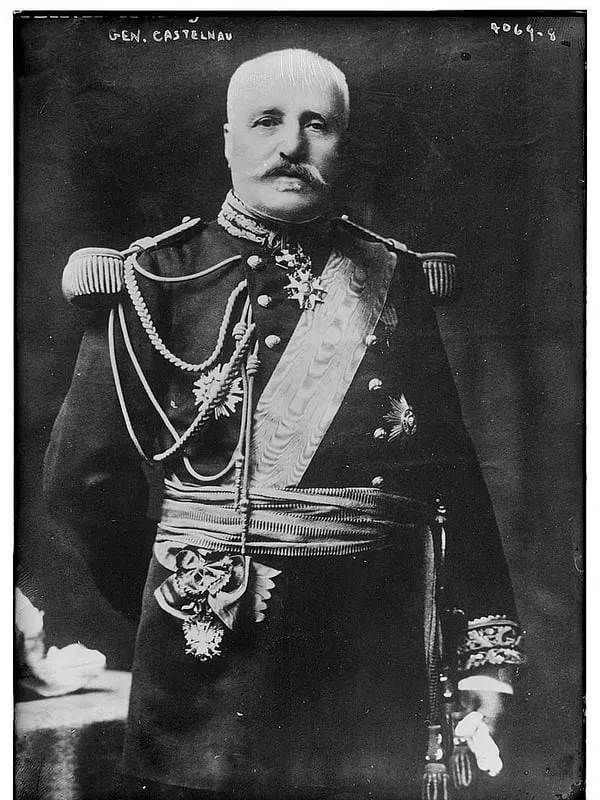
- Born:
- 24 December 1851, Saint-Affrique (France)
- Died:
- 19 March 1944, Montastruc-la-Conseillère (France)
- Author:
- Łukasz Skowroń
- Photo:
- Bain News Service, domena publiczna, Wikimedia Commons

Noël Édouard de Curières de Castelnau was one of the most important French generals of the first years of the war, and also one of the most controversial. Before 1914 he helped to draw up the French war plan. In August 1914 he was defeated at Morhange, but a few days later he threw back the Germans on the Mortagne, and in September he saved Nancy, for which he was called “the saviour of Nancy”. In the autumn he opened the race to the sea, in 1915 he conducted the great offensive in Champagne, and as Joffre’s chief of staff he played a key role in the first days of the Battle of Verdun. The war took three of his sons. Although many considered him one of France’s ablest generals, he never became commander-in-chief or a marshal. The obstacle was not only his disputes with Joffre and Foch, but also his fervent Catholicism, which aroused distrust in the anticlerical Third Republic.
Before the war
He was born on 24 December 1851 in Saint-Affrique in the Aveyron department, into an impoverished noble family from the Rouergue. As a cadet at the officers’ school of Saint-Cyr he was commissioned second lieutenant in August 1870 and fought in the Franco-Prussian War in the Army of the Loire. After graduating from the École de Guerre he worked on the General Staff in Paris. His career slowed at the turn of the century, when the war minister, General Louis André, was removing officers suspected of hostility to the Republic from important posts. Castelnau, an aristocrat and a practising Catholic, commanded an infantry regiment in Nancy for five years, twice as long as usual. In the army he was nicknamed “the booted Capuchin”.
He became a brigade general in 1906 and a division general in 1909. He then commanded a division in the corps of General Joseph Joffre. When Joffre took charge of the army in July 1911, he brought Castelnau onto the General Staff as his first deputy. Castelnau directed the work on the new mobilisation and concentration plan, Plan XVII (PL). In 1913 he was also heavily involved in the dispute over extending military service to three years. At the end of 1913 he joined the Supreme War Council, earmarked to command the 2nd Army in the event of war.
1914: Lorraine and Nancy
The 2nd Army assembled around Nancy. On 14 August, together with the 1st Army of General Auguste Dubail, it set off on the offensive in Lorraine. The Germans fell back to prepared positions, and headquarters gave assurances that only rearguards stood in its way. On 20 August the German 6th Army of Crown Prince Rupprecht of Bavaria went over to the counter-attack, and at Morhange Castelnau’s corps came under the fire of heavy artillery and machine guns. Among those killed that day was his son Xavier, an infantry second lieutenant. According to some historians, the XX Corps of General Ferdinand Foch attacked without the army commander’s consent, and the two generals later held different views about the causes of the defeat. The 2nd Army fell back across the border to the heights in front of Nancy.
Castelnau quickly regained the initiative. When the Germans set off in pursuit towards the Trouée de Charmes, they exposed their flank to his army. On 24 and 25 August he struck them from the north, and on 25 August he issued the order: “Forward everywhere, with all your strength!” The Battle of the Mortagne was one of the first French victories of the war. The right wing of the front held, and Joffre was able to transfer troops westwards to the Marne without anxiety.
At the beginning of September Rupprecht attacked again, this time against the heights of the Grand Couronné covering Nancy. In the Battle of the Grand Couronné the 2nd Army, weakened by handing over corps to the west, repulsed attacks from 4 to 13 September. The worst day was 7 September, when one of the reserve divisions abandoned the Sainte-Geneviève hill without orders. That same day, on the Marne near Sommesous, the general’s second son, Gérald, was killed. Joffre later wrote that it was he who forbade Castelnau to give up Nancy. French historians and the general’s biographers point out, however, that Castelnau prepared two options, retreat and continued defence, and chose defence himself, and that there is no convincing evidence of Joffre’s personal intervention. On 12 September the Germans withdrew. On 18 September Castelnau received the Grand Officer’s Cross of the Legion of Honour.
The race to the sea
Joffre moved him with his whole staff to the north. Castelnau was given a new 2nd Army, made up of corps brought in by rail, and on 22 September he opened the First Battle of Picardy in order to outflank the German wing north of the Oise. He ran into German corps being moved into the same area with the identical intention. At Roye, Lassigny and Albert there were head-on clashes, after which the front moved ever further north. Alexander von Kluck wrote after the war that Castelnau was the French opponent for whom the Germans felt the greatest sympathy, on account of his talent and chivalry.
On 4 October, when the Germans entered Lens and threatened Arras, Castelnau and his subordinate General Louis de Maud’huy concluded that they had to fall back. Joffre disagreed. He removed Maud’huy’s group from Castelnau’s authority, turned it into an independent 10th Army and sent Foch north as his deputy. Arras held. Foch and Joffre later recalled this episode as proof that Castelnau lacked firmness, while his biographers regard that judgement as unjust.
Champagne and Verdun
In the winter of 1914–1915 Castelnau argued that without a mass of heavy artillery and ammunition a breakthrough of the German front was impossible, and advised sparing men and, until then, seeking a decision in the Balkans. These views won him the favour of President Raymond Poincaré and Aristide Briand, but not of Joffre. In June 1915 he took over the Centre Army Group and chose the sector on which, on 25 September, the Second Battle of Champagne began. The French took the first German line and more than 20,000 prisoners, but the second position held. On 1 October his third son, Hugues, was killed in Artois. On 8 October the general received the Grand Cross of the Legion of Honour, and in a note of 25 October he conceded that the enemy had been beaten but not broken.
In December 1915 he became Joffre’s chief of staff and deputy. The scope of his authority was unclear, and some officers in the commander-in-chief’s entourage were hostile to him. The war minister, Joseph Gallieni, reportedly saw him as Joffre’s successor. His first task took him to Salonika, from which he returned on 31 December. The real test came in February 1916. When the Germans attacked at Verdun, Castelnau went to the Meuse on the night of 24/25 February with full powers from the commander-in-chief. On 25 February he ordered the right bank of the river to be held at all costs, against the view of the army group commander, who doubted whether it could be held, and entrusted the defence to General Philippe Pétain. That same day the Germans took Fort Douaumont. Some modern historians, such as Jean-Yves Le Naour, believe that Castelnau’s orders saved Verdun at that point to a greater extent than the later decisions of Pétain, to whom legend attributed all the credit.
Castelnau took part in the preparations for the Battle of the Somme as chief of staff, but according to his biographers Joffre, fearing that the government would put him in his place, kept him away from the conduct of the battle. In December 1916, when Joffre lost his command, the post of chief of staff was abolished, and the new commander-in-chief was General Robert Nivelle, his junior in rank.
Russia and Lorraine
At the beginning of 1917 Castelnau travelled with the colonial minister Gaston Doumergue to the Allied conference in Petrograd. He discussed the 1917 offensives with Russian generals and reported on the enormous losses of the Russian army. He left Russia shortly before the outbreak of the revolution. On his return he took over the Eastern Army Group in Lorraine and the Vosges, the quietest sector of the front, and commanded it until the end of the war. In the autumn of 1918 his troops were to carry out a great offensive in Lorraine, set for 14 November, but the armistice forestalled it. Castelnau, like Pétain, believed that the armistice came too soon.
After the war
On 22 November 1918 he made a ceremonial entry into Colmar. The press was already announcing his appointment as marshal, but the government did not sign it, and in 1921 he was passed over again. In 1919 he became a deputy for Aveyron for the right-wing Republican Federation and chaired the Chamber’s army committee. After his defeat in 1924 he founded the National Catholic Federation, which forced the left-wing government to abandon its anticlerical plans. After France’s defeat in 1940 he firmly dissociated himself from Pétain and the Vichy government, and his grandsons fought in the ranks of the Free French. He died in March 1944 at the Château de Lasserre in Montastruc-la-Conseillère near Toulouse. The French defence ministry gives the date as 19 March, some biographies 18 March.
Assessment
For a long time the assessment of Castelnau depended on the memoirs of his rivals. Joffre and Foch wrote that at the critical moments at Nancy and Arras he lacked firmness, and their supporters at headquarters called him a defeatist. Allies and subordinates saw him differently. General Maurice Pellé, chief of staff at Joffre’s headquarters, praised his quick and sound judgement and meticulous preparation of battles in 1915, and General Hubert Lyautey is said to have wondered why it was not he who had been entrusted with conducting the war. Soldiers valued him for frequently visiting the front line and for forbidding unnecessary raids, and the historian André Bach counted him among the least severe generals in the matter of carrying out the sentences of courts martial.
Recent French biographies, from Yves Gras to Benoît Chenu and Jean-Louis Thiériot, present him as a general whose achievements at Nancy and Verdun were credited to others. Some of them were written by his descendants or admirers, so their conclusions are sometimes treated with caution. Most historians agree, however, that Castelnau was among the ablest French commanders of the war, and that his caution about frontal attacks came earlier and was more justified than that of many of his colleagues.
Sources
Spotted a mistake?Report an error
Commanded in battles
(08)- 7–25 August 1914Battle of the FrontiersWestern Front
- 14–25 August 1914Battle of LorraineWestern Front
- 25 August – 3 September 1914Battle of the MortagneWestern Front
- 4–12 September 1914Battle of the Grand CouronnéWestern Front
- 15 September – 19 October 1914Race to the SeaWestern Front
- 22–25 September 1914First Battle of AlbertWestern Front
- 22–26 September 1914First Battle of PicardyWestern Front
- 25 September – 6 November 1915Second Battle of ChampagneWestern Front
Mentioned in battles
(04)Often appears with
People who appear in the same events.
On the timeline
(24)1914
August
September
- 22
- Key eventFirst Battle of Picardy beginsOn 22 September 1914 General de Castelnau's new French Second Army attacked north of the Oise. The Race to the Sea had begun.
- Key eventFirst Battle of Albert beginsIn September 1914 the French and Germans clashed at Albert and Bapaume. On the heights above the Somme a front formed that held until the Somme battle of 1916.