Key event
First Battle of Albert begins
- Category:
- Military operations
- Front:
- Western Front
- Date:
- 22 September 1914
- Author:
- Natalia
- Battle:
- First Battle of Albert
- Tags:
- France, Germany, Race to the Sea, Picardy
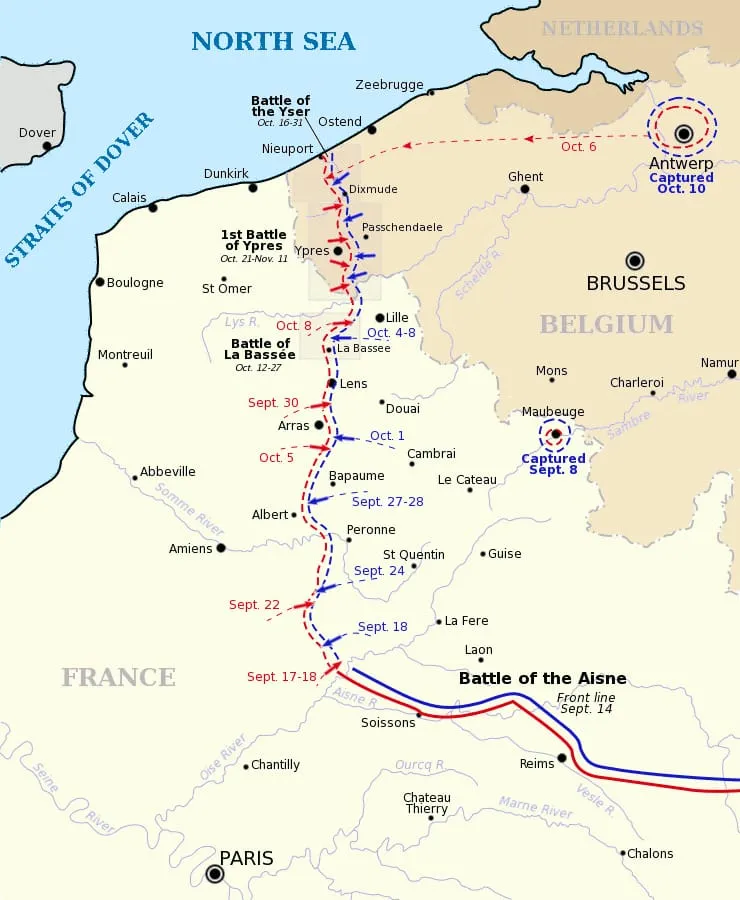
On 22 September 1914, according to the British chronology of the war, the First Battle of Albert began, named after a small town in the Somme department. The French Second Army of General Noël de Castelnau and the German Sixth Army of Crown Prince Rupprecht of Bavaria tried to outflank each other north of the Somme. The fighting ended on 29 September without a decision, and the front that then formed between Albert and Bapaume survived almost unchanged until the summer of 1916.
When did the battle begin?
The old British chronology of the war opens the Battle of Albert on 22 September, the same day on which the French attack in Picardy began. Its authors treated all the fighting between the Oise and the Somme in the last days of September as a single sequence of operations. Most modern historians, French and English-speaking, distinguish two battles, however. The first, in Picardy, was fought on 22–26 September south of the Somme, at Roye and Lassigny. The second, the Battle of Albert proper, began on 25 September, when the French attack shifted further north, and according to these works lasted until 29 September. The British chronology and the greatwar.co.uk website, on the other hand, end it as early as 25 September.
The race north
In the second half of September 1914, after the indecisive Battle of the Aisne, both sides were moving troops west to turn the enemy’s open flank. The commander-in-chief of the French Army, General Joseph Joffre, sent one corps after another to Castelnau’s new Second Army, assembling around Amiens. When its attack south of the Somme stalled, Castelnau extended his line north of the river and decided to strike east from the Albert area.
The chief of the German General Staff, General Erich von Falkenhayn, had the same intention, only in the opposite direction. The Sixth Army, being brought from Lorraine, was to strike west, towards Amiens and the coast. The French attack in Picardy, however, forced him to send part of its forces south of the Somme. North of the river the attack was made by II Bavarian Corps and XIV Reserve Corps, supported by cavalry.
The fighting at Albert
On 25 September the French advanced east from the Albert area. Instead of an open flank they ran into German columns coming towards them. The next day the Germans took Bapaume. The Bavarians routed French territorial units and advanced towards Albert through the villages of Combles, Guillemont and Montauban. XIV Reserve Corps attacked along the old Roman road linking Bapaume with Albert and on 27 September reached Thiepval, on the heights above the river Ancre.
On 28 September the Germans tried to break through to Albert and on towards Amiens. French infantry and artillery stopped them on a line from Maricourt through Fricourt to Thiepval. On 29 September the Germans took Fricourt but could advance no further, and French counter-attacks almost retook the village. The exhausted troops of both sides began to dig trenches where the end of the fighting found them. Albert itself, shelled by German artillery, was largely destroyed.
The Somme front
After the battle the fighting moved further north, to Arras, and then to Flanders. The front between the Somme and the Ancre fell quiet and for almost two years was considered one of the quietest sectors of the Western Front. The Germans used this time to build powerful fortifications on the heights, with deep dugouts cut into the chalk. In 1915 the British took over this sector from the French.
It was here, on 1 July 1916, that the Battle of the Somme began, one of the bloodiest battles in history. The villages fought over in September 1914, such as Thiepval, Fricourt, Mametz and Montauban, became symbols of that battle for the British. Today a memorial stands at Thiepval commemorating more than 72,000 British and South African soldiers who died on the Somme and have no known grave.
Remember the articles you have read? Only in this browser; nothing is sent anywhere.How it works
Read ·
Spotted a mistake?Report an error
Meanwhile
(04)Elsewhere in the same days.
- 22 September 1914 · War at seaVon Spee shells PapeeteOn 22 September 1914 the cruisers Scharnhorst and Gneisenau shelled Papeete on Tahiti. The French burned the coal stocks before the Germans could seize them.
- 22 September 1914 · War at seaEmden bombards MadrasOn the night of 22 September 1914 the German cruiser Emden shelled Madras and set its oil tanks ablaze. The attack caused panic on India's east coast.
- 21 September 1914 · SocietyBritain extends its contraband listOn 21 September 1914 a British proclamation declared copper, lead, rubber, glycerine, iron ore and hides, among others, to be conditional contraband.
- 21 September 1914 · Asia and the PacificGerman troops in New Guinea surrenderOn 21 September 1914 the last German units on New Britain laid down their arms at Herbertshöhe. One German officer hid in the jungle until 1919.
Related events
(04)The same battle, people or subject.
- 25 September 1914 · Western FrontFirst Battle of Albert endsThe British chronology ends the First Battle of Albert on 25 September 1914, but fighting for the heights between Albert and Bapaume went on to the month's end.
- 27 September 1914 · Western FrontFirst Battle of Artois beginsOn 27 September 1914 the Race to the Sea reached Artois. The French and Germans began fighting for Arras, Lens and the heights that shaped the front for years.
- 1 October 1914 · Western FrontBattle of Arras beginsOn 1 October 1914 three German corps attacked between Arras and Douai. The Battle of Arras began, the heaviest phase of the fighting in Artois.
- 26 September 1914 · Western FrontEnd of the First Battle of PicardyOn 26 September 1914 the First Battle of Picardy ended. The French failed to turn the German flank, and the front between the Oise and Somme set in trenches.