Key event
First Battle of Picardy begins
- Category:
- Military operations
- Front:
- Western Front
- Date:
- 22 September 1914
- Author:
- Łukasz Skowroń
- Battle:
- First Battle of Picardy
- Tags:
- France, Germany, Noël de Castelnau, Race to the Sea
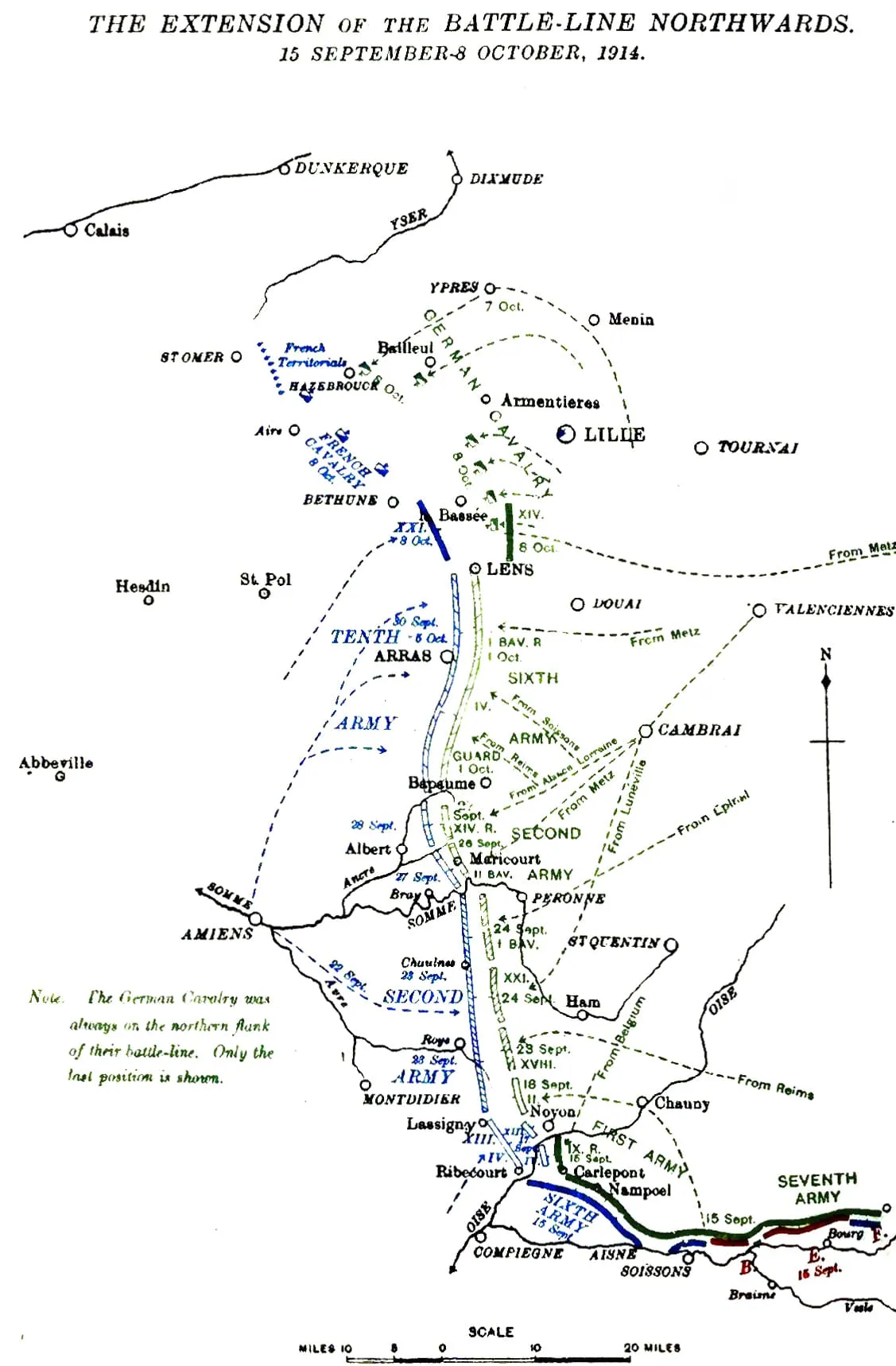
On 22 September 1914 the First Battle of Picardy began in Picardy, north of the river Oise. The newly formed French Second Army of General Noël de Castelnau went over to the attack in order to turn the flank of the German armies from the west. The battle, which lasted until 26 September, was the first major engagement of the so-called Race to the Sea, the series of attempts to outflank the enemy which in the autumn of 1914 extended the Western Front all the way to the North Sea coast.
Deadlock on the Aisne
In mid-September the German armies, withdrawn from the Marne, halted on the heights above the river Aisne. For several days the French and British tried in vain to drive them from these positions. When the Battle of the Aisne came to an end, both sides began to dig in. The front now ran from the Swiss border to the area of Compiègne, but further west and north there was no line at all. Between the Oise and the English Channel lay an area held only by a few units of cavalry and territorial troops.
The commanders on both sides came to the same conclusion. If the front could not be broken, it had to be outflanked. The commander-in-chief of the French Army, General Joseph Joffre, had already ordered the French Sixth Army to attack north of the Oise, near Noyon, from 17 September, but the Germans quickly halted this attack. Joffre therefore decided to assemble a new army further west to strike the open German flank.
Castelnau’s new army
Joffre gave command of the new army to Castelnau, who in August and September had commanded the Second Army in Lorraine and saved Nancy. Castelnau came north with his staff, keeping the army’s number. Its core consisted of corps brought by rail from various sectors of the front. IV and XIII Corps came to it from the Sixth Army, XIV and XX Corps arrived from the east, and the left flank was covered by General Louis Conneau’s cavalry corps. The troops detrained around Amiens and Montdidier.
The French had an important advantage in this race. They moved their troops over their own undamaged railway lines, which ran in an arc behind the front. The Germans used the railways in occupied France and Belgium, which had been largely destroyed during the August advance and the retreat from the Marne. According to some estimates the French could run up to 200 military trains a day, the Germans only a few dozen.
The German response
The new chief of the German General Staff, General Erich von Falkenhayn, thought much as Joffre did. He sent corps taken from the Aisne front to the right flank, next to General Alexander von Kluck’s First Army. Around 21 September he decided that the Sixth Army of the heir to the Bavarian throne, Crown Prince Rupprecht, would be concentrated in the Amiens area. This army had until then been fighting in Lorraine, opposite Castelnau. Now the two opponents were meeting again, several hundred kilometres further north.
The German railways, however, could not keep up with the movements. On 22 September only II Corps, which had just arrived from the Aisne, and IX Reserve Corps stood facing the French, protecting the extreme right flank of Kluck’s army.
The attack of 22 September
On 22 September Castelnau’s corps crossed the small river Avre and moved east and north-east, on a line from Lassigny through Roye to Chaulnes. The aim was to get into the rear of the Germans fighting on the Oise and the Aisne. On the first day the French pushed the enemy out of some of his positions, but they did not find the empty space in front of them that they had counted on. The Germans defended themselves stubbornly and waited for reinforcements.
In the following days the situation was reversed. On 23 and 24 September the German XVIII Corps, taken from the front at Reims, arrived and together with II Corps went over to the counter-attack. Heavy fighting took place at Roye and Lassigny and on the roads leading to Péronne. The French had to give up some of the ground they had taken, and on the northern flank their cavalry and territorial divisions withdrew behind the Somme. By 26 September the forces of both sides were exhausted and the troops began to dig in.
Significance
The First Battle of Picardy was indecisive, but it set the pattern for the following weeks. Every attempt to outflank the enemy ended in a head-on clash with fresh forces arriving from the opposite direction, and each new stretch of front froze into trenches. As early as 25 September the fighting moved further north, to the area of Albert and Bapaume, and at the beginning of October to Arras. In October the race reached Flanders and ended on the North Sea coast.
The name “Race to the Sea” is in fact somewhat misleading. Neither side was trying to reach the coast, but to turn the enemy’s flank. The sea was simply the place where there was no more room for further manoeuvres. The line that settled in Picardy at the end of September 1914 survived almost unchanged until the spring of 1917.
Remember the articles you have read? Only in this browser; nothing is sent anywhere.How it works
Read ·
A voice from the front
“The battery moves off. A crackle of rifles and machine guns accompanies the thunder of the artillery. The enemy resists the envelopment and turns to face us. No doubt the movement must be pushed further still. We resume our march northwards, towards Roye. The success of the manoeuvre is a question of numbers: but do we have the numbers now?”
Translated · Original (fr)
La batterie s'ébranle. Un bruit de mousqueterie et de mitrailleuses accompagne le tonnerre de l'artillerie. L'ennemi résiste à l'enveloppement et fait face. Il faut, sans doute, accentuer le mouvement. Nous reprenons notre marche vers le nord, vers Roye. Le succès de la manœuvre est une question de nombre: mais avons-nous le nombre à présent?
Spotted a mistake?Report an error
Meanwhile
(04)Elsewhere in the same days.
- 22 September 1914 · War at seaAboukir, Hogue and Cressy are sunkOn 22 September 1914 the German U-9 sank three British armoured cruisers in about an hour. Almost 1,500 sailors were killed.
- 22 September 1914 · War at seaVon Spee shells PapeeteOn 22 September 1914 the cruisers Scharnhorst and Gneisenau shelled Papeete on Tahiti. The French burned the coal stocks before the Germans could seize them.
- 22 September 1914 · War at seaEmden bombards MadrasOn the night of 22 September 1914 the German cruiser Emden shelled Madras and set its oil tanks ablaze. The attack caused panic on India's east coast.
- 21 September 1914 · Asia and the PacificGerman troops in New Guinea surrenderOn 21 September 1914 the last German units on New Britain laid down their arms at Herbertshöhe. One German officer hid in the jungle until 1919.
Related events
(04)The same battle, people or subject.
- 26 September 1914 · Western FrontEnd of the First Battle of PicardyOn 26 September 1914 the First Battle of Picardy ended. The French failed to turn the German flank, and the front between the Oise and Somme set in trenches.
- 27 September 1914 · Western FrontFirst Battle of Artois beginsOn 27 September 1914 the Race to the Sea reached Artois. The French and Germans began fighting for Arras, Lens and the heights that shaped the front for years.
- 1 October 1914 · Western FrontBattle of Arras beginsOn 1 October 1914 three German corps attacked between Arras and Douai. The Battle of Arras began, the heaviest phase of the fighting in Artois.
- 4 September 1914 · Western FrontBattle of the Grand Couronné beginsOn 4 September 1914 Crown Prince Rupprecht's army struck the Grand Couronné heights before Nancy. General Castelnau's French held the city for over a week.