1914: The Aisne and the Race to the Sea
First Battle of Picardy
- Dates:
- 22–26 September 1914
- Front:
- Western Front
- Location:
- Picardy between the Oise and the Somme (Lassigny, Roye, Chaulnes, Péronne), FranceOn the battle map →
- Sides:
- FranceJoseph Joffre, Noël de Castelnau, Michel-Joseph Maunoury
- Result:
- Inconclusive. Neither side outflanked the enemy's wing, and the front settled between the Oise and the Somme. The fighting moved further north.
- Author:
- Łukasz Skowroń
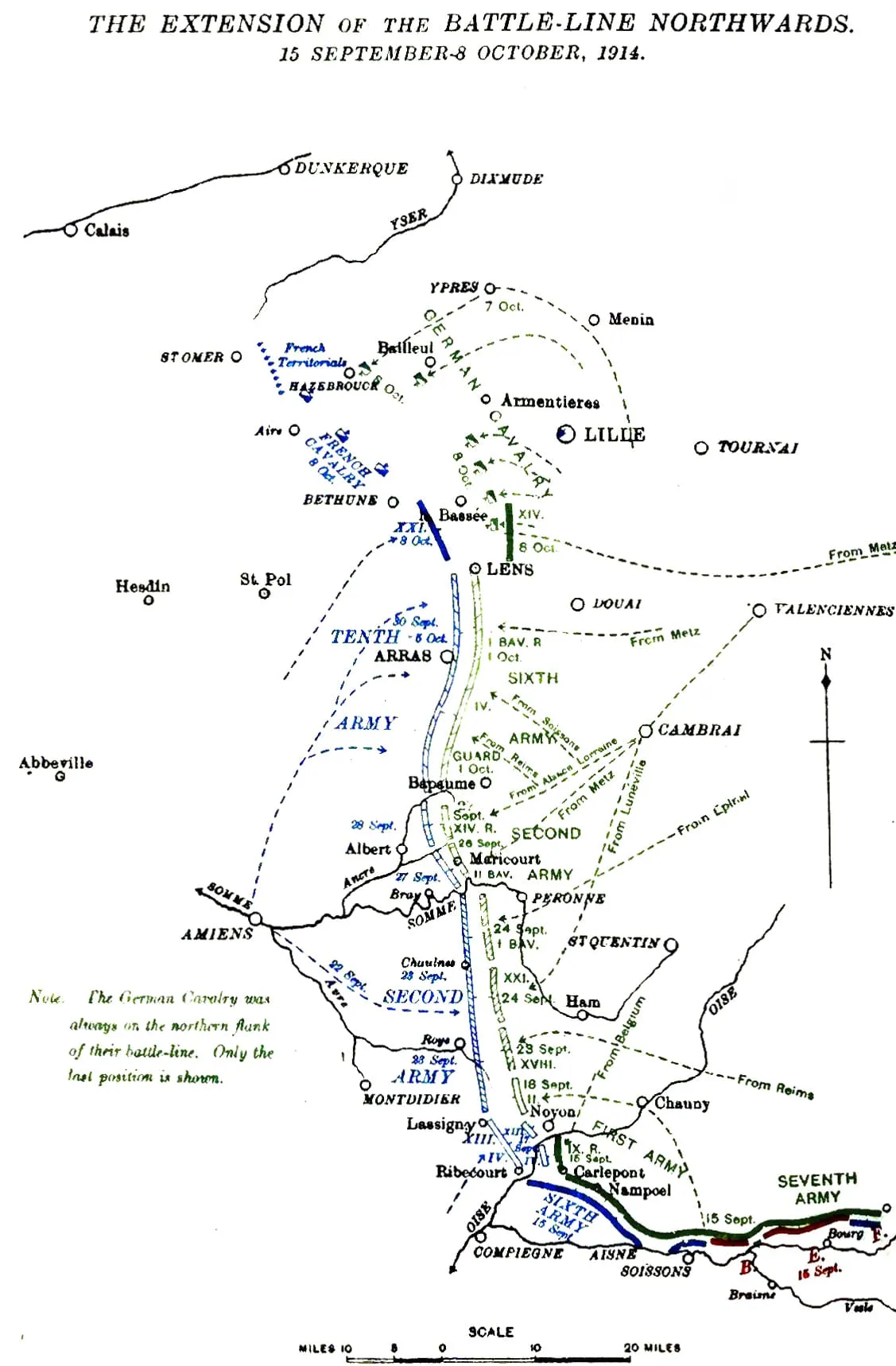
The First Battle of Picardy, fought on 22–26 September 1914, was the first major clash of the so-called Race to the Sea. The French Second Army of General Noël de Castelnau tried to outflank from the west the open wing of the German armies, which had halted on the Aisne. It ran, however, into German corps being moved to the same area with an identical intention. Instead of an outflanking manoeuvre there was a series of frontal clashes, after which the front shifted another section northwards.
Dates of the battle
On this page we adopt the dates 22–26 September 1914, given by French historiography (French bataille de Picardie) and most modern studies. The limits are, however, conventional. Fighting north of the Oise had been going on since about 17 September, when the French Sixth Army tried to outflank the German wing around Noyon, and the clashes at Roye and Lassigny dragged on into the beginning of October. From 25 September the main weight of the fighting shifted further north, to the area of Albert and Bapaume. That fighting is usually described as a separate Battle of Albert.
Background: the open wing
In mid-September 1914, after the Battle of the Marne, the German armies halted on the heights above the Aisne. The First Battle of the Aisne showed that they could not be driven from there by frontal attack. The front already ran unbroken from Switzerland to the area of Compiègne, but west and north of the Oise, as far as the English Channel and the North Sea, lay an almost empty space. Both sides saw in it a chance to outflank the enemy and strike at his rear.
The commander-in-chief of the French army, General Joseph Joffre, decided that the German wing would be outflanked by a new army assembled to the left of the Sixth Army of General Michel Joseph Maunoury. He entrusted its command to Castelnau, who until then had commanded the Second Army in Lorraine and had defended Nancy. Castelnau came north with his staff, and the army in Lorraine was taken over by other commands. The new Second Army consisted of corps brought by rail from various sectors of the front. IV and XIII Corps passed to it from the Sixth Army, XIV and XX Corps came from the east, and the wing was covered by the cavalry corps of General Louis Conneau. The troops detrained around Amiens and Montdidier.
On the German side, from 14 September the armies were directed by the new Chief of the General Staff, General Erich von Falkenhayn. He too wanted to outflank the enemy from the west. To the right wing, next to the 1st Army of General Alexander von Kluck, he sent one corps after another, taken from the front on the Aisne and from Lorraine. Around 21 September he decided to concentrate in the Amiens area the 6th Army of the Crown Prince of Bavaria, Rupprecht, which had until then been fighting in Lorraine. Its corps were to strike westwards, towards the coast.
The railways decide
In this contest for the flank much depended on the railways. The French had their own undamaged rail network and could move troops along the front on interior lines. The Germans used lines in occupied France and in Belgium, largely destroyed during the August advance and the retreat from the Marne. By some estimates the French could run as many as 200 military trains a day, the Germans only a few dozen. German corps often had to cover the last stretch of the way on foot. Even so, both sides arrived on the battlefield at roughly the same time, so neither found an open flank in front of it.
Course of the fighting
22 September. The French Second Army moved off east and north-east, crossing the small river Avre. Its corps advanced on a line from Lassigny through Roye to Chaulnes. Facing them were the German II Corps, which had only just arrived from the Aisne, and IX Reserve Corps, forming the extreme right wing of Kluck’s army. The French managed to push the Germans out of some positions, but resistance grew by the hour.
23–24 September. New German forces reached the battlefield. XVIII Corps, taken from the front at Reims, covered several dozen kilometres in a forced march and together with II Corps launched a counter-attack. The heaviest fighting took place around Roye, Lassigny and on the roads leading to Péronne. The French had to give up some of the ground they had gained. On the northern wing their cavalry and territorial divisions were unable to hold on east of the Somme.
25–26 September. The attacking strength of both sides was exhausted. The French halted the German counter-attacks, and the troops of both sides began to dig in. After further local clashes at the turn of September and October the front settled on a line running roughly from Ribécourt on the Oise through the area of Lassigny and Roye northwards, towards the Somme. By then the corps of the German 6th Army were already arriving north of the Somme, and the French Second Army was extending its line towards Albert. There, from 25 September, another battle began.
Losses
Losses in this battle cannot be established precisely. The fighting merged smoothly into further clashes of the Race to the Sea, and neither French nor German sources give separate, reliable figures for it. It is known that both sides lost thousands of soldiers and that many villages around Roye and Lassigny were destroyed.
Significance
The First Battle of Picardy brought no decision, but it set the pattern for the following weeks. Every attempt to outflank the enemy ended in a frontal clash with fresh forces arriving from the opposite side, and the new section of the front froze into trenches. After Picardy came the turn of Albert, then Arras, and in October Flanders. The race ended only on the North Sea coast.
The line that settled in Picardy at the end of September 1914 survived in little-changed form until the spring of 1917, when the Germans withdrew to the previously prepared Hindenburg Line. These lands again became the scene of great battles in 1918, during the German spring offensive and the Allied offensive that brought the war to an end.
Spotted a mistake?Report an error