1914: The Aisne and the Race to the Sea
First Battle of the Aisne
- Dates:
- 12–15 September 1914
- Front:
- Western Front
- Location:
- The Aisne valley and the Chemin des Dames ridge between Compiègne, Soissons and Reims, FranceOn the battle map →
- Sides:
- United KingdomJohn French, Douglas Haig, Horace Smith-DorrienFranceJoseph Joffre, Michel-Joseph Maunoury, Louis Franchet d'EspéreyGerman EmpireAlexander von Kluck, Karl von Bülow, Josias von Heeringen
- Result:
- Inconclusive. The Germans held the heights north of the Aisne and the front froze into a line of trenches. Both sides began the race to the sea.
- Author:
- Łukasz Skowroń
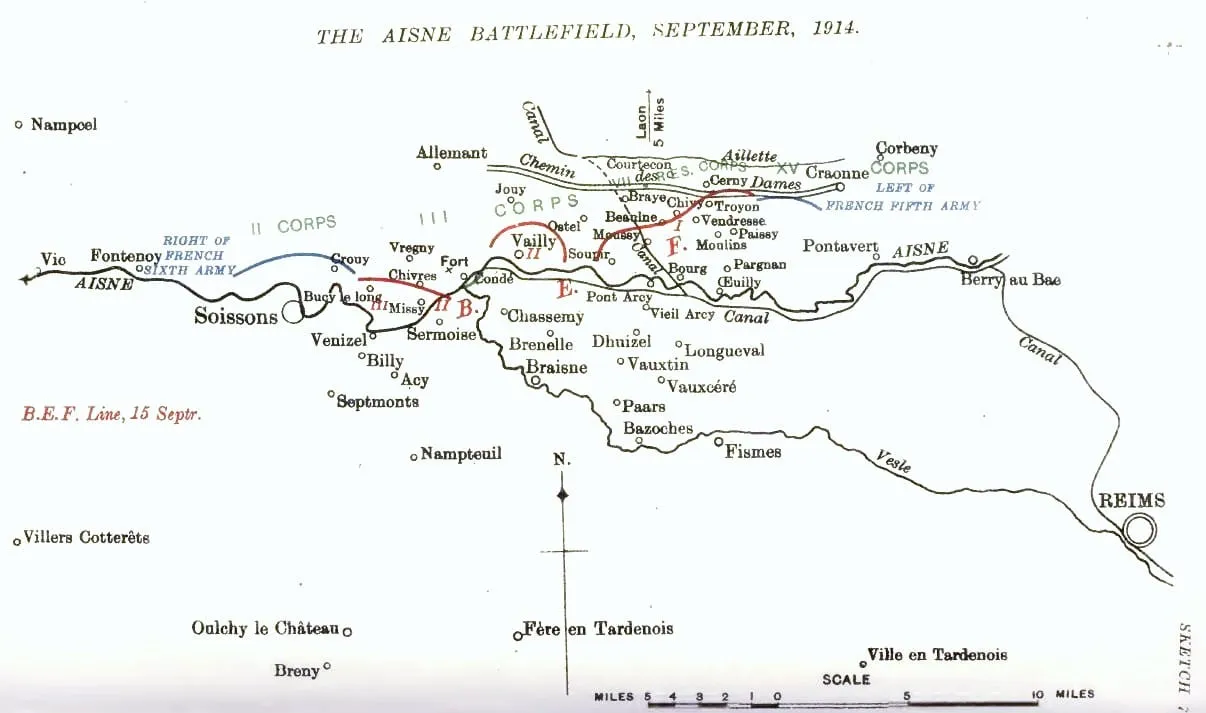
The First Battle of the Aisne, fought in September 1914 in northern France, followed directly from the Battle of the Marne. The French and the British Expeditionary Force, pursuing the retreating German armies, came up against an enemy on the river Aisne who had halted on a strong position and had no intention of giving it up. Several days of attacks brought no breakthrough. Soldiers on both sides began to dig trenches, and the war of manoeuvre on the Western Front came to an end. The battle is widely regarded as the beginning of the trench warfare that lasted in the west almost until the end of the war.
Dates of the battle
On this page we use the dates 12–15 September 1914. This is how the battle is defined by the British chronology of the war and the official British nomenclature of battles: from the arrival of the troops on the river on 12 September, through the crossings on 13 September and the attacks on the ridge on 14 September, to 15 September, when the British went over to the defensive and began to dig in. The fighting on the Aisne, however, lasted longer. The Germans launched counter-attacks, and the French renewed their attacks on both flanks until about 28 September. French and German historians, and following them most modern accounts, give 12 or 13–28 September as the dates of the whole battle. The British nomenclature treats later engagements involving the British as separate, smaller actions.
Background: the retreat from the Marne
On 9 September the German First Army under General Alexander von Kluck and the Second Army under General Karl von Bülow began to retreat. A gap several dozen kilometres wide had opened between them, into which the British and the French Fifth Army advanced. Over the following days the German armies in the centre also withdrew. The Chief of the German General Staff, Helmuth von Moltke, designated the river Aisne and its surroundings as the new line of defence.
The Allies pursued the Germans slowly. The troops were exhausted after the long retreat and the battle, there were no fresh reserves, and from 10 September torrential rain fell. The retreating Germans blew up bridges and left strong rearguards behind them. The Commander-in-Chief of the French army, General Joseph Joffre, was convinced that the enemy was beaten and would continue to fall back. His orders assumed a continued pursuit to the north.
The terrain
Between Compiègne and Berry-au-Bac the Aisne flows from east to west. It is about 30 metres wide and too deep to ford. The flat floor of the valley is roughly one and a half kilometres wide on each side of the river. Above it rise steep wooded slopes about 100 metres high, cut by side valleys, and at the top stretches a plateau.
East of Soissons this plateau forms a long, narrow ridge between the Aisne and the small river Ailette. Along its crest runs the Chemin des Dames road, the “Ladies’ Way”, named after the daughters of King Louis XV, for whom it was laid out in the 18th century. From the ridge the defenders could see the whole valley and fire on the crossings, while they themselves, hidden behind the edge of the plateau and in the woods, were hard to spot. The attackers first had to cross the river and then climb the exposed slopes.
Forces
On the western flank, from Compiègne to Soissons, the French Sixth Army under General Michel-Joseph Maunoury attacked. In the centre, between Soissons and Bourg, advanced the British Expeditionary Force of Field Marshal John French, made up of three corps: I Corps under General Douglas Haig, II Corps under General Horace Smith-Dorrien and III Corps under General William Pulteney, as well as a cavalry division. To the right of the British, as far as Reims, attacked the French Fifth Army under General Louis Franchet d’Espérey, and further east other French armies.
On the German side, Kluck held the line from the Oise to the area of Soissons and Vailly. East of him, near Reims, stood Bülow’s army. The sector between them, at the eastern end of the Chemin des Dames ridge, was almost empty at the start of the battle, screened mainly by cavalry. The Germans assigned to it the new Seventh Army under General Josias von Heeringen, formed from troops brought by rail from Alsace and Lorraine. Its units, however, were not due to arrive for several days.
Course of the fighting
12 September. The Allied troops reached the Aisne along the whole of its middle course. The French Sixth Army entered Soissons, abandoned by the Germans, but failed to cross the river on any wider front. The British, after a day’s march in the rain, crossed the small river Vesle and took the heights south of the Aisne. In the evening the 11th Brigade of the 4th Division crossed the damaged bridge at Venizel. The French Fifth Army forced the Vesle and approached the Aisne and Reims.
13 September. The British crossed the river on a broad front. They crossed on damaged bridges, single footbridges, boats and rafts, while engineers built pontoon bridges. Units of the 4th Division crossed at Venizel, the 5th Division at Missy, the 3rd Division at Vailly, and Haig’s I Corps at Pont-Arcy, Chavonne and Bourg, where the aqueduct carrying the canal over the river had survived. The bridge at Condé, between Missy and Vailly, remained in German hands, and the Chivres heights above it proved to be one of the strongest points of the German defence. On the British right the French XVIII Corps crossed the Aisne and reached the eastern end of the Chemin des Dames ridge near Craonne.
The same day the Germans closed the gap between the First and Second Armies at the last moment. The VII Reserve Corps under General Hans von Zwehl, released after the capitulation of the fortress of Maubeuge, came by forced march through Laon and took up positions on the Chemin des Dames ridge only a few hours before the British arrived. According to various accounts its soldiers covered about 60 kilometres in 24 hours. Behind them came XV Corps from Alsace.
14 September. In the morning Haig’s I Corps, taking advantage of thick fog, moved on the ridge near Troyon and Vendresse. The British took a sugar factory on the plateau, and some units even crossed the Chemin des Dames road near Cerny. When the fog lifted, they came under machine-gun and artillery fire. The Germans counter-attacked, and the fighting went on all day, in rain and confusion, with units intermingled on the wooded slopes. According to British estimates, I Corps alone lost about 3,500 killed, wounded and missing that day. To the west of it the divisions of II and III Corps were pinned down on the slopes just above the river, below the Chivres and Vregny heights. The French Sixth Army attacked the heights north of Soissons without success, and the Fifth Army fought near Craonne and north of Reims. That day the arriving units of the Seventh Army began to occupy the sector between Kluck and Bülow.
15 September. The Allies renewed their attacks but nowhere managed to break through the German defence. The Germans went over to counter-attacks, especially in the French sector near Craonne. The British command, having concluded that the enemy did not intend to fall back any further, ordered the troops to hold the ground they had taken and dig in. British nomenclature regards this day as the end of the battle.
Further fighting until the end of September
After 15 September the fighting on the Aisne did not stop. The Germans, reinforced by further corps, tried to push the British and French back across the river, while the Allies kept attacking in the hope of a breakthrough. Particularly heavy fighting took place at the eastern end of the Chemin des Dames and near Reims, which from mid-September became a front-line city and was shelled by German artillery. At the end of the month the Germans launched another series of strong attacks on the French positions, but the front line barely changed. Further French attempts to recapture the ridge in the autumn of 1914 also failed.
Both sides were learning a new kind of war. The British, equipped with few entrenching tools and spades, at first dug shallow rifle pits, often with tools taken from nearby farms. Within a few days these had turned into trenches up to about two metres deep, linked by communication passages. The Germans quickly brought heavy siege howitzers, trench mortars and hand grenades to the Aisne. The British artillery, short of heavy guns, was outmatched by the German, and London hastily sent batteries of six-inch guns. In this battle British airmen tried out directing artillery fire by wireless telegraphy.
Casualties
Casualties in the Battle of the Aisne are hard to establish, because the fighting merged seamlessly into the operations of the race to the sea. According to British figures, the British Expeditionary Force lost about 13,500 killed, wounded and missing over the whole period of fighting on the Aisne. There are no complete figures for French and German losses. Both armies are estimated to have lost tens of thousands of men in this fighting.
Significance
The Battle of the Aisne closed the period in which great armies on the Western Front marched and manoeuvred across hundreds of kilometres. The Germans, though defeated on the Marne, halted the pursuit and held a favourable position. The Allies learned that even a weakened enemy, dug in on high ground and supported by machine guns and artillery, was almost impossible to dislodge by frontal attack. This experience would be repeated in the years that followed.
Since the frontal attacks had failed, both sides tried to turn the enemy’s open flank to the north. From the second half of September the French and Germans moved corps after corps to the west and north, fighting in Picardy, near Albert and Arras. At the beginning of October the British Expeditionary Force left its positions on the Aisne and moved to Flanders, closer to its ports on the Channel. This so-called race to the sea ended in October on the North Sea coast. By the end of 1914 an unbroken line of trenches stretched from Switzerland to the sea.
The Chemin des Dames ridge remained in German hands until 1917. In April of that year it became the objective of the Nivelle Offensive, whose failure provoked mutinies in the French army. In May 1918 the Germans struck here again in the Third Battle of the Aisne and for the second time in the war reached the Marne.
Spotted a mistake?Report an error