1914: The Great Retreat
Battle of the Mortagne
- Dates:
- 25 August – 3 September 1914
- Front:
- Western Front
- Location:
- The Trouée de Charmes and the Mortagne valley between Lunéville and Rambervillers, Lorraine (France)On the battle map →
- Sides:
- FranceNoël de Castelnau, Auguste DubailGerman EmpireRupprecht, Crown Prince of Bavaria, Josias von Heeringen
- Result:
- French victory. The German drive on the Trouée de Charmes was halted, and the front settled along the Mortagne and in front of Lunéville.
- Author:
- Natalia
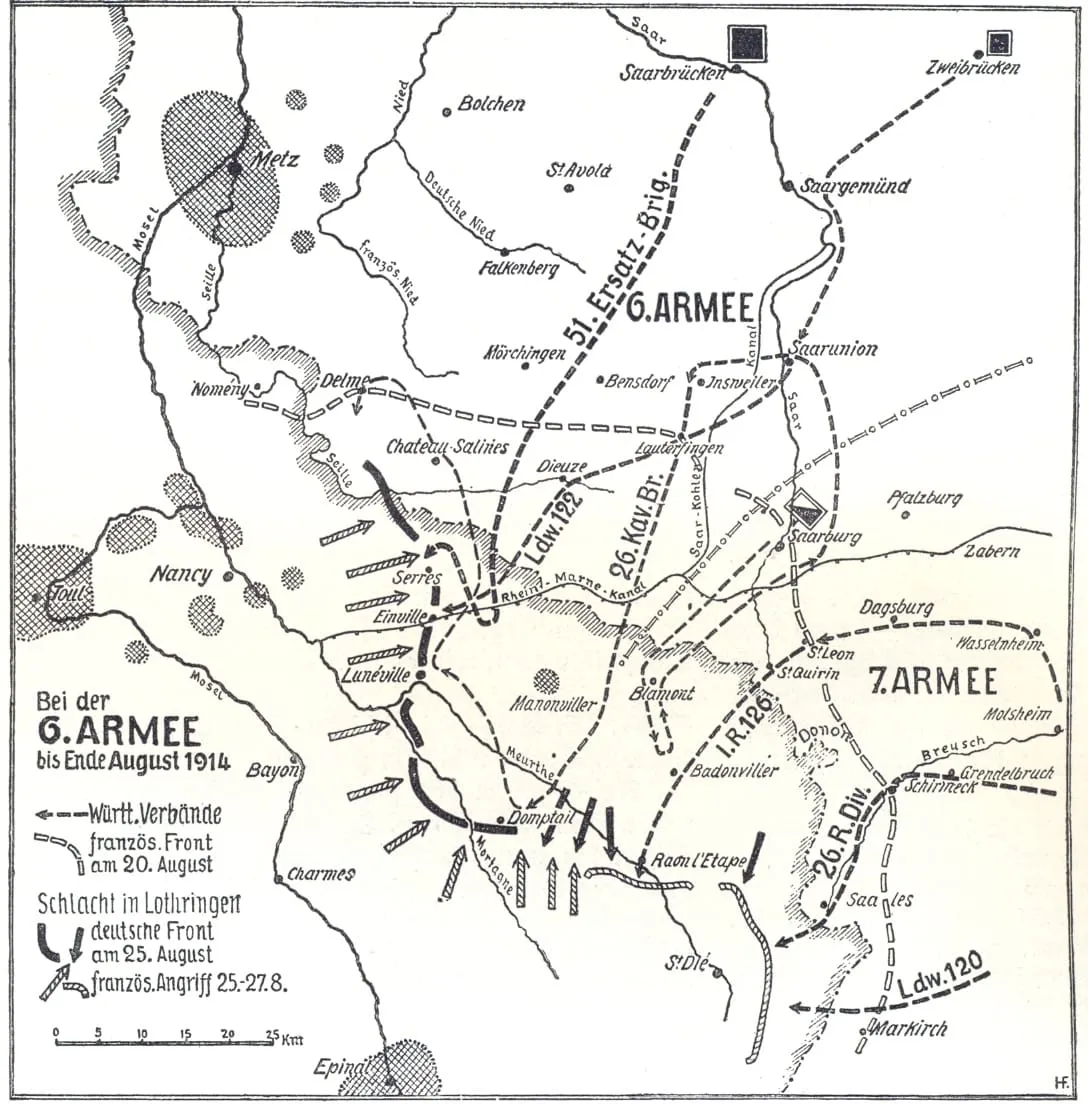
The Battle of the Mortagne, known in France above all as the battle of the Trouée de Charmes (Fr. trouée de Charmes), was fought in Lorraine in the last days of August 1914. The French Second Army of General Noël de Castelnau and First Army of General Auguste Dubail, beaten a few days earlier at Morhange and Sarrebourg, stopped the German pursuit and went over to a counter-offensive. It was one of the first French victories of the war.
Dates of the battle
The British chronology of the war, from which the dates in our timeline are taken, gives the Battle of the Mortagne in the Vosges as beginning on 25 August and ending on 3 September. The next day the defence of the Grand Couronné heights in front of Nancy began. French historians usually narrow the battle of the Trouée de Charmes itself to 24–26 August. They treat the further fighting along the Mortagne and in front of Lunéville, which lasted until early September, as its continuation. Polish Wikipedia describes the whole of the fighting in Lorraine from 14 August as a single Battle of Lorraine.
The German pursuit
After the victory at Morhange and Sarrebourg on 20 August, the German Sixth Army of Crown Prince Rupprecht of Bavaria and the Seventh Army of General Josias von Heeringen set off after the retreating French (see End of the battles of Morhange and Sarrebourg). The German command hoped to break through the French defensive line between the fortresses of Toul and Épinal. Between them lay an unfortified gap near the small town of Charmes on the Moselle. According to an often repeated view, pre-war French planners had deliberately left it without forts in order to draw an attacking enemy into it.
Around 22–23 August the Germans occupied Lunéville, abandoned by the French. Castelnau deployed his troops in a semicircle on the heights south-west of the town, from Nancy to the Mortagne valley. He noticed that the German columns were turning south, towards the gap, and in doing so exposing their flank to his army.
Gerbéviller, 24 August
On 24 August the Germans attacked towards the Moselle. Their corps crossed the Meurthe and the Mortagne under French artillery fire and suffered heavy losses. In the small town of Gerbéviller on the Mortagne, a few dozen French chasseurs à pied defended the bridge over the river for most of the day, holding up an entire German brigade. After taking the town the Germans, convinced that civilians had fired on them, took revenge on the inhabitants. People were shot and houses burned. According to various sources some 50–60 civilians were killed and almost all the buildings went up in flames. Gerbéviller was later called the “martyred town”, and a nun, Sister Julie (Amélie Rigard), who sheltered the wounded from the Germans in her hospice, received the Legion of Honour.
On the afternoon of 24 August Castelnau launched his first counter-attack north of Lunéville. Units including the XX Corps of General Ferdinand Foch retook several villages.
Rozelieures, 25 August
25 August was the decisive day. Fighting raged along the whole front, from Lunéville to the woods south of Gerbéviller. The greatest danger was at Rozelieures, at the junction of Castelnau’s and Dubail’s armies. In the morning German units drove the French VIII Corps out of it and came within about 10 kilometres of the Moselle. The situation was saved by the French artillery. Several dozen 75 mm guns, placed on a hill near Borville, poured a hail of shells on the attackers. French cavalry and chasseurs à pied attacked the German infantry.
In the afternoon the Germans began to fall back. Castelnau then issued his famous order: “Forward everywhere, with all your strength!” (Fr. En avant partout, à fond!). The French corps came down from the heights to attack and retook Rozelieures and a number of villages and woods between the Moselle and the Mortagne. On the right, Dubail’s First Army fought in the forests of the Vosges, where its progress was smaller.
Fighting on the Mortagne
The exhausted French troops were unable to turn success into a rout. The Germans dug in on the heights between the Mortagne and the Meurthe and in front of Lunéville, building lines of trenches with barbed wire and machine-gun nests. The French, not yet used to fighting against such positions, advanced slowly and with heavy losses. At the end of August they retook Gerbéviller and crossed the Mortagne, but further attacks, for example in the woods near Fraimbois, ended in failure. In the Vosges the First Army was meanwhile fighting bloody battles at the La Chipotte pass and around Saint-Dié.
On 27 August the commander-in-chief Joseph Joffre praised both armies in an order of the day as a model of tenacity and courage. The front in Lorraine was by now secure enough that from 1 September Joffre began withdrawing corps from here and transferring them west, where he was preparing the great battle on the Marne.
Losses
Exact losses for the Battle of the Mortagne alone cannot be given. Both sides counted losses jointly for all the fighting in Lorraine. They were very high. According to French accounts thousands of German dead lay in the fields around Mont-sur-Meurthe and Rozelieures. The French also suffered heavy losses, and their Second Army lost several tens of thousands of men killed, wounded and missing in the fighting in Lorraine from August to mid-September.
Significance
The Battle of the Mortagne thwarted the German plan to break through the French defensive line between Toul and Épinal. Had the Germans succeeded, they could have come out in the rear of the French armies retreating from the north. Castelnau and Dubail held the right wing of the French front, which allowed Joffre to transfer troops westward undisturbed.
At the beginning of September the Germans renewed their attack, this time on Nancy and the heights of the Grand Couronné. The fighting lasted from 4 to 11–13 September (sources date its end differently) and also ended in German failure. In French memory the defence of the Grand Couronné overshadowed the earlier victory in the Trouée de Charmes. Only later historians recognised its importance. The battle also ushered in positional warfare: the trenches dug along the Mortagne foreshadowed the war that would soon engulf the whole Western Front. We write more about the fighting in Lorraine in the article on the Battle of Lorraine.
Spotted a mistake?Report an error