Key event
Battle of the Mortagne begins
- Category:
- Military operations
- Front:
- Western Front
- Date:
- 25 August 1914
- Author:
- Natalia
- Battle:
- Battle of the Mortagne
- Tags:
- Lorraine, France, Germany, Noël de Castelnau
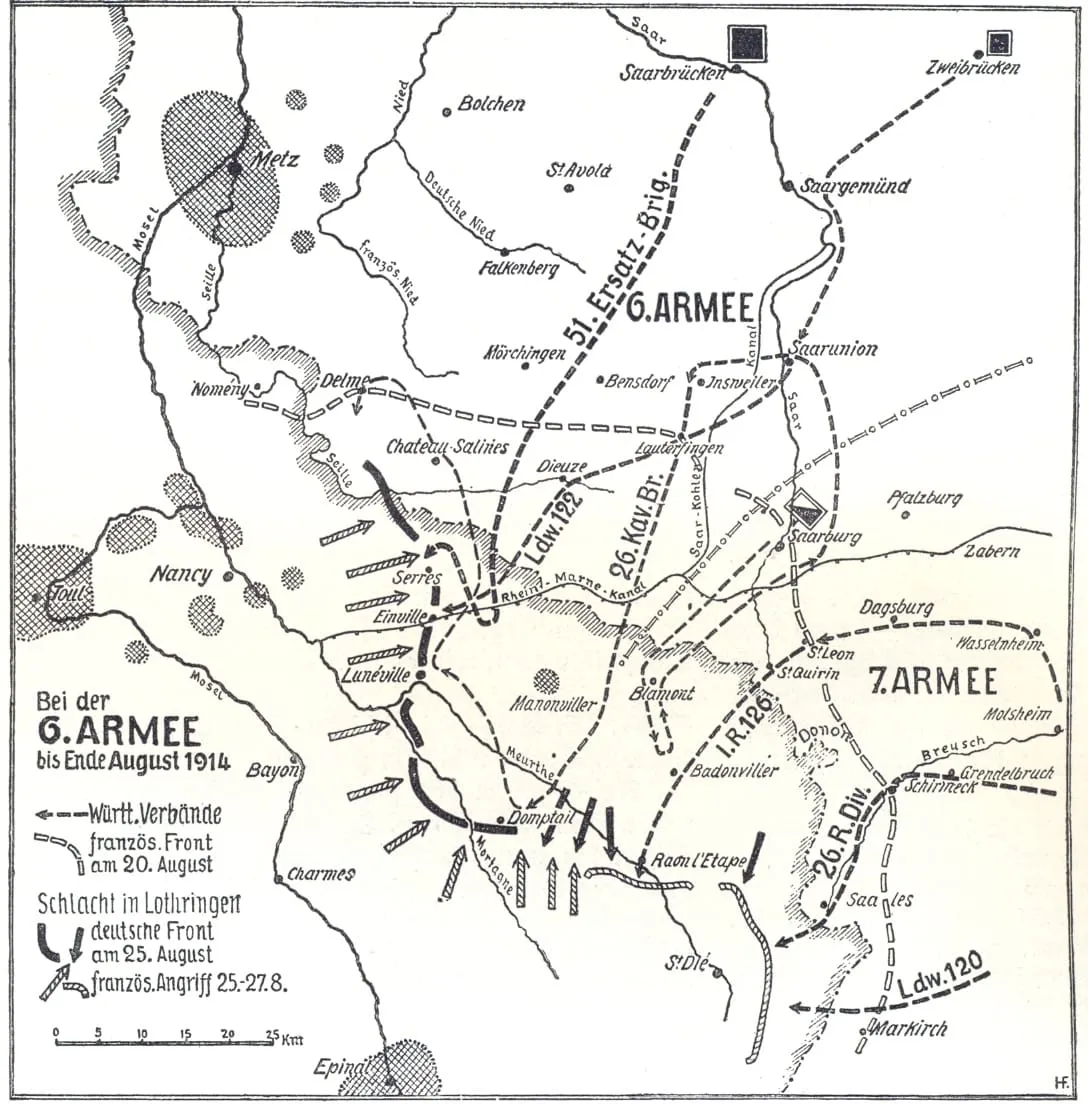
On 25 August 1914 in Lorraine, between the Moselle and the river Mortagne, the decisive day was fought of the battle which the British chronology of the war calls the Battle of the Mortagne and the French the battle of the Trouée de Charmes. The French Second Army of General Noël de Castelnau and First Army of General Auguste Dubail halted the German attack and went over to a counter-attack. While in the north the Allies were falling back before the German right wing, in the east France won one of its first victories.
After the defeat at Morhange
Five days earlier the French offensive in Lorraine had collapsed at Morhange and Sarrebourg (see End of the battles of Morhange and Sarrebourg). Both French armies withdrew behind the border, to the heights in front of Nancy and into the Mortagne valley. On their heels came the German Sixth Army of Crown Prince Rupprecht of Bavaria and the Seventh Army of General Josias von Heeringen. Around 22–23 August the Germans occupied Lunéville.
The Germans believed the French were beaten. They wanted to pass through the unfortified gap between the fortresses of Toul and Épinal, near the small town of Charmes on the Moselle. A breakthrough would have opened the way to the rear of the French armies. Castelnau, however, posted with his army on the heights west of Lunéville, noticed that the German columns were turning south and exposing their flank to him.
The crime at Gerbéviller
On 24 August the Germans crossed the Meurthe and the Mortagne. At the crossings they suffered heavy losses from French artillery fire. In the small town of Gerbéviller on the Mortagne, about sixty French chasseurs à pied defended the bridge against an entire German brigade for most of the day. After taking the town, German soldiers, convinced that the civilian population had fired on them, shot inhabitants and burned houses. According to various sources some 50–60 civilians were killed and the town burned almost entirely. In France Gerbéviller became a symbol of German atrocities in 1914.
That same afternoon Castelnau launched his first counter-attack north of Lunéville. The XX Corps of General Ferdinand Foch and neighbouring units retook several villages.
The day of decision
On 25 August fighting raged along the whole front. The greatest danger was at the village of Rozelieures, at the junction of the two French armies. In the morning German units drove the French VIII Corps out of it and came within about 10 kilometres of the Moselle. The Trouée de Charmes lay open.
Then the French artillery went into action. Several dozen quick-firing 75 mm guns, placed on a hill near Borville, poured a hail of shells on the attacking German troops. Chasseurs à pied and cavalry counter-attacked in the woods. In the afternoon the Germans, exhausted and out of ammunition, began to withdraw.
Castelnau reacted at once. He issued the order: “Forward everywhere, with all your strength!” (Fr. En avant partout, à fond!). The French corps came down from the heights to attack, retook Rozelieures and a number of villages and woods between the Moselle and the Mortagne, taking prisoners and capturing guns. On the right wing, Dubail’s First Army, fighting in the wooded Vosges mountains, advanced more slowly.
Fighting on the Mortagne
The exhausted French units were unable to turn victory into a rout. The Germans dug in on the heights between the Mortagne and the Meurthe and in front of Lunéville. The French attacked their positions for several more days. At the end of August they retook Gerbéviller and crossed the Mortagne, but further attacks, made against trenches protected by barbed wire and machine guns, brought only small gains at heavy cost. The British chronology gives 3 September as the end of the Battle of the Mortagne. French historians narrow the battle of the Trouée de Charmes itself to 24–26 August and treat the later fighting as its continuation.
On 27 August the commander-in-chief Joseph Joffre praised both armies in an order of the day for their tenacity and courage. From 1 September, with the front in Lorraine now secure, he began withdrawing corps from here and transferring them west.
Significance
The victory on the Mortagne was of enormous importance for the whole 1914 campaign. The Germans did not break the French defensive line in the east and did not reach the rear of the armies retreating from Belgium. The right wing of the French front, anchored on Nancy, Toul and Épinal, remained intact. Thanks to this Joffre could transfer troops from Lorraine to the Paris area without fear, where a few days later the Battle of the Marne began.
The German command did not, however, give up the offensive in Lorraine. On 4 September Rupprecht’s armies attacked Nancy and the heights of the Grand Couronné, but this time too they had no success. In French memory this defence of Nancy overshadowed the earlier victory at Rozelieures and in the Trouée de Charmes, although it was that victory which stopped the Germans at the most dangerous moment.
Remember the articles you have read? Only in this browser; nothing is sent anywhere.How it works
Read ·
Spotted a mistake?Report an error
Meanwhile
(04)Elsewhere in the same days.
- 25 August 1914 · Eastern FrontEnd of the Battle of KraśnikOn 25 August 1914 the Austro-Hungarian First Army took Kraśnik and the Russian Fourth Army fell back towards Lublin. It was Austria-Hungary's first victory.
- 25 August 1914 · Balkan FrontEnd of the first invasion of SerbiaAt the end of August 1914 the Serbs recaptured Šabac and the last Austro-Hungarian units withdrew across the Drina and Sava. The first invasion ended in defeat.
- 25 August 1914 · Asia and the PacificJapan breaks off diplomatic relations with Austria-HungaryOn 25 August 1914 Japan broke off diplomatic relations with Austria-Hungary. The ambassador, Baron Ladislaus Müller von Szentgyörgy, left Tokyo.
- 25 August 1914 · Asia and the PacificJapan declares a state of war with Austria-HungaryOn 25 August 1914 Japan and Austria-Hungary found themselves at war. The reason was the Austro-Hungarian cruiser Kaiserin Elisabeth, stationed at Tsingtao.
Related events
(04)The same battle, people or subject.
- 3 September 1914 · Western FrontEnd of the Battle of the MortagneOn 3 September 1914 the Battle of the Mortagne ended. The French held Lorraine, and the Germans prepared a new blow, this time against Nancy.
- 4 September 1914 · Western FrontBattle of the Grand Couronné beginsOn 4 September 1914 Crown Prince Rupprecht's army struck the Grand Couronné heights before Nancy. General Castelnau's French held the city for over a week.
- 14 August 1914 · Western FrontBattles of Morhange and Sarrebourg beginOn 14 August 1914 the French armies launched a great offensive in Lorraine. It began a series of battles that ended in defeat at Morhange and Sarrebourg.
- 27 September 1914 · Western FrontFirst Battle of Artois beginsOn 27 September 1914 the Race to the Sea reached Artois. The French and Germans began fighting for Arras, Lens and the heights that shaped the front for years.