Key event
Battles of Morhange and Sarrebourg begin
- Category:
- Military operations
- Front:
- Western Front
- Date:
- 14 August 1914
- Author:
- Łukasz Skowroń
- Battle:
- Battle of Lorraine
- Tags:
- Lorraine, France, Germany, Noël de Castelnau
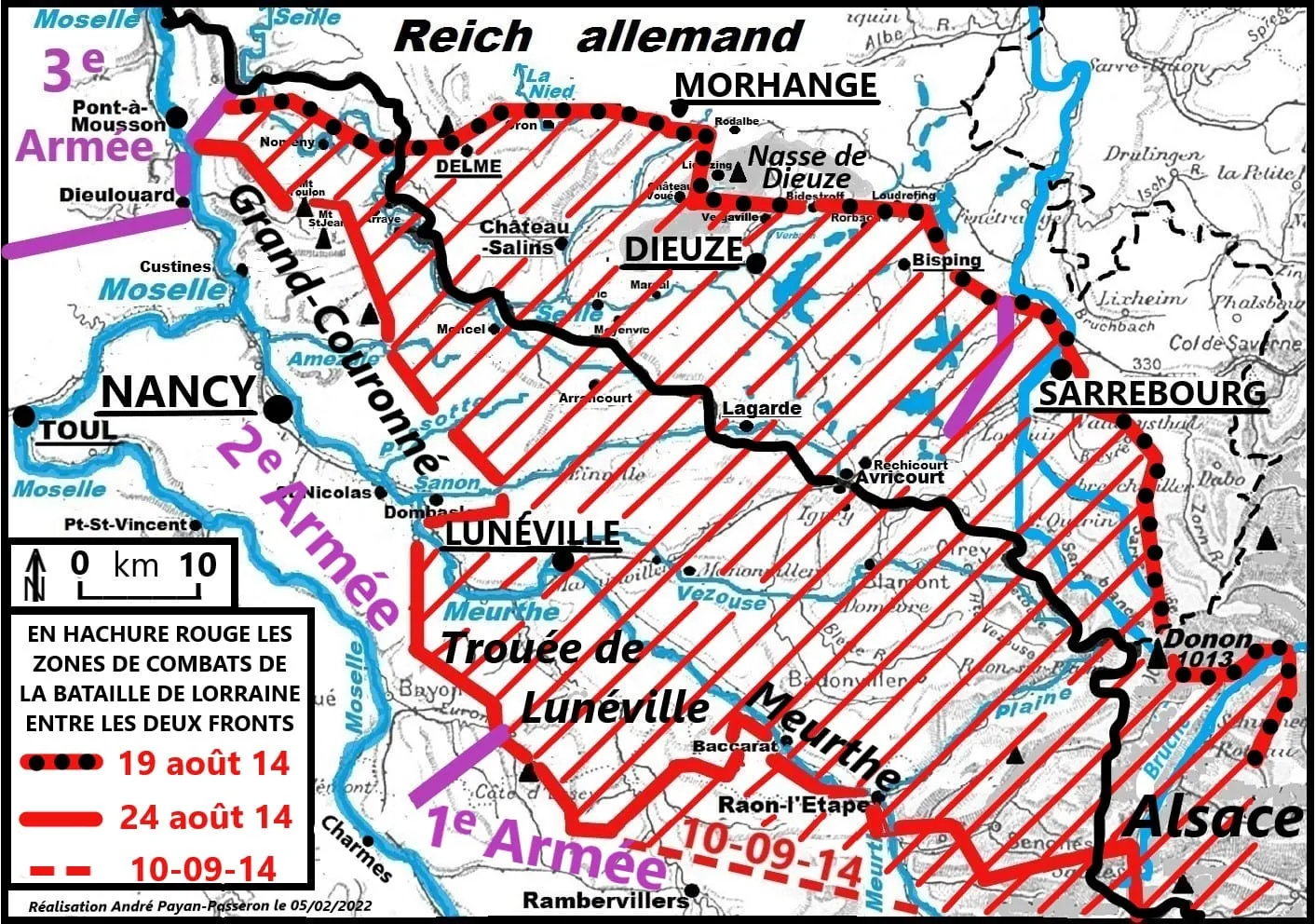
On 14 August 1914 the main offensive of the French army in Lorraine began. Two armies, General Auguste Dubail’s First Army and General Noël de Castelnau’s Second Army, crossed the frontier and advanced into the province France had lost in 1871. The fighting that then began later became known as the battles of Morhange and Sarrebourg.
The great offensive
The French war plan provided for a thrust eastwards, into Alsace and Lorraine. The commander-in-chief, Joseph Joffre, and his staff believed that a determined attack, pressed home with full commitment, would break the enemy’s defence, and the recovery of Lorraine, rich in coal and iron ore, mattered enormously to the whole nation. The first attempt, the capture of Mulhouse on 8 August, ended two days later in retreat. On the same 14 August a new Army of Alsace under General Paul Pau set off into Alsace again, in greater strength.
The offensive, however, started out weaker than planned. As early as 9 August Joffre, worried by German movements in Belgium, took two corps, the XVIII and IX, away from Castelnau. Castelnau protested in a note to headquarters, and in a letter to his son wrote bitterly that it was “a challenge to common sense” that “will cost us very dear”. He was left with three corps: General Ferdinand Foch’s XX Corps, the XV and the XVI, as well as a group of reserve divisions that was to cover the heights in front of Nancy.
The first day
On 14 August the Second Army crossed the river Seille, which had marked the Franco-German frontier since 1871. Its two right-hand corps advanced alongside Dubail’s army, while the left wing, with the group of reserve divisions, moved more slowly towards Morhange, guarding the offensive against an attack from the fortress of Metz. The First Army advanced with two corps into the Vosges, where since 8 August it had been taking one pass after another, and with two north-eastwards, on Sarrebourg.
The Germans fell back all day. The French took the Donon in the Vosges, and on the left of the First Army they advanced 10–12 kilometres. But the first day also brought a warning. At dusk the 26th Division of the XIII Corps attacked the small town of Cirey and was driven back by artillery and machine-gun fire with heavy losses. The next day the Second Army reported that German long-range artillery was shelling the French batteries and infantry undisturbed, and that dug-in German infantry was inflicting heavy losses on the attackers.
The trap
The French did not know how many enemies they faced. Headquarters believed that the Germans had thirteen to fifteen corps in the west, when in fact there were almost twice as many. Between Metz and the Vosges stood the German Sixth Army, commanded by the Crown Prince of Bavaria, Prince Rupprecht, and General Josias von Heeringen’s Seventh Army. According to the British official history they numbered together some 345,000 men and held down 456,000 French. Their task was to hold the French in Lorraine so that they could not shift forces to the north, and if strongly attacked to fall back to prepared positions between Strasbourg and Metz. The Sixth Army’s chief of operations, General Hermann von Mertz, wrote that if the French really did advance with great masses east of Metz, “it would not take much skill” to lead them to their ruin.
Over the following days the French pushed forward almost unopposed, taking among other places Château-Salins (PL) and Dieuze, and optimistic reports flowed to Paris. On 16 August Joffre, now convinced that the main German forces were advancing through Belgium, reclassified the offensive in Lorraine as a secondary attack, meant only to hold the enemy. On 20 August the Germans launched a massive counter-attack. The Second Army suffered a heavy defeat at Morhange, and the First Army had to fall back from Sarrebourg. The British official history, quoting a French report, wrote that the armies, tired by several days of marching and fighting, “came up against strongly organised positions, armed with powerful artillery”.
Significance
The offensive in Lorraine was the first great test of the French doctrine of the offensive at all costs, and it ended in its bloody failure. Together with the defeat in the Ardennes a few days later, it forced Joffre to change his plans and opened the way to the Great Retreat, which halted only on the Marne. At the same time the French managed to hold the heights in front of Nancy, which secured the right wing of their army.
Remember the articles you have read? Only in this browser; nothing is sent anywhere.How it works
Read ·
Sources
Spotted a mistake?Report an error
Meanwhile
(04)Elsewhere in the same days.
- 13 August 1914 · AfricaAllies advance on Kamina in TogolandOn 13 August 1914 British and French troops set out from Lomé into the interior of Togoland. Their objective was the German radio station at Kamina.
- 13 August 1914 · Balkan FrontAustrians cross the Drina and begin the first invasion of SerbiaIn mid-August 1914 the Austro-Hungarian Fifth Army crossed the Drina and struck Serbia from the west. The first invasion of Serbia had begun.
- 15 August 1914 · AfricaGermans occupy Taveta in British East AfricaOn 15 August 1914 a German detachment under Tom von Prince crossed the border of British East Africa and took Taveta at the foot of Kilimanjaro.
- 15 August 1914 · War at seaBritish and French squadrons join forces at the entrance to the AdriaticOn 15 August 1914 British and French warships joined forces at the entrance to the Adriatic to blockade the Austro-Hungarian fleet together.
Related events
(04)The same battle, people or subject.
- 4 September 1914 · Western FrontBattle of the Grand Couronné beginsOn 4 September 1914 Crown Prince Rupprecht's army struck the Grand Couronné heights before Nancy. General Castelnau's French held the city for over a week.
- 25 August 1914 · Western FrontBattle of the Mortagne beginsOn 25 August 1914 the armies of Castelnau and Dubail halted the German drive on the Trouée de Charmes in Lorraine and went over to a counter-offensive.
- 3 September 1914 · Western FrontEnd of the Battle of the MortagneOn 3 September 1914 the Battle of the Mortagne ended. The French held Lorraine, and the Germans prepared a new blow, this time against Nancy.
- 20 August 1914 · Western FrontEnd of the battles of Morhange and SarrebourgOn 20 August 1914 a German counter-attack in Lorraine shattered the French offensive. The French armies fell back towards Nancy with heavy losses.