1915: The autumn offensive – Loos and Champagne
Third Battle of Artois
- Dates:
- 25 September – 15 October 1915
- Front:
- Western Front
- Location:
- Artois north of Arras, between Angres, Souchez, Neuville-Saint-Vaast, Thélus and Vimy Ridge (Pas-de-Calais), FranceOn the battle map →
- Sides:
- FranceJoseph Joffre, Ferdinand Foch, Victor d'UrbalGerman EmpireErich von Falkenhayn, Rupprecht, Crown Prince of Bavaria
- Result:
- Inconclusive. The French took Souchez and part of the slopes of Vimy Ridge, advancing 1–3 kilometres, but did not take the ridge or break the front.
- Author:
- Natalia
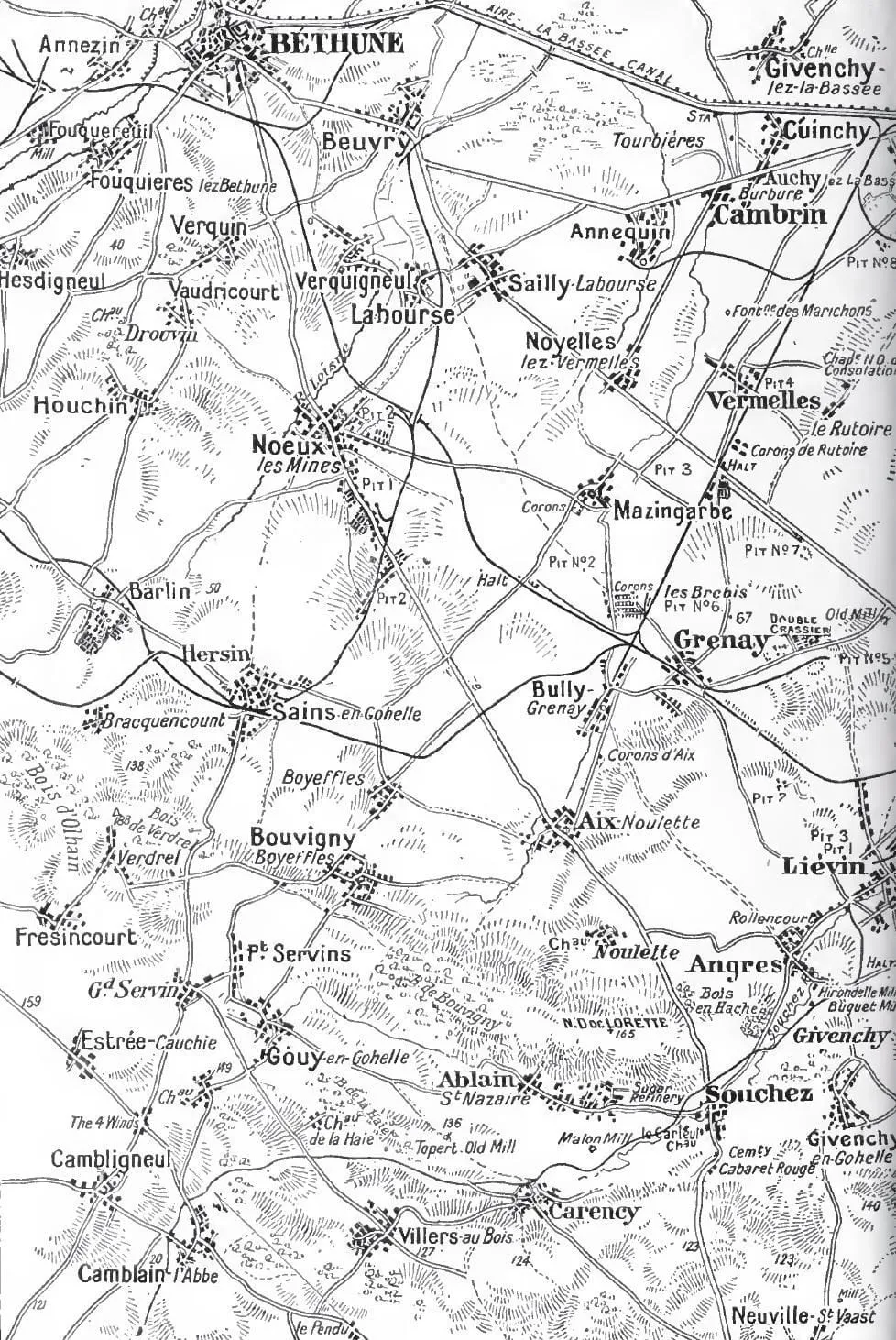
The Third Battle of Artois was the northern part of the great Allied autumn offensive on the Western Front in 1915. On 25 September General Victor d’Urbal’s French 10th Army struck for the third time at the German positions north of Arras, to take Vimy Ridge and open the way to the Douai plain. On the same day, on its left flank, the British attacked at Loos, and some 150 kilometres further south-east the main French attack began in Champagne. In Artois the attack was meant to be a subsidiary one, but General Ferdinand Foch was counting on a breakthrough. After several days of fighting the French took the ruined village of Souchez, which they had been fighting for since May, and briefly reached the highest point of Vimy Ridge. For more they lacked men and ammunition, and the high command preferred to save them for Champagne.
Name and dates
On this page we adopt the dates 25 September – 15 October 1915. The first day is not in doubt. As for the end, the British chronology of the war, on which our timeline is based, gives 15 October. According to the French official history, as summarised in the British official history, the 10th Army’s last attack went in on 11 October, and on 15 October General d’Urbal issued orders to fortify the captured ground for the winter. French losses in the battle were also counted up to that day. The English and German Wikipedias and some studies end the battle only on 4 November, because local fighting went on along the whole front of the German 6th Army until that date, and some English-language studies also mention 13 October.
The names vary. In Polish and English literature it is the Third Battle of Artois, after the fighting of the autumn of 1914 and of May and June 1915. The French speak of the autumn battle in Artois, and the Germans of the autumn battle of La Bassée and Arras (Herbstschlacht bei La Bassée und Arras), in which they also include the fighting against the British at Loos. The British attack has a name of its own, and we describe it separately.
Background
After the spring offensive in Artois the Germans held Vimy Ridge and fortified Souchez. Over the summer both sides strengthened their positions. Behind the first line the Germans prepared a second position, which in Artois lay close to the edge of the ridge, often on the reverse slopes, out of sight of French observation. Meanwhile in the east the Russians were retreating from the Kingdom of Poland, and in August the Germans took Warsaw. The commander-in-chief of the French army, General Joseph Joffre, decided that he had to strike before the Germans moved troops back to the west. The British hesitated for a long time, and at the Calais conference in July they proposed confining themselves to defence, but in August the Secretary of State for War, Lord Kitchener, agreed to the British Expeditionary Force taking part in the autumn offensive.
Joffre’s plan provided for two simultaneous attacks. The main one was to be made in Champagne by two armies under General Noël de Castelnau, and the second, in Artois, by the 10th Army and General Douglas Haig’s British First Army, on either side of the mining town of Lens. Once both fronts were broken, the cavalry was to drive deep into the enemy’s rear, in Artois as far as the Belgian border. Between the French and British armies, opposite Lens and Liévin, there remained a passive sector, which was expected to fall of its own accord once the attacks from north and south forced the Germans to retreat.
D’Urbal wanted to proceed step by step: first take Souchez and the other “keys” of the position, and only two days later strike at the ridge. Foch, commanding the French armies in the north, demanded instead an immediate strategic breakthrough towards Douai, without stopping to widen the breach. Remembering 9 May, when success had been wasted because the reserves were too far back, the French this time placed their reserves close to the front. According to the French official history the 10th Army had 17 active and 2 territorial divisions, about 670 field guns and 420 heavy guns, and the I Cavalry Corps in reserve. Facing it stood mainly the VI Corps of the German 6th Army of Rupprecht of Bavaria, roughly three times weaker on the sector of the attack.
Course
21–24 September. For four days, day and night, the French artillery shelled the German trenches, wire and batteries. The field guns were above all to cut the wire, and the heavy guns to destroy machine-gun nests, fortified houses and observation posts. About 1,200 rounds were prepared for each field gun, but there was still too little heavy artillery and ammunition for it to destroy the whole German position.
25 September. The British attacked at dawn, the French only in the afternoon. Foch ordered the infantry to go forward four hours after the artillery could see the German second position. The French official history gives the time of the attack as 12.45 p.m., while a British liaison officer reported 12.25 p.m. Things went best on the left flank, next to the British. General Paul Maistre’s XXI Corps took the Bois en Hache between Souchez and Angres and reached the Souchez stream, and its 13th Division broke into the village. The two left-hand divisions of General Émile Fayolle’s XXXIII Corps took the first line of German trenches, while the third was stopped by fire. Further south the III and XII Corps held only fragments of the German first line, and the attacks just outside Arras were repulsed. In the afternoon it began to rain, which hampered artillery observation. At about 3.30 p.m. d’Urbal, wrongly believing that the edge of the Vimy plateau had been taken, called up the cavalry and a reserve division, but they did not reach the front line in time. During the night the Germans retook the Bois en Hache.
26–27 September. In the morning Joffre, to whom the reports from Champagne seemed promising, instructed Foch not to force Vimy Ridge, to save ammunition and to limit the attacks, but in such a way that the British would not feel they had been left alone. The 10th Army attacked again around noon. The XXI Corps retook the Bois en Hache and crossed the Souchez stream, and the XXXIII Corps took the village of Souchez and the cemetery. The French Wikipedia states that the Germans finally cleared Souchez on 27 September, but most sources say the village was taken on 26 September. In the south the XII Corps’ report that it had taken the hamlet of Les Tilleuls proved false. On 27 September progress was negligible, and d’Urbal, on Foch’s orders, halted the attacks of the four corps of the centre and the right flank.
28–29 September. On 28 September the French attacked the ridge once more. Units of the XXXIII and III Corps took the southern part of La Folie wood on the slopes of the ridge, and at about 3 p.m. part of the 6th Division of the III Corps reached Hill 140, the highest point of Vimy Ridge. The Germans moved most of the Guard Corps into the area; it had arrived from the Eastern Front and was meant to counter-attack the British at Loos. The counter-attacks drove the French off the highest part of the ridge. Foch forbade the use of the last reserve division to exploit the success and decided to break off the attack, so as to prepare a new joint attack with the British. In five days of fighting the 10th Army lost nearly 37,000 men.
October. The joint attack was postponed several times. The French IX Corps took over from the British the sector right at Loos-en-Gohelle and Hill 70, and downpours turned the battlefield into mud. On 8 October the Germans counter-attacked between Loos and the La Bassée canal, but were repulsed with heavy losses. On 11 October the 10th Army attacked Vimy Ridge on its own. The attack cost about 2,200 men and gained only a small strip of ground. Foch wanted to renew it, because the French troops stood just below the ridge, in a position it completely dominated. Joffre, however, for lack of ammunition, especially for the heavy guns, would not agree to any further large operations either in Artois or in Champagne. On 15 October d’Urbal ordered the captured ground to be fortified for the winter.
Losses
According to the French official history, from 25 September to 15 October the 10th Army lost 1,250 officers and 46,980 other ranks, 48,230 men in all, less than half its losses in the spring battle in Artois. The historian Elizabeth Greenhalgh states that 18,657 of them were killed or missing. The French took about 2,000 prisoners. German losses are hard to separate from those in the fighting against the British. The German official history puts them, for the whole autumn battle in Artois and at Loos up to the end of October, at about 51,000, and the British official history, based on German lists, at about 56,000. The French Wikipedia estimates German losses on the French sector alone at about 30,000 men.
Significance
The French advanced 1–3 kilometres on a front several kilometres wide and took Souchez, but Vimy Ridge remained in German hands and the front was not broken. As in May, the most ground was gained on the first day, and then German reserves, including the Guard brought from the east, closed the breach. The commander of the XXXIII Corps, Fayolle, considered the battle a failure, caused by uncut wire and the fire of German machine guns and artillery. Joffre treated Artois from the outset as a secondary sector, and as early as 26 September he limited the attack here in favour of Champagne. Foch and the British, who at Loos had counted on stronger French support, took this decision with bitterness, and the mutual recriminations weighed on relations between the allies long after the battle.
For the Germans the defence of Artois was a success, and according to German sources Rupprecht of Bavaria earned for it the epithet “the victor of Arras and La Bassée”. In the winter of 1915–1916 the French held on in the mud below the ridge. In the spring of 1916 the British took over the sector, and Vimy Ridge was taken only by the Canadians in April 1917, in the Battle of Vimy Ridge.
Spotted a mistake?Report an error