Key event
Start of the Battle of Verdun
- Category:
- Military operations
- Front:
- Western Front
- Date:
- 21 February 1916
- Author:
- Łukasz Skowroń
- Battle:
- Battle of Verdun
- Tags:
- France, Germany, Erich von Falkenhayn, Joseph Joffre
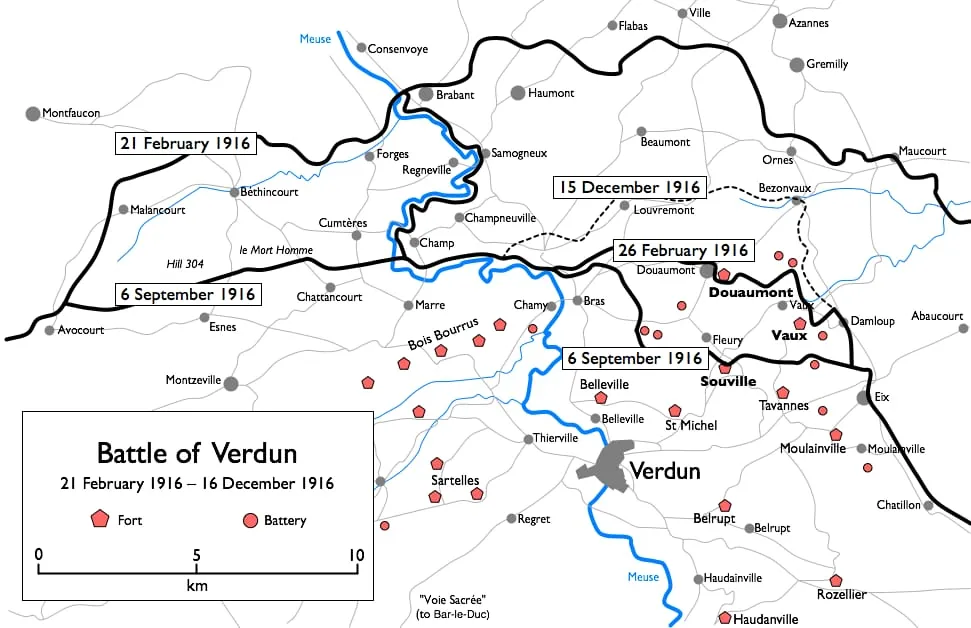
On the morning of 21 February 1916 the German artillery opened fire on the French positions north of Verdun, an old fortress on the Meuse. The bombardment from more than twelve hundred guns lasted all day, and in the afternoon the German infantry moved forward to attack. So began a battle which, with pauses, lasted until December 1916, claimed hundreds of thousands of casualties on both sides and became for the French the symbol of the whole war. The first days belonged to the Germans: within four days they broke through two French lines of defence and stood at the foot of the forts, and the French high command went through one of the gravest crises of the war.
Why Verdun
After the failed Entente offensives of 1915, including the autumn battle in Champagne, the chief of the German General Staff, Erich von Falkenhayn, concluded that mass attempts to break through the front in the west had no chance of success. He regarded Britain as Germany’s main enemy, but its troops in Flanders did not seem to him a good target for a winter offensive. He therefore decided to strike at France, “England’s best sword”. In his memoirs, published in 1919, he quoted a memorandum which he was said to have presented to Emperor Wilhelm II around Christmas 1915. In it he wrote that France was already close to the limit of its endurance and that within reach of the German armies lay places for whose retention the French command would throw in every soldier. If it did so, “the forces of France will bleed to death”, whether or not the Germans reached their objective. The choice lay between Belfort and Verdun. Falkenhayn chose Verdun.
This version of events, however, raises doubts. The original of the memorandum has never been found, and the German historian Holger Afflerbach (PL), Falkenhayn’s biographer, and other scholars believe that the text in this form was written only after the war, to give meaning to a failed battle. The commanders of the army that attacked Verdun later denied that anyone had spoken to them of “bleeding” the French white; they rather expected to take the fortress. General Philippe Pétain, who defended Verdun, wrote years later that Falkenhayn “aimed higher than he cares to admit in writing”.
Whatever Falkenhayn’s real intentions, the choice of place had solid grounds. Since 1914 Verdun had lain in a salient of the front, surrounded by the Germans on three sides. The capture of Saint-Mihiel in September 1914 had cut the railway to the south, and in 1915 German fire from the Argonne blocked the main line to the west. The French were left with a narrow-gauge railway from Bar-le-Duc and a single road. The Germans, meanwhile, had a dense network of railways behind them, and the wooded ravines north of the town allowed them to hide their preparations. Verdun was also a special place for the French: a fortress they could not give up without a great shock.
Operation “Gericht”
The attack was entrusted to the 5th Army, commanded by Crown Prince Wilhelm but in practice directed by its chief of staff, General Konstantin Schmidt von Knobelsdorf. The orders, at first given only orally for the sake of secrecy, arrived just before Christmas. The operation was given the code name “Gericht” (court, judgement). Falkenhayn limited the attack to the right, eastern bank of the Meuse, although the 5th Army staff wanted to attack on both banks at once. He kept some of the reserves at the disposal of the Supreme Army Command, because he expected the Entente to respond with a relief offensive elsewhere on the front and wanted the means to repel it.
Preparations went on from January. The III Corps, the VII Reserve Corps and the XVIII Corps were brought up to the front, and they put six divisions into the first attack on a narrow sector from the Meuse to Ornes. Two divisions of the XV Corps were to widen the attack to the east in the following days. Engineers built new railway lines and stations, and dug deep shelters in the ground, the so-called Stollen, in which the infantry could wait for the attack unseen from the air. According to various calculations the Germans concentrated between 1,200 and 1,225 guns at Verdun, most of them heavy and super-heavy, including the 420 mm mortars which in 1914 had shattered the forts of Liège, and long-range 380 mm naval guns. Stocks were prepared for firing about two million shells in the first six days. Companies of flamethrowers were also sent to the 5th Army, a weapon the Germans had first used at Verdun a year earlier. To divert the attention of the French, other German armies carried out a series of local attacks from Artois to Alsace in January and February.
A fortress without guns
Since the Franco-Prussian War Verdun had been surrounded by two rings of forts, the largest of which was Fort Douaumont. After the fall of the Belgian and French fortresses in 1914, however, the French high command lost faith in forts. In August 1915 Verdun ceased to be a fortress in the old sense: the Fortified Region of Verdun (Région fortifiée de Verdun) was created under the command of General Frédéric-Georges Herr, and most of the guns and ammunition were removed from the forts for the needs of the field front. Only the guns in armoured turrets and small garrisons remained in the forts, and some works were prepared for demolition. The trench lines that were to replace the forts were built slowly, because men and equipment were being sent to Champagne.
On the sector the Germans had chosen for the attack, between the Meuse and the heights near Ornes, Herr had the 72nd and 51st Infantry Divisions of General Paul Chrétien’s XXX Corps. According to Pétain they were supported by about 130 field guns and about 140 heavy guns, most of them of old pattern. General Fernand de Langle de Cary, commander of the Centre Army Group, advised against crowding soldiers into the front lines, which the artillery would smash anyway, but the rear positions had not been completed in time.
Driant’s warnings
The loudest voice warning of Verdun’s weakness was that of Lieutenant-Colonel Émile Driant. A sixty-year-old officer, son-in-law of General Boulanger and author of popular novels about a future war written under the pen name “Capitaine Danrit”, he had been deputy for Nancy since 1910 and a member of the army committee of the Chamber of Deputies. Since 1914 he had commanded two battalions of chasseurs à pied (PL), the 56th and 59th, which in the autumn of 1915 held the Bois des Caures north of the town. His alarming reports about disarmed forts and unfinished trenches reached the government. President Raymond Poincaré asked the Minister of War, Joseph Gallieni, to look into the matter, and in mid-December Gallieni wrote to General Joseph Joffre asking about the state of the defences. The commander-in-chief replied sharply that he could not tolerate soldiers under his command complaining to the government over the heads of their superiors.
At the end of January, however, Joffre sent his chief of staff, General Noël de Castelnau, to Verdun, and he ordered the defences on the right bank of the Meuse to be strengthened. Warnings were also coming in ever more often. The Deuxième Bureau, French military intelligence, and airmen reported movements of troops and artillery, and deserters, often Alsatians and Lorrainers, spoke of cancelled leave and an approaching attack. French air reconnaissance, however, found none of the usual jumping-off trenches, because the German infantry was waiting in the Stollen. Joffre was absorbed in planning a great joint offensive with the British, agreed at the Chantilly conference and finally planned on the Somme, and for a long time believed that the Germans would rather strike at Russia. As late as 18 February, according to Pétain, he was considering in correspondence with Douglas Haig how the allies would help the Russians if the Germans attacked in the east. Even so, he reinforced Verdun with two divisions and kept the VII and XX Corps in reserve nearby.
A week’s delay
The attack was set for 12 February. That day the Crown Prince issued an order of the day in which he wrote that the fatherland expected “great things” of the soldiers and that the German army, when it moves to the attack, “stops at no obstacle”. The ground along the Meuse, however, was sodden from constant rain, snow was falling, and low cloud and fog made artillery observation impossible. The attack was postponed day after day. For more than a week thousands of soldiers waited crowded in damp shelters, while the French gained time to bring up reinforcements and finish some of the works. On 20 February Driant wrote to his wife that the hour was near and that he felt a certain satisfaction, because he had not been wrong in his predictions. Only when the weather improved did the Germans set a new date for the attack.
The bombardment of 21 February
Most accounts state that the German artillery opened fire on 21 February at 7.15 a.m. The bombardment covered a front about 40 kilometres long, on both sides of the Meuse as far as the Woëvre plain, although the infantry was to attack on a much narrower sector. Long-range guns shelled Verdun itself, the bridges over the Meuse and the approach roads. According to many accounts one of the first large-calibre shells fell in the courtyard of the bishop’s palace in the town. The army evacuated the last inhabitants of Verdun on 25 February.
The heaviest fire fell on the woods of Haumont, Caures, Ville and Herbebois, where the first French lines stood. On the Bois des Caures alone, a sector little more than a kilometre long, about 80,000 shells fell according to French estimates. The bombardment lasted about nine hours. Gas shells also landed in the trenches and ravines. Trenches and communication passages were levelled, shelters collapsed, burying soldiers, and the wood turned into a tangle of broken trunks. Pétain later wrote that in the triangle between Brabant, Ornes and Verdun more than two million shells fell in the first days and that “never before, on any front, in any battle” had anything like it been seen. German aircraft, concentrated over Verdun in previously unheard-of numbers, ruled the air for the first days and closed the sky to French reconnaissance.
The infantry attack
At about 4 p.m. French time (in Germany the clocks showed an hour later) the fire lifted to the rear and the first units of the III Corps, the VII Reserve Corps and the XVIII Corps moved forward to attack, on the sector from the Bois d’Haumont to Ornes. French accounts give the time of the attack variously, from 4 p.m. to 4.45 p.m. The German orders for the first day were cautious: strong patrols with engineers, flamethrowers and grenades were to reconnoitre the damage, take the forward trenches and prepare the ground for the main assault the next day. That is why Falkenhayn in his memoirs dates the infantry attack only to 22 February. The Germans expected to walk across dead ground after such a bombardment, but stunned and wounded Frenchmen came out of the ruined trenches and opened fire from surviving machine guns.
The furthest advance was made by General Johann von Zwehl’s VII Reserve Corps, which, contrary to instructions, threw its main forces into the fight. After several hours of fighting it took the Bois d’Haumont, in which little remained of the two French battalions. To its right, regiments of the German 21st Division ran into Driant’s chasseurs in the Bois des Caures. According to Pétain about 1,200 men, supported by a dozen or so batteries, stood here against eight to ten thousand attackers. The chasseurs of the 59th Battalion, which was in the front line, lost some of their positions, but in the evening Driant brought the 56th Battalion into the fight, and during the night the chasseurs counter-attacked and regained most of the lost trenches. Towards evening it began to snow. On the first day the Germans took only the Bois d’Haumont and the forward trenches, but they lost few men, and the French front line was destroyed.
The first days
On 22 February the bombardment resumed and the assault went forward along the whole sector. The Germans took the village of Haumont and surrounded the Bois des Caures on both sides. In the afternoon Driant ordered the remnants of his battalions to fall back towards Beaumont. During the withdrawal he was killed by a bullet. Of his two battalions, little more than a hundred chasseurs reached the French lines; the rest were killed, wounded or taken prisoner. The resistance in the Bois des Caures, which lasted almost a full day, nevertheless delayed the German advance, and Driant became the first hero of Verdun.
On 23 February there was fighting for the woods of Herbebois and Wavrille. The Germans took Brabant on the Meuse, and during the night Samogneux fell. On 24 February the second French position collapsed: the Germans took Hill 344, the Bois des Fosses, Beaumont and Ornes. In four days they had advanced several kilometres, and the 51st and 72nd Divisions were in disarray. That day the first reinforcements arrived, the 37th Division of the VII Corps and brigades of General Maurice Balfourier’s XX Corps, thrown into the fight straight from the march. De Langle de Cary ordered the troops to be withdrawn from the Woëvre plain to the heights above the Meuse, and at headquarters there was even talk of giving up the whole right bank of the river.
On the evening of 24 February Castelnau obtained Joffre’s consent to send General Pétain’s 2nd Army to Verdun, and he himself drove to the Meuse during the night. According to the British historian Robert Foley, by 26 February the French had lost about 24,000 men and the Germans about 25,000.
What the following days brought
The next day, 25 February, the German infantry entered Fort Douaumont almost without a fight; it was defended by a handful of soldiers. In Germany a great victory was celebrated, while in France the news caused a shock. Castelnau, however, ordered the right bank of the Meuse to be held, and on the night of 25–26 February Pétain took over command at Verdun. Under his leadership the defence steadied, and the German assault, whose infantry had moved away from its own heavy artillery, began to weaken. The battle, which was meant to last a few weeks, turned into a struggle of attrition lasting almost ten months.
Remember the articles you have read? Only in this browser; nothing is sent anywhere.How it works
Read ·
A voice from the front
“A little while ago came the news that the attack had been put off for another 24 hours, and soon afterwards the word that it is now fixed for the 20th. That seems to be final, although there is no prospect of the weather improving. We are to go with packs, by the way, leaving behind everything we can do without. I take leave of you, my beloved Parents and Brother, from the depths of an overflowing heart; thanks, heartfelt thanks for all you have done for me.”
Translated · Original (de)
Vorhin kam die Nachricht, daß der Angriff weiter um 24 Stunden verschoben, und bald darauf die Parole, daß er nunmehr auf den 20. festgesetzt sei. Das scheint definitiv zu sein, trotzdem keine Aussicht auf eine Besserung des Wetters besteht. Übrigens soll es mit Tornister gehen, unter Zurücklassung alles Entbehrlichen. Ich nehme Abschied von Euch, Ihr geliebten Eltern und Bruder, aus tiefstem, übervollem Herzen; Dank, innigen Dank für alles, was Ihr an mir getan.
Spotted a mistake?Report an error
Meanwhile
(04)Elsewhere in the same days.
- 21 February 1916 · War at seaDispute in Congress over armed merchant shipsIn late February 1916 Berlin maintained that armed Entente merchantmen were auxiliary cruisers. In the US Congress a revolt against Wilson's line grew.
- 21 February 1916 · MilitaryDismissal of Henry SclaterOn 21 February 1916 Gen. Henry Sclater ceased to be Adjutant-General of the British Army. His place at the War Office was taken by Nevil Macready.
- 22 February 1916 · MilitaryMacready appointed Adjutant-GeneralOn 22 February 1916 General Nevil Macready became Adjutant-General of the British Army. At the War Office his main task was to find men for the front.
- 23 February 1916 · PoliticsPortugal seizes German shipsOn 23 February 1916, at Britain's request, the Portuguese seized 36 German and Austrian ships that had lain in the Tagus off Lisbon since the start of the war.
Related events
(04)The same battle, people or subject.
- 25 February 1916 · Western FrontGermans capture Fort DouaumontOn 25 February 1916 a few dozen Brandenburgers walked without a shot into Fort Douaumont, the largest fort of Verdun, held by a handful of Frenchmen.
- 25 September 1915 · Western FrontSecond Battle of Champagne beginsOn 25 September 1915 two French armies attacked in Champagne. They took the German first line and 14,000 prisoners, but the second position stopped the attack.
- 23 June 1916 · Western FrontGermans capture ThiaumontOn 23 June 1916, after a night bombardment with shells of a new gas, the Germans took the Thiaumont work and Fleury, a few kilometres from Verdun.
- 10 December 1915 · Western FrontCastelnau becomes Joffre's chief of staffOn 10 December 1915 General Noël de Castelnau, who had led the Champagne offensive, became chief of staff and deputy to Joffre, the French commander-in-chief.