1914: First clashes and the Battles of the Frontiers
Battle of Liège
- Dates:
- 4–17 August 1914
- Front:
- Western Front
- Location:
- Liège and the ring of forts in the Meuse valley, BelgiumOn the battle map →
- Sides:
- German EmpireOtto von Emmich, Erich LudendorffBelgiumGérard Leman
- Result:
- German victory. The last forts fell on 16 and 17 August.
- Author:
- Łukasz Skowroń
The Battle of Liège was the first major engagement on the Western Front. It began on 4 August 1914, the day of the German invasion of Belgium, and lasted until 16–17 August, when the last Belgian forts fell.
A fortress on the road to France
Liège lay in the valley of the Meuse, on the main road leading from Germany into the heart of Belgium, in a narrow corridor between the Dutch border and the Ardennes. This was the way the right, strongest part of the German army had to pass, which under the Schlieffen Plan was to encircle the French army. The city was protected by a ring of twelve forts designed at the end of the 19th century by the Belgian engineer Henri Brialmont. They were concrete, partly underground fortifications placed a few kilometres from the city centre. The fortress of Liège was considered one of the most modern in Europe.
The Germans did not intend to conduct a long siege. A special force of six brigades under General Otto von Emmich was to take the city with a swift blow before the Belgians could prepare it for defence. The defence was directed by General Gérard Leman.
Course of the battle
On 4 August German troops crossed the border at Gemmenich and moved towards the Meuse. On the night of 5–6 August they attacked in the gaps between the forts, suffering heavy losses from the fire of Belgian infantry and artillery. On 6 August a German airship appeared over the city and dropped bombs on Liège, killing several civilians.
One of the brigades managed to break through the line of defence. When its commander was killed, the staff officer Erich Ludendorff took over its direction. On 7 August his soldiers entered the city and occupied the citadel. King Albert I had earlier withdrawn the Belgian field division from Liège to prevent its encirclement. The forts, cut off from one another, nevertheless continued to hold out.
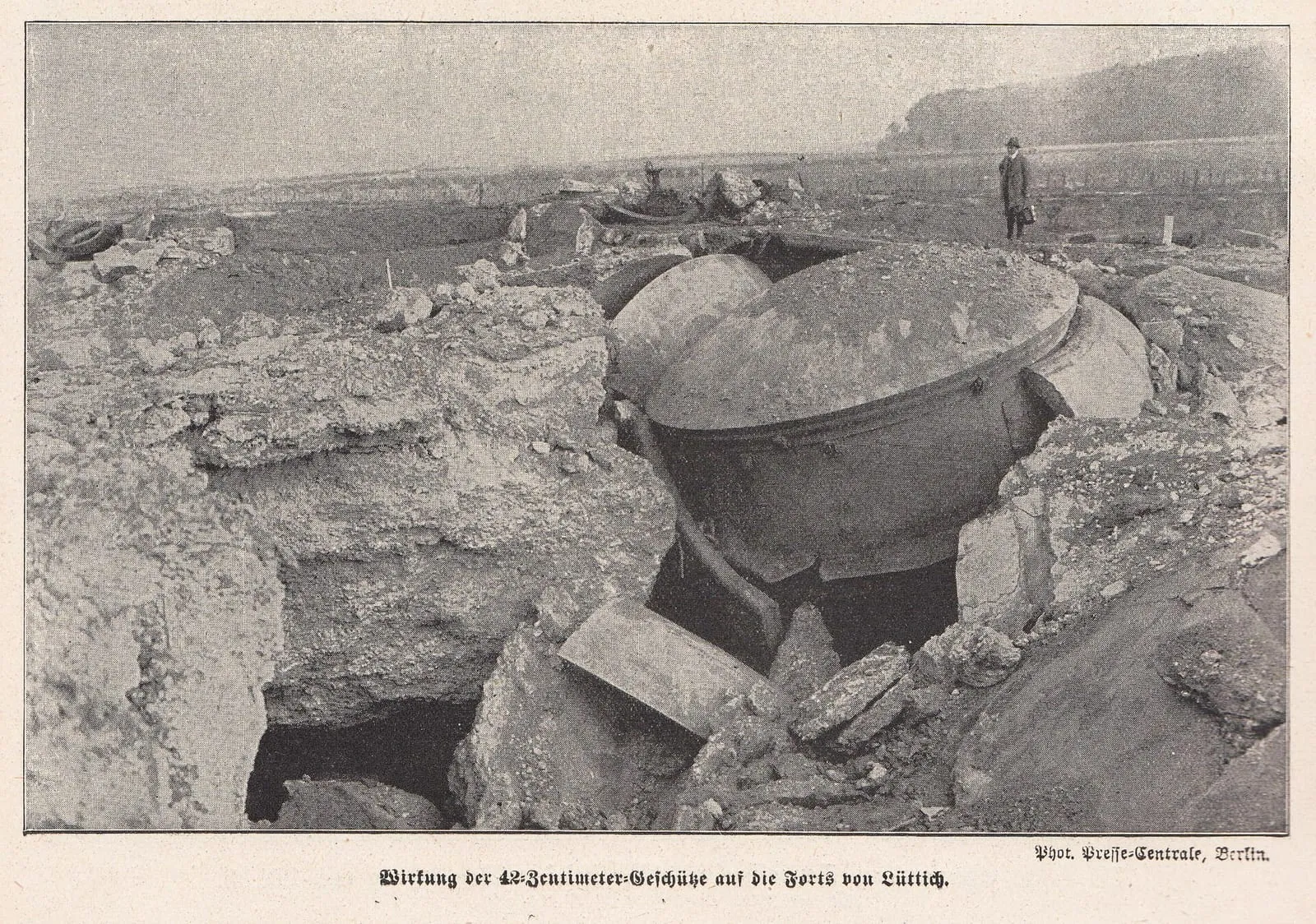
To destroy them the Germans brought up heavy siege artillery: 420 mm mortars, known as “Big Berthas”, and Austro-Hungarian 305 mm Škoda mortars. From 12 August their shells smashed the concrete vaults of the forts. On 15 August a shell hit the ammunition store of Fort Loncin. The explosion destroyed the fort and buried a large part of the garrison, and General Leman, badly concussed, was taken prisoner. The last forts capitulated on 16 and 17 August.
Significance
Liège fell, but its defence became a symbol of Belgian resistance. France awarded the city the Legion of Honour, and in Paris the Rue de Berlin was renamed Rue de Liège. Historians still argue over how much the fighting delayed the German advance. It certainly showed, however, that Belgium would not let the Germans through without a fight, and it gave France and Britain a little time to prepare.
The battle also revealed a new face of war. Concrete forts, until then considered impregnable, could not withstand the fire of modern heavy artillery. A similar fate soon awaited the fortress of Namur, which fell on 25 August.
Spotted a mistake?Report an error