Key event
Second Battle of Champagne begins
- Category:
- Military operations
- Front:
- Western Front
- Date:
- 25 September 1915
- Author:
- Natalia
- Battle:
- Second Battle of Champagne
- Tags:
- France, Germany, Joseph Joffre, Noël de Castelnau
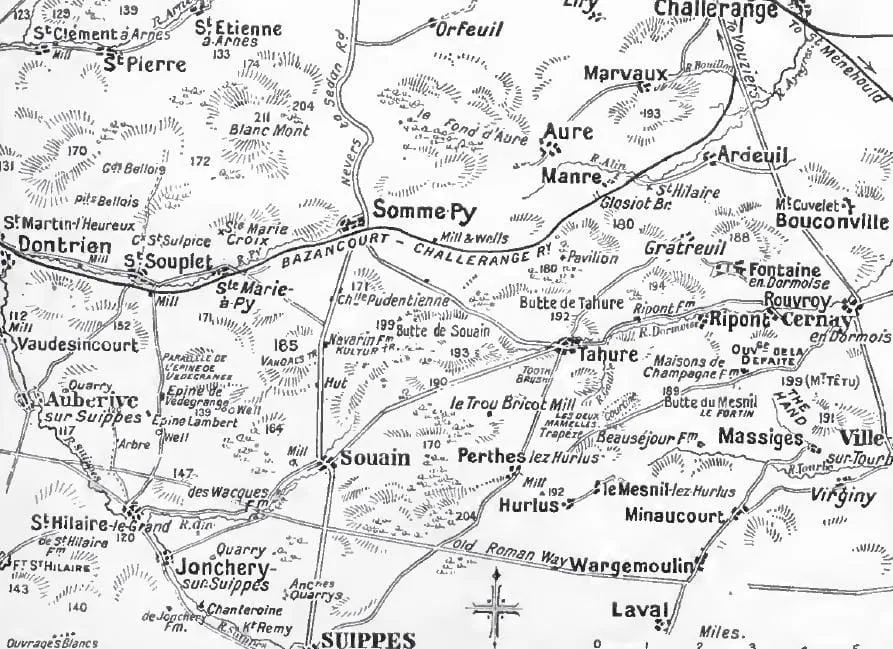
At 9.15 a.m. on 25 September 1915, after three days of bombardment, the French infantry went over to the attack in Champagne, east of Reims. So began the Second Battle of Champagne, the main part of the great Allied autumn offensive in the west. A few hours later and about 150 kilometres further north-west the French Tenth Army attacked, and earlier still that morning the British at Loos. The commander-in-chief of the French army, General Joseph Joffre, hoped for a breakthrough in Champagne that would force the Germans to retreat from France and relieve the Russians retreating in the east. In his order of the day of 23 September he told the soldiers that their onrush would be irresistible and would carry them at one stroke to the German batteries, beyond the enemy’s fortified lines.
The largest attack since the start of the war
For the attack General Noël de Castelnau, commander of the Army Group Centre, prepared two armies: the Fourth Army of General Fernand de Langle de Cary on the left wing and the Second Army of General Philippe Pétain on the right. On a front some 25–30 kilometres long, from Aubérive to Ville-sur-Tourbe, 20 divisions stood in the first line, with seven more behind them, and six cavalry divisions waited in reserve to ride out into the open through the gap. Each division attacked on a sector little more than a kilometre wide, in deep formation, wave after wave. From 22 September more than a thousand guns and trench mortars smashed the German trenches and wire, while heavy guns shelled roads and railway stations in the rear.
Facing them stood the German Third Army of General Karl von Einem, with seven divisions on the attacked sector and no substantial reserves. From the higher hills the Germans could see the French preparations and expected an attack. They had withdrawn most of their field artillery behind the second position, built largely on reverse slopes, and intended to make their main stand there. The Chief of the General Staff, General Erich von Falkenhayn, did not, however, believe in a great offensive. According to German sources, as late as the morning of 25 September he assured the Kaiser that the Third Army was taking too gloomy a view of the situation and that the French were no longer capable of attacking.
Rain and the first line
During the night heavy rain began to fall and did not stop until noon. It grounded the aircraft directing artillery fire and turned the chalk battlefield into mire. Even so, the first German line gave way on most sectors. Some regiments went into the attack with colours unfurled and bands playing. On the left wing the Fourth Army’s attack stalled before the fortifications of the Épine de Vedegrange and the Wacques farm, but in the centre the II Colonial Corps crossed the trenches by the road from Souain to Somme-Py and approached the Navarin farm. The corps of the Second Army crossed the road from Souain to Tahure and halted before the Bois Jaune wood and the Butte du Mesnil hill. On the right wing the I Colonial Corps broke into the Main de Massiges, a group of hills that from above resembled a hand with outspread fingers, which the Germans had been fortifying for months. That day General Jean-Baptiste Marchand, known from the Fashoda incident of 1898 and commander of a colonial division, was seriously wounded in the stomach.
The French broke through the first line in four places and in places advanced 3–4 kilometres. According to the French official history, they took about 14,000 prisoners that day and captured many guns.
Before the second position
By evening only two of the breaches reached the German second position. There the attackers ran into intact wire, which the artillery could not destroy because it could not see it, and into machine-gun fire. In the rear further waves of infantry and the cavalry waiting for the breakthrough crowded together. Joffre, judging the results promising, assigned Castelnau two reserve divisions and ordered the armies in eastern France to send to Champagne all their 75 mm ammunition beyond 500 rounds per gun. Pétain and de Langle de Cary issued orders to resume the attack the next morning.
On the German side there was alarm. The Third Army’s chief of staff proposed falling back a few kilometres, and Falkenhayn soon replaced him with Colonel Fritz von Loßberg, who ordered the second position to be held at all costs. Further divisions set off for Champagne from the reserves and from the Eastern Front. In the following days the French reached the second position on a wide sector and once managed to break through it, but German counter-attacks closed the breach. The breakthrough Joffre had hoped for did not come.
Remember the articles you have read? Only in this browser; nothing is sent anywhere.How it works
Read ·
Voices from the front
“My regiment attacks tomorrow and my company is in the front line. That is to say, my beloved ones, that I am approaching one of the most solemn hours of my life. […] He who searches hearts knows that I abhor blood. I go into the fight without hatred for our enemies, but to do my duty as a good Frenchman, a soldier of Liberty and a good Christian.”
Translated · Original (fr)
Mon régiment attaque demain et ma compagnie est en première ligne. C'est vous dire, mes bien-aimés, que je touche à l'une des heures les plus solennelles de ma vie. […] Lui qui sonde les coeurs sait que j'ai horreur du sang. Je vais à la lutte sans haine contre nos ennemis, mais pour remplir mon devoir de bon Français, de soldat de la Liberté et de bon chrétien.
“I am very confident and sanguine about the result and expect to march right up to the Aisne, borne on in an irresistible élan. I have been waiting for this moment for more than a year. It will be the greatest moment in my life. I shall take good care to live up to it.”
Spotted a mistake?Report an error
Meanwhile
(04)Elsewhere in the same days.
- 25 September 1915 · Balkan FrontBulgaria begins mobilisationIn late September 1915 hundreds of thousands of reservists poured into Bulgarian barracks. Rifles and uniforms were short, and zeal was lower than in 1912.
- 25 September 1915 · Balkan FrontSerbia promises Dojran and Gevgelija to GreeceUnder 25 September 1915 the British chronology records that Serbia promised Greece the Dojran and Gevgelija area. Pašić hoped to win Greek help this way.
- 24 September 1915 · Balkan FrontEntente promises troops to GreeceOn 24 September 1915 the French and British ministers assured Venizelos that their countries would send 150,000 men. The first were to come from Gallipoli.
- 26 September 1915 · MilitaryArchibald Murray becomes Chief of the Imperial General StaffOn 26 September 1915 Gen. Archibald Murray became Chief of the Imperial General Staff. For three months he tried to give the General Staff its voice back.
Related events
(04)The same battle, people or subject.
- 6 November 1915 · Western FrontEnd of the Second Battle of ChampagneOn 6 November 1915 the last fighting of the Second Battle of Champagne died down. German counter-attacks retook the Butte de Tahure and Hill 199 near Massiges.
- 21 February 1916 · Western FrontStart of the Battle of VerdunOn 21 February 1916 more than 1,200 German guns opened fire on the French positions at Verdun. A battle began that lasted until December 1916.
- 10 December 1915 · Western FrontCastelnau becomes Joffre's chief of staffOn 10 December 1915 General Noël de Castelnau, who had led the Champagne offensive, became chief of staff and deputy to Joffre, the French commander-in-chief.
- 18 June 1915 · Western FrontSecond Battle of Artois endsOn 18 June 1915 Foch halted the offensive near Arras. The last attack on Vimy Ridge failed, and the French had lost more than 100,000 men in the battle.