France · The Entente
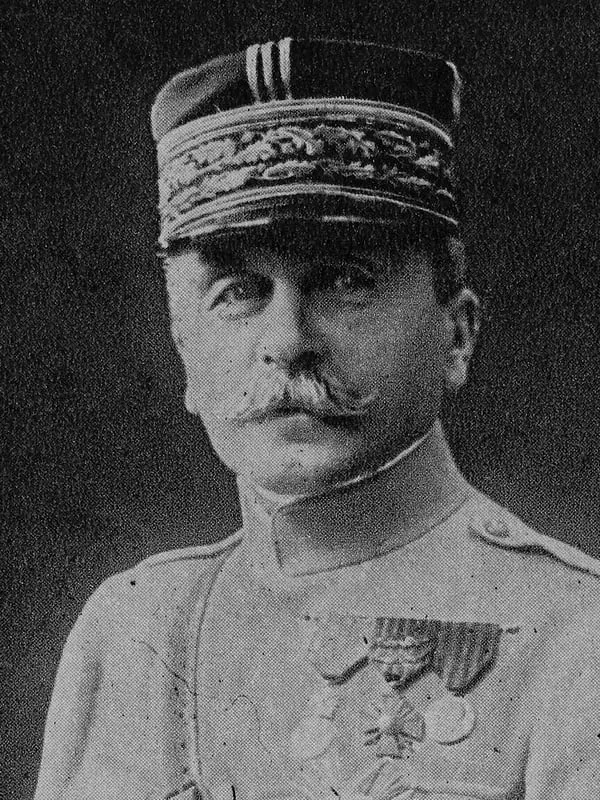
Fernand de Langle de Cary
Commander of the French Fourth Army (1914–1915) and of Army Group Centre (December 1915 – May 1916)
- Born:
- 4 July 1849, Lorient (Brittany)
- Died:
- 19 February 1927, Pont-Scorff (Brittany)
- Author:
- Łukasz Skowroń
- Photo:
- Manuel, Henri (1874-1947). Photographe, domena publiczna, Wikimedia Commons

Fernand de Langle de Cary was one of the oldest French army commanders who led their troops into the Battles of the Frontiers in August 1914. He was 65 at the time and on the verge of retirement. His Fourth Army suffered a heavy defeat in the Ardennes, but unlike many other generals he did not lose his post: he held the line of the Meuse, stood firm on the Marne, and throughout 1915 conducted two great and costly offensives in Champagne. In December 1915 Joseph Joffre entrusted him with Army Group Centre, and with it responsibility for Verdun. When the Germans struck the fortress in February 1916, the first days of the battle decided his career. Some historians regard him as a scapegoat who paid for the failings of the high command.
Before the war
He was born on 4 July 1849 in Lorient in Brittany, into a noble family. In 1867 he entered the military school of Saint-Cyr and graduated in 1869 first in his year, after which he joined the cavalry, in the Chasseurs d’Afrique. During the Franco-Prussian War he fought in besieged Paris (PL) and was severely wounded. According to French biographers a bullet hit him in the chest at the Battle of Buzenval on 19 January 1871, and a few days later he received the cross of the Legion of Honour.
After the war he climbed the successive rungs of an ordinary officer’s career, and also taught at the war college. In 1900 he became a brigadier general and took over a cavalry brigade in Algeria, and in 1906 he was promoted to divisional general. He commanded in turn a colonial division, the 14th Division, and from 1908 the IV and then the VIII Corps. In December 1912 he joined the Superior War Council, whose members were to take command of armies in the event of war. The Fourth Army was earmarked for him. In July 1914 he turned 65 and was due to retire, but when war broke out, on 2 August he took up the command assigned to him.
The Ardennes and the Meuse
Under the French war plan the Fourth Army initially stood in reserve behind the Third Army of General Pierre Ruffey and the Fifth Army of General Charles Lanrezac. When it became clear that the Germans were coming through Belgium, Joffre reinforced it at the Fifth Army’s expense and threw it, together with Ruffey’s army, northwards into the wooded Ardennes. The French staff assumed that they would meet weak forces on the march there. On 21 August the Fourth Army crossed the Semois towards Neufchâteau, and on 22 August it ran into the German Fourth Army of Duke Albrecht of Württemberg, which was waiting for it in the forests. The Colonial Corps suffered worst, at Rossignol. It was the bloodiest day in the history of the French army. Langle de Cary ordered a retreat, and on 24 August Joffre instructed him to withdraw behind the Meuse. The general later criticised the commander-in-chief’s method of command and called the Ardennes forest itself “a real death trap”.
Unlike Ruffey and Lanrezac, who were dismissed in the following days, Langle de Cary kept his command. From 25 August his army defended the Meuse crossings between Mézières and Stenay. The general ordered determined resistance, and on the morning of 28 August he went over to a counter-attack to push the Germans back across the river. In this way he delayed the march of the German centre and prevented the front from being torn apart at the most difficult moment of the Great Retreat, but that evening he received orders to fall back further to the Aisne. It was then that the detachment of General Ferdinand Foch, from which the Ninth Army grew, was formed from his army’s left wing.
The Marne and Champagne
In the Battle of the Marne the Fourth Army stood between Foch’s Ninth Army and the Third Army of General Maurice Sarrail, around Vitry-le-François. It was attacked by the German Fourth Army and part of the Saxon Third Army of General Max von Hausen. The French held, and when the German right wing began to fall back, on 11 September Albrecht received orders to retreat. The Fourth Army followed him into Champagne, where in the second half of September the front froze into trenches.
On 20 December 1914 the Fourth Army opened an offensive in Champagne, east of Reims. The First Battle of Champagne was the first great French offensive against fortified trench lines. The general shifted the main effort to the area of Perthes and Massiges, and in February 1915 he renewed the attack on a narrow sector, with more than a dozen divisions and nearly 900 guns. The French gained at most 2–3 kilometres and Perthes-lès-Hurlus, and lost over 90,000 men. On 17 March, in line with the condition Joffre had set, the offensive was halted. Langle de Cary afterwards defended his method of successive, limited attacks on important points of ground.
On 25 September 1915 his army and the Second Army of General Philippe Pétain, both in the army group of General Noël de Castelnau, struck again. In the Second Battle of Champagne the French took the German first line and more than 20,000 prisoners, but did not break the second position, and by November had lost, according to various estimates, between 140,000 and 180,000 men.
Verdun
In December 1915 Castelnau became Joffre’s chief of staff, and on 12 December he handed command of Army Group Centre to Langle de Cary. General Henri Gouraud succeeded him at the head of the Fourth Army. The new army group held the front from Champagne to Verdun, and from January 1916 the general had direct authority over the Fortified Region of Verdun. The fortress had been weakened, because in 1915 a large part of its artillery and garrisons had been taken away. Langle de Cary had a few weeks to prepare the defence. He advised against crowding the soldiers into the front lines, which the artillery would smash anyway, but the rear positions were not finished in time.
On 21 February 1916 the Germans attacked at Verdun. Within four days they shattered two French divisions and broke through the second position. On 24 February Langle de Cary ordered the troops to be withdrawn from the Woëvre plain to the heights above the Meuse, and at headquarters there was even talk of giving up the whole right bank of the river. Joffre and Castelnau thought otherwise. During the night Castelnau went to the Meuse with full powers from the commander-in-chief and on 25 February, over Langle de Cary’s doubts, ordered the right bank to be held at all costs. That same day the Germans took Fort Douaumont, and Pétain took over the defence of Verdun.
Formally Langle de Cary remained in command of the army group for more than two months. At the beginning of May 1916 Pétain replaced him. The official reason was age: the general was 66, and the limit was 65. According to some sources he had been removed from command as early as March. In the summer, when Romania entered the war, Joffre reportedly wanted him at the head of the French military mission in Bucharest, but the government did not agree and General Henri Berthelot was sent. According to some accounts his last assignment was an inspection in North Africa. In 1917 he was finally retired.
After the war
In retirement the general wrote memoirs of the years 1914–1916, markedly unfavourable to Joffre. They were published only after his death, in 1935, with a preface by Marshal Louis Franchet d’Espèrey. He died on 19 February 1927 at Pont-Scorff (PL) near Lorient. Some sources give Paris as the place of death, and some lists wrongly give the year 1931.
Assessment
Langle de Cary belonged to the generation of commanders brought up on the doctrine of the offensive at all costs, and in the Ardennes he paid for it, like the others, with enormous losses. Unlike many of them, however, he quickly regained control of the situation, and on the Meuse and the Marne his army performed well. The Champagne offensives that he conducted in 1915 on Joffre’s orders achieved little and cost a great deal. Verdun is the most disputed. Some authors blame him for the unprepared defence, others stress that he had been responsible for the fortress for only a few weeks, and that its disarming had been a decision of the high command. The British site historyofwar.org calls him a competent commander who did not deserve to take the blame for the state of Verdun’s defences, and the former site firstworldwar.com notes that Joffre himself was also to blame for the surprise at Verdun.
Sources
Spotted a mistake?Report an error
Commanded in battles
(05)Mentioned in battles
(01)Often appears with
People who appear in the same events.