Key event
Battle of the Marne begins
- Category:
- Military operations
- Front:
- Western Front
- Date:
- 6 September 1914
- Author:
- Łukasz Skowroń
- Battle:
- First Battle of the Marne
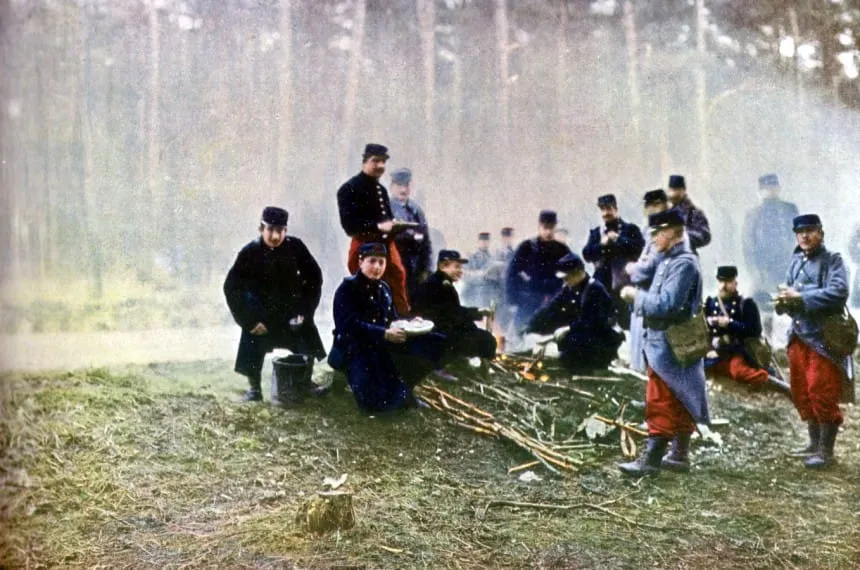
On 6 September 1914, after two weeks of retreat, the French armies and the British Expeditionary Force halted and struck at the Germans on a front about 200 kilometres long, from the outskirts of Paris to Verdun. So began the Battle of the Marne, one of the most important battles of the whole war. Within a few days it decided that Germany would not defeat France in a single rapid campaign.
The Germans at the gates of Paris
At the beginning of September it seemed that the German plan for victory in the west, known as the Schlieffen Plan, was close to fulfilment. After their defeats in the Battle of the Frontiers the French and British had been retreating for almost two weeks. Five German armies of the right wing and centre, from the 1st Army of General Alexander von Kluck in the west to the 5th Army of Crown Prince Wilhelm at Verdun, were pressing southwards. The French government had left Paris for Bordeaux, and German cavalry patrols were appearing a few dozen kilometres from the capital.
The plan assumed that the German right wing would pass west of Paris and close the French armies in a great encirclement. Kluck, however, did not take that route. At the end of August, wishing to catch the retreating French 5th Army and prevent its escape, he turned south-east, so that his troops would pass east of Paris. The chief of the German General Staff, Helmuth von Moltke, commanding from distant Luxembourg, accepted this move and merely instructed Kluck to cover the right flank on the Paris side. Kluck, sure that the French were already beaten, crossed the Marne on 3 September and pressed on south, leaving only a weak screen behind him.
Joffre’s decision
Kluck’s move was spotted by French and British airmen, and the military governor of Paris, General Joseph Gallieni, at once understood that the German flank lay exposed to the capital’s garrison. The commander-in-chief of the French army, General Joseph Joffre, had already been preparing a counter-offensive. From troops brought in from other sectors he formed the new 6th Army of General Michel-Joseph Maunoury, concentrated near Paris, and the 9th Army of General Ferdinand Foch, inserted in the middle of the front. On 4 September Joffre decided that the general attack would begin on 6 September.
The hardest task was persuading the British. Field Marshal John French, whose troops had suffered in the retreat from Mons, wanted to withdraw them behind the Seine to rest. On 5 September Joffre came to his headquarters and, according to witnesses, begged him in dramatic words to take part in the battle, invoking the honour of England. French agreed, and the British retreat ended that same day.
The order of the day
On the morning of 6 September Joffre issued his famous order of the day to the troops, which was then read out to units along the whole front. In it he reminded them that a battle was beginning on which the salvation of the country depended, and that this was no longer the time to look back. All forces were to be directed to attacking and driving back the enemy. A unit that could no longer advance was to hold the ground it had won at any cost and let itself be killed where it stood rather than fall back. In the present circumstances, Joffre wrote, no failure could be tolerated.
The front from Paris to Verdun
On the Allied side, from the west, stood in turn: Maunoury’s 6th Army north-east of Paris, French’s British Expeditionary Force, the 5th Army of General Louis Franchet d’Espèrey, who a few days earlier had replaced the dismissed General Lanrezac, Foch’s 9th Army, the 4th Army of General Fernand de Langle de Cary and the 3rd Army of General Maurice Sarrail, anchored on the fortress of Verdun. Facing them stood the German 1st to 5th Armies: those of Kluck, Karl von Bülow, Max von Hausen, Duke Albrecht of Württemberg and Crown Prince Wilhelm. Further east, in Lorraine, fierce fighting was already under way for the heights in front of Nancy.
The gap between the German armies
Fighting on the western wing had begun a day earlier. On 5 September the 6th Army, approaching the river Ourcq, ran into the German IV Reserve Corps, which was covering Kluck’s flank. Kluck quickly grasped the danger. On 6 September he began to turn his corps that had stood south of the Marne back north to the Ourcq, and over the following days he brought almost his entire army there. This allowed him to halt Maunoury, but between his 1st Army and Bülow’s 2nd Army a gap several dozen kilometres wide opened up, covered only by cavalry and a few Jäger battalions.
The British and the left wing of the 5th Army were to advance into this gap. On 6 September, however, the British first had to cover the distance they had put behind them in the retreat, and they advanced cautiously. At the same time, along the whole front from Meaux to the Argonne, heavy encounter battles were raging. The Germans, surprised that their supposedly beaten opponent had gone over to the attack, defended themselves and attacked in turn, especially in the centre, against Foch’s army.
What came next
The battle lasted several days. On 7 and 8 September the Germans attacked fiercely in the centre, in the St Gond marshes and east of them, and Gallieni sent reinforcements to the Ourcq, carrying some of the soldiers in Paris taxis. Meanwhile the British and the 5th Army were slowly entering the gap between the German armies. On 9 September, after consultations with Moltke’s envoy, Lieutenant Colonel Richard Hentsch, Bülow and Kluck ordered a retreat. By 12–13 September the Germans had withdrawn to the Aisne, where they dug in on the heights.
The French date
The British chronology of the war, like French tradition, takes 6 September, the day of the general offensive and Joffre’s order, as the start of the battle. The fighting on the Ourcq, which began a day earlier, is treated by French historians as a separate battle forming part of the great Battle of the Marne, and often as its prelude. For this reason many studies, especially German and English-language ones, date the Battle of the Marne from 5 September.
Significance
The Battle of the Marne wrecked the German plan for a quick victory in the west. France was not defeated, and Germany had to wage the long two-front war it had tried to avoid. The French called this victory the “Miracle of the Marne”. Moltke, broken by the failure, lost effective command to Erich von Falkenhayn in mid-September. After the battle neither side was able to outflank the other, and the front in the west soon turned into a line of trenches stretching from the North Sea to Switzerland.
Remember the articles you have read? Only in this browser; nothing is sent anywhere.How it works
Read ·
A voice from the front
“What had happened, or why we were suddenly to turn against the enemy after ten days of retreat, we could not conceive; but the fact was there, and the difference in the spirits of the men was enormous. They marched twice as well, whistling and singing, back through Tournans and on to Villeneuve.”
Spotted a mistake?Report an error
Meanwhile
(04)Elsewhere in the same days.
- 6 September 1914 · AfricaSkirmish on the TsavoOn 6 September 1914 in the Tsavo valley in British East Africa, Indian and African soldiers clashed with Germans heading for the Uganda Railway.
- 5 September 1914 · AfricaDefence of AbercornOn 5 September 1914 troops from German East Africa crossed the border of Northern Rhodesia. The small garrison of Abercorn held out until relief arrived.
- 5 September 1914 · Eastern FrontBattle of the Masurian Lakes beginsAt the beginning of September 1914 Hindenburg's German Eighth Army moved against Rennenkampf's Russian First Army. The Battle of the Masurian Lakes began.
- 5 September 1914 · War at seaSinking of HMS PathfinderOn 5 September 1914 the German U-21 sank the cruiser HMS Pathfinder off Scotland, the first British warship sunk by a submarine.
Related events
(04)The same battle, people or subject.
- 9 September 1914 · Western FrontGermans retreat from the MarneOn 9 September 1914 the German 1st and 2nd Armies began to retreat from the Marne, sealed by Moltke's envoy Hentsch. The plan for a quick victory failed.
- 25 August 1914 · Western FrontBattle of the Meuse beginsOn 25 August 1914 the French Fourth Army, pulled back from the Ardennes, took post behind the Meuse from Mézières to Stenay. The fight for the crossings began.
- 12 September 1914 · Western FrontBattle of the Aisne beginsOn 12 September 1914 the British and French, pursuing the Germans after the Marne, reached the Aisne. The Germans dug in on the heights beyond the river.
- 10 September 1914 · Western FrontEnd of the Battle of the MarneOn 10 September 1914 the British and French pursued the retreating Germans. British historiography regards this day as the end of the Battle of the Marne.