Key event
Battle of the Ourcq begins
- Category:
- Military operations
- Front:
- Western Front
- Date:
- 5 September 1914
- Author:
- Natalia
- Battle:
- Battle of the Ourcq
- Tags:
- France, Germany, Joseph Gallieni, Alexander von Kluck
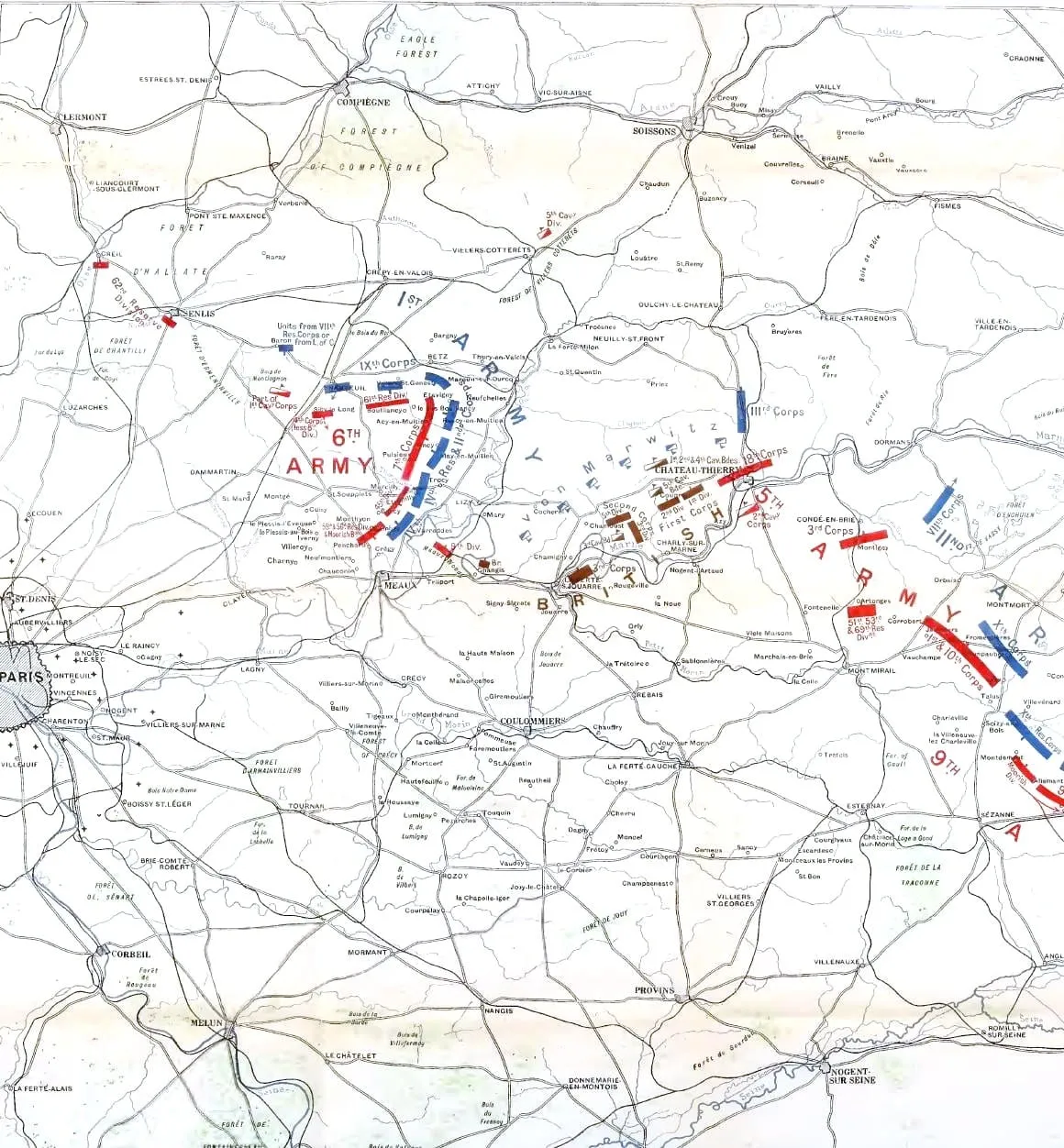
On 5 September 1914, north-east of Paris, the French Sixth Army of General Michel Maunoury collided with the German corps covering the right wing of the 1st Army of General Alexander von Kluck. The fighting on the hills at Monthyon and Penchard, a few kilometres from Meaux, began the battle on the river Ourcq. It was the first act of the Battle of the Marne, which halted the German march on Paris and dashed Germany’s hopes of a quick victory in the west.
Kluck’s turn
Under the German war plan, known as the Schlieffen Plan, Kluck’s army, the furthest out on the right wing, was to pass west of Paris and encircle the French armies. At the end of August, however, Kluck changed his direction of march. Wanting to catch the retreating French Fifth Army and support the neighbouring 2nd Army of General Karl von Bülow, he turned south-east, and his columns began to pass east of the French capital. On 3 September his leading units crossed the Marne.
This manoeuvre exposed the right wing of the German army. French airmen and cavalrymen quickly noticed it. The military governor of Paris, General Joseph Gallieni, to whom the Sixth Army, being formed since the end of August, was subordinate, judged that an opportunity had arisen to strike the Germans in the flank. On the evening of 4 September the commander-in-chief, General Joseph Joffre, issued orders for a general counter-offensive by all the armies of the left wing, set for 6 September. By then the Sixth Army was to move east and prepare to cross the Ourcq.
The clash at Monthyon
The Germans expected a threat from the direction of Paris, but did not know how serious it was. Kluck entrusted the cover of his right wing to a single corps, the IV Reserve Corps of General Hans von Gronau, deployed north of Meaux. The rest of the army was already south of the Marne, in pursuit of the Allies.
On the afternoon of 5 September, as Maunoury’s units were marching to their starting positions, they ran into the Germans. Gronau, alarmed by reports of enemy movements, decided to attack himself to find out what he had in front of him. The German artillery, placed on the hills at Monthyon, opened fire on the French columns on the open plain. The French reserve divisions suffered heavy losses. On the right wing a Moroccan brigade drove the Germans out of some positions, but was unable to take the hills at Penchard. There was also fighting for the village of Saint-Soupplets. By evening the French stood on the line Saint-Soupplets – Monthyon – Penchard.
Gronau realised that he faced a whole army, not merely weak detachments of the Paris garrison. During the night he withdrew his corps a few kilometres east, to better positions, and informed army headquarters. Kluck received the news on the night of 5 to 6 September and began to turn his corps back north from the Marne, against Maunoury. Gronau’s effort cost him dearly, but it saved the 1st Army from being taken by surprise.
The death of Charles Péguy
Among those killed on 5 September was Charles Péguy, one of the most outstanding French poets and essayists of the time. The 41-year-old lieutenant of the 276th Infantry Regiment of the 55th Reserve Division was leading his men in an attack across the fields near the village of Villeroy, towards the hills at Monthyon. He was killed by a bullet to the forehead. Near the place of his death there is today a monument, and in the area there are graves and cemeteries of the soldiers killed in this fighting. Péguy’s death became in France a symbol of the sacrifice of a whole generation.
Further course
The next day, 6 September, the Franco-British counter-offensive began along the whole front from the outskirts of Paris to Verdun. On the Ourcq fierce fighting went on for the following days. Kluck moved one corps after another north, and the French brought up reinforcements. On the night of 7 to 8 September Gallieni sent some of the soldiers of the newly arrived 7th Division to the front in requisitioned Paris taxis. The Germans had the advantage in heavy artillery and several times came close to outflanking the Sixth Army.
Moving the whole of Kluck’s army to the Ourcq, however, opened a gap between it and Bülow’s army. British troops and the French Fifth Army entered it. On 9 September, fearing that the front would be cut in two, the German command ordered a retreat. Kluck’s army, close to success on the Ourcq, began to withdraw north, towards the Aisne.
Significance
The clash at Monthyon was on the face of it a local skirmish, but it set off an avalanche of events. Alarmed, Kluck turned his army against Paris, and this enabled the Allies to strike into the gap between the German armies. The Battle of the Ourcq tied down the main forces of the German right wing and decided the fate of the whole 1914 campaign in the west. The war of movement in France began to draw to a close, and a few weeks later both sides dug in on a line that largely survived until 1918.
Remember the articles you have read? Only in this browser; nothing is sent anywhere.How it works
Read ·
Voices from the front
“Then a little smoke would rise from one hamlet, then from another; then a tiny flame—hardly more than a spark—would be visible; and by dark the whole plain was on fire, lighting up Mareuil in the foreground, silent and untouched. There were long lines of grain-stacks and mills stretching along the plain. One by one they took fire, until, by ten o'clock, they stood like a procession of huge torches across my beloved panorama.”
“Another car follows, then others and still others, hundreds of them, silent, endlessly. In the light of the risen moon we make out the faintly gleaming oilcloth caps of the taxi drivers. In the cars we glimpse the bowed heads of sleeping soldiers. Someone asks: 'Wounded?' They answer as they pass: 'No. It's the 7th Division. We've come from Paris. We're going up there!…'”
Translated · Original (fr)
Une autre auto suit, puis d'autres et d'autres encore, des centaines, silencieuses, interminablement. On reconnaît, luisant un peu, sous la lune qui s'est levée, les casquettes de toile cirée des chauffeurs de taxis. On entrevoit dans les voitures des têtes penchées de soldats qui dorment. Quelqu'un interroge : — Blessés? On nous répond au passage : — Non. C'est la 7e division. On vient de Paris. On va là-bas!...
Spotted a mistake?Report an error
Meanwhile
(04)Elsewhere in the same days.
- 5 September 1914 · War at seaSinking of HMS PathfinderOn 5 September 1914 the German U-21 sank the cruiser HMS Pathfinder off Scotland, the first British warship sunk by a submarine.
- 5 September 1914 · Eastern FrontBattle of the Masurian Lakes beginsAt the beginning of September 1914 Hindenburg's German Eighth Army moved against Rennenkampf's Russian First Army. The Battle of the Masurian Lakes began.
- 5 September 1914 · AfricaDefence of AbercornOn 5 September 1914 troops from German East Africa crossed the border of Northern Rhodesia. The small garrison of Abercorn held out until relief arrived.
- 5 September 1914 · DiplomacyPact of LondonOn 5 September 1914 in London Britain, France and Russia pledged not to make a separate peace. The Entente became a formal wartime alliance.
Related events
(04)The same battle, people or subject.
- 6 September 1914 · Western FrontBattle of the Marne beginsOn 6 September 1914 the French armies and the British went over to the counter-offensive from Paris to Verdun. The battle that decided 1914 had begun.
- 30 August 1914 · Western FrontBattle of Guise endsOn 30 August 1914 the French Fifth Army broke off the fight with Bülow's army and withdrew behind the Serre. The Battle of Guise was over.
- 29 August 1914 · Western FrontBattle of Guise beginsOn 29 August 1914 Lanrezac's French Fifth Army broke off its retreat and counter-attacked Bülow's German Second Army on the river Oise.
- 12 September 1914 · Western FrontBattle of the Aisne beginsOn 12 September 1914 the British and French, pursuing the Germans after the Marne, reached the Aisne. The Germans dug in on the heights beyond the river.