Key event
Battle of Guise begins
- Category:
- Military operations
- Front:
- Western Front
- Date:
- 29 August 1914
- Author:
- Łukasz Skowroń
- Battle:
- Battle of Guise
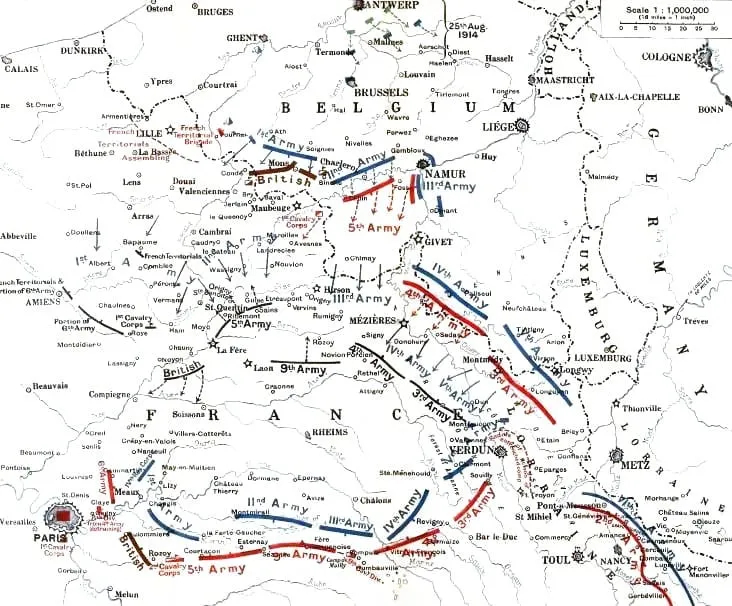
On 29 August 1914 the French Fifth Army under General Charles Lanrezac stopped retreating for the first time since its defeat at Charleroi and struck at the Germans. In the valley of the river Oise, around the small town of Guise and the town of Saint-Quentin, the Battle of Guise began. The Germans call it the Battle of Saint-Quentin. It was the only major Allied counter-attack during the Great Retreat and one of the most important engagements leading up to the Battle of the Marne.
A retreat that had to be halted
At the end of August the Allied situation in the west was very difficult. After the lost Battle of the Frontiers, the French armies and the British Expeditionary Force were falling back to the south, while the German right wing pressed on towards Paris. The French Commander-in-Chief, General Joseph Joffre, was forming a new Sixth Army on his left wing and needed time to assemble it. He decided that the Fifth Army would halt and strike westwards, towards Saint-Quentin, into the flank of the German First Army under General Alexander von Kluck, which was pursuing the British.
Lanrezac was opposed. Wheeling the army to face west meant exposing its right flank to a blow from the German Second Army under General Karl von Bülow, approaching from the north. Joffre would not give way. On 28 August he came to Lanrezac’s headquarters at Marle and demanded that the order be carried out; at his instruction it was written down and signed on the spot. On the morning of 29 August he came again, this time to Laon, and for several hours watched in silence as Lanrezac directed the battle. He left convinced that the commander of the Fifth Army was handling it well.
Without the British
The attack was meant to be a joint one. General Douglas Haig, commander of the British I Corps, had himself offered the French his cooperation. During the night, however, a refusal came from GHQ: Field Marshal John French judged that his men were too tired and needed at least a day’s rest. The Expeditionary Force continued its retreat and the French had to fight alone. Lanrezac took this bitterly, and the mistrust between him and the British grew still further.
The fighting
The Germans pre-empted the French plan. As early as 28 August Bülow’s troops attacked the crossings over the Oise at Guise, and at dawn on 29 August they crossed the river at several points. On the French left, XVIII Corps and the reserve divisions crossed the Oise at Ribemont and advanced on Saint-Quentin, but their attack soon stalled under artillery fire. The town was not taken.
Meanwhile, north of the Oise, the French III and X Corps were locked in combat with the German Guard Corps and X Corps. Some villages changed hands several times. In the afternoon Lanrezac decided to commit his last reserve, I Corps under General Louis Franchet d’Espérey. Franchet d’Espérey personally reorganised the units and at about 5.30 p.m. led a counter-attack supported by artillery fire. According to participants, the infantry went forward to the sound of military bands. The attack by I Corps, backed by the neighbouring corps, threw the Germans back. The French retook several villages, and the German Guard withdrew towards the river.
A tactical success
On the evening of 29 August the French could speak of success at Guise, though not at Saint-Quentin. For the first time in weeks it was the Germans who had to fall back. The success was fragile, however. German troops were still coming up from the north and west, and the Fifth Army was in danger of being outflanked. Late in the evening Joffre allowed Lanrezac to break off the fight, retreat and blow up the bridges over the Oise. The next day the battle came to an end.
Significance
The Battle of Guise was no great victory, but it had serious consequences. Bülow’s army halted for a day and a half. Bülow asked Kluck for support, and on the evening of 30 August Kluck turned the First Army south-east to cut off the Fifth Army’s retreat. Instead of going round Paris to the west, as the Schlieffen Plan had envisaged, the Germans passed east of the capital and exposed their right flank. This turn gave the French an opportunity, which they seized at the beginning of September in the Battle of the Marne.
Franchet d’Espérey came out of the battle with a reputation as the most energetic general of the Fifth Army. A few days later he replaced Lanrezac as its commander.
Remember the articles you have read? Only in this browser; nothing is sent anywhere.How it works
Read ·
Spotted a mistake?Report an error
Meanwhile
(04)Elsewhere in the same days.
- 29 August 1914 · Eastern FrontZeppelin Z V shot down near MławaAt the end of August 1914 the German airship Z V, hit by the Russians during a raid on the station at Mława, made a forced landing. Its crew was captured.
- 28 August 1914 · War at seaBattle of Heligoland BightOn 28 August 1914 British ships surprised the Germans off Heligoland. They sank three light cruisers and a torpedo boat without losing a single ship.
- 30 August 1914 · Eastern FrontBattle of the Złota Lipa endsOn 30 August 1914 the Russians broke the Austro-Hungarian defence on the Gniła Lipa. Brudermann's army fell back beyond Lviv, opening the city to them.
- 30 August 1914 · AfricaFirst attack on GaruaOn the night of 29–30 August 1914 British troops from Nigeria attacked the German forts at Garua in Kamerun. The attack was repulsed and its commander killed.
Related events
(04)The same battle, people or subject.
- 30 August 1914 · Western FrontBattle of Guise endsOn 30 August 1914 the French Fifth Army broke off the fight with Bülow's army and withdrew behind the Serre. The Battle of Guise was over.
- 12 September 1914 · Western FrontBattle of the Aisne beginsOn 12 September 1914 the British and French, pursuing the Germans after the Marne, reached the Aisne. The Germans dug in on the heights beyond the river.
- 6 September 1914 · Western FrontBattle of the Marne beginsOn 6 September 1914 the French armies and the British went over to the counter-offensive from Paris to Verdun. The battle that decided 1914 had begun.
- 9 September 1914 · Western FrontGermans retreat from the MarneOn 9 September 1914 the German 1st and 2nd Armies began to retreat from the Marne, sealed by Moltke's envoy Hentsch. The plan for a quick victory failed.