1914: The Great Retreat
Battle of Guise
- Dates:
- 29–30 August 1914
- Front:
- Western Front
- Location:
- The Oise valley between Guise and Saint-Quentin, Aisne department, FranceOn the battle map →
- Sides:
- GermanyKarl von Bülow
- Result:
- Inconclusive. The French threw the Germans back at Guise but failed to take Saint-Quentin and resumed their retreat. Bülow halted for a day and a half.
- Author:
- Natalia
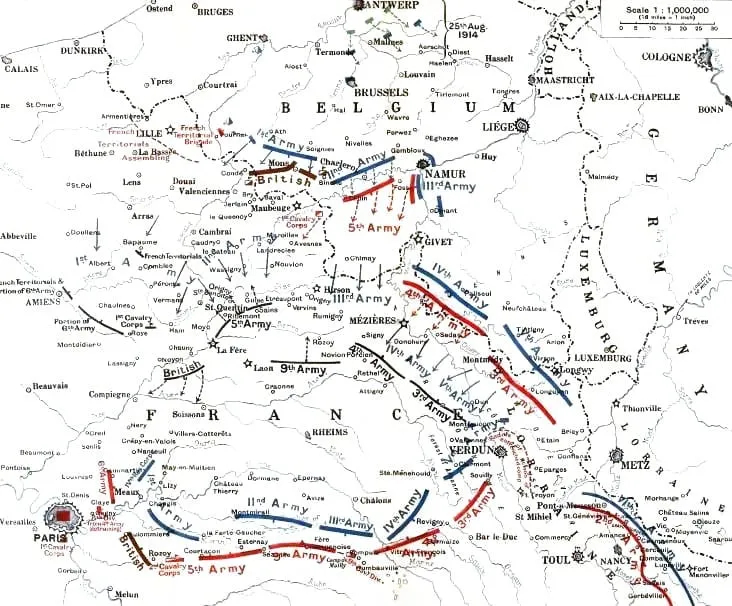
The Battle of Guise, fought on 29 and 30 August 1914 in the valley of the Oise in northern France, was the only major French counter-attack during the Great Retreat of August 1914. The French name it after the small town of Guise, the Germans after the nearby town of Saint-Quentin. It was fought between the French Fifth Army of General Charles Lanrezac and the German Second Army of General Karl von Bülow.
Joffre’s order
After the defeat at Charleroi the Fifth Army had been falling back southwards for several days, covering the right flank of the British Expeditionary Force. The commander-in-chief, General Joseph Joffre, needed time to assemble new forces on the left wing, around Amiens and Paris. On 27 August, therefore, he ordered Lanrezac to halt and strike westwards, towards Saint-Quentin, into the flank of Kluck’s German First Army, which was pursuing the British.
Lanrezac considered the plan very risky. His army would have to wheel through 90 degrees and expose its right flank to Bülow’s army approaching from the north. Joffre came in person to his headquarters at Marle and forced him to carry out the order, which at his insistence was written down and signed on the spot. On the morning of 29 August the commander-in-chief also came to Laon, where for several hours he silently watched Lanrezac direct the battle.
The British were to support the attack. The commander of their I Corps, General Douglas Haig, declared himself ready to act together with the Fifth Army, but the commander-in-chief of the Expeditionary Force, Field Marshal John French, refused his consent. He judged that his exhausted soldiers had to rest and continued the retreat. The French fought alone.
29 August
The Germans did not wait passively. As early as 28 August Bülow’s troops were attacking the Oise crossings around Guise, and early on the morning of 29 August they forced the river at several points. Meanwhile, on the French left wing, XVIII Corps and the reserve divisions moved off towards Saint-Quentin as ordered. They crossed the Oise at Ribemont, but their attack stalled under German artillery fire and did not reach the town.
The heaviest fighting took place north of the Oise. There the French III and X Corps clashed with the German Guard Corps and X Corps, which had crossed the river around Guise. Some villages changed hands several times. At about 3 p.m. Lanrezac committed his last reserve, the I Corps of General Louis Franchet d’Espèrey. The energetic commander restored order in the ranks and at about 5.30 p.m. led a massed counter-attack supported by artillery fire. According to accounts, the soldiers advanced to the sound of a military band. The Germans were thrown back and the French recovered several lost villages. In the evening the Guard was withdrawing towards the Oise.
30 August
The success at Guise did not change the overall situation. On the left wing the attack on Saint-Quentin had failed, and German units were still arriving from the west and north, threatening to outflank the whole Fifth Army. Late in the evening of 29 August Joffre authorised Lanrezac to retreat and destroy the bridges over the Oise. On 30 August the French still repelled scattered attacks, and from late morning they began to withdraw southwards, behind the river Serre. By the morning of 31 August the army had broken contact with the enemy. Bülow, whose troops were exhausted and had suffered serious losses, did not mount a vigorous pursuit.
Losses
Figures for losses are incomplete and vary from source to source. According to various estimates the French lost about 10,000–12,000 men (killed, wounded and prisoners), and the Germans from about 7,000 to more than 9,000.
Significance
The Germans regarded the battle as their victory, because it was the French who left the battlefield. From the perspective of the campaign as a whole, however, it was a valuable Allied success. Bülow’s army halted for a day and a half, and the Fifth Army escaped encirclement and withdrew in good order.
The indirect consequences proved more important. Bülow, convinced that the French had been beaten yet alarmed by their strength, asked General Alexander von Kluck for support. On the evening of 30 August Kluck decided to direct the First Army south-east to cut off the Fifth Army’s retreat, instead of passing west of Paris as the Schlieffen Plan envisaged. The Supreme Army Command approved this change. As a result Kluck’s army passed east of Paris and exposed its right flank to the newly formed French Sixth Army, stationed around the capital. A few days later the French exploited this in the Battle of the Marne.
Lanrezac did not remain in command to see that victory. On 3 September Joffre removed him from command, accusing him of a lack of offensive spirit and poor cooperation with the British. He was succeeded by Franchet d’Espèrey, the hero of the fighting at Guise.
Spotted a mistake?Report an error