1914: First clashes and the Battles of the Frontiers
Battle of Mulhouse
- Dates:
- 7–25 August 1914
- Front:
- Western Front
- Location:
- Mulhouse and the Upper Alsace plain, Alsace (Germany)On the battle map →
- Sides:
- FranceLouis Bonneau, Paul PauGerman EmpireJosias von Heeringen
- Result:
- German victory. The French withdrew from Mulhouse, keeping a small strip of southern Alsace.
- Author:
- Łukasz Skowroń
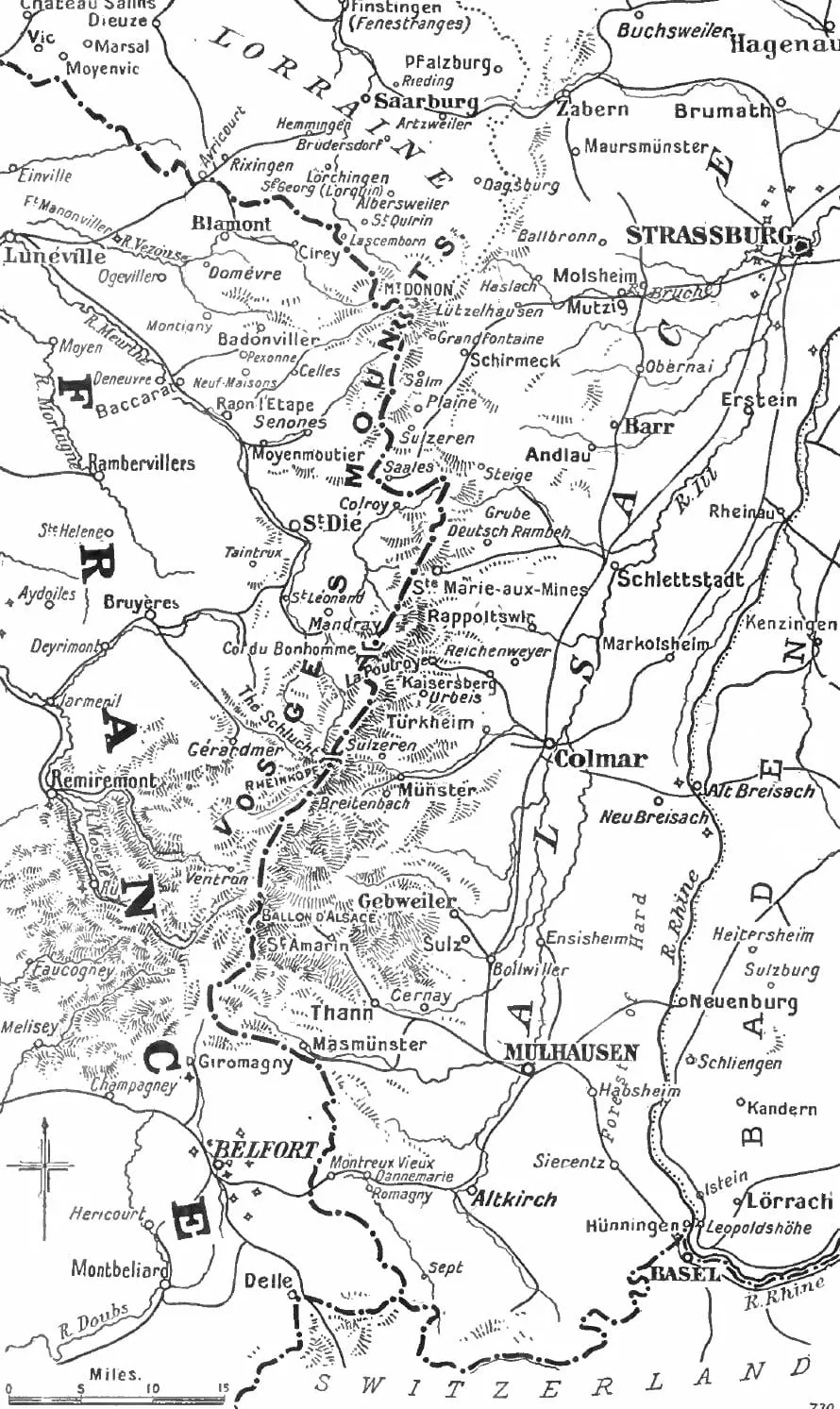
The Battle of Mulhouse was the first French offensive of the First World War. In August 1914 French troops twice advanced from the Belfort area into southern Alsace, then German territory, and twice took Mulhouse, the largest town in that part of the province. The first time a German counter-attack drove them out after two days. The second time they captured the town after heavy fighting, but had to give it up without a fight when defeats in Lorraine and Belgium forced the high command to pull troops away to the north.
Name and dates
The French speak of the Battle of Mulhouse (bataille de Mulhouse), and also call the second capture of the town the fighting at Dornach, after the district where the heaviest fighting took place on 19 August. The German official history, Der Weltkrieg, uses the name “Battle of Mülhausen” (Schlacht bei Mülhausen) only for the action of 9–10 August. The battle was part of the Battle of the Frontiers.
This page uses the dates 7–25 August 1914: from the crossing of the frontier by the French VII Corps to the reoccupation of Mulhouse by the Germans. The British official history states that the French crossed the frontier as early as 6 August, but French and German sources agree on the morning of 7 August. The end is less certain. Sources give different dates for the evacuation of the town, from 24 to 26 August, and according to the German official history the Landwehr brigades moved back into the abandoned area around Mulhouse only in the last days of the month. The dates given for the disbandment of the Army of Alsace also differ: the 1920 Michelin guide gives 25 August, the German official history 26 August.
Background
Alsace had belonged to Germany since 1871, when France lost it after its defeat in the Franco-Prussian War. The French war plan, Plan XVII, provided for the First Army to rest the right of the front on the Rhine, with part of it advancing into Upper Alsace through the Belfort Gap and the passes of the Vosges. The order could be given as early as the fourth day of mobilisation. The task of VII Corps and the 8th Cavalry Division was, in the words of the plan, “to hold in Alsace, by attacking them, any enemy forces” on the eastern slopes of the Vosges, and to assist the removal of that part of the population that had “remained faithful to the cause of France”.
The German official history sees two aims in the expedition. The French command hoped for a strong effect on the pro-French Alsatians, perhaps even a rising, and at the same time wanted to tie down as many German troops as possible in Alsace and relieve the main offensive in Lorraine. Facing the French was the German Seventh Army of General Josias von Heeringen, with XIV and XV Corps, whose task was to defend Alsace and co-operate with the Sixth Army in Lorraine. On the frontier itself there was only the reinforced 58th Infantry Brigade. The first skirmishes in this area had taken place even before the declaration of war, when on 2 August at Joncherey the first soldiers of the Western Front were killed.
The first entry, 7–10 August
The commander of the First Army, General Auguste Dubail, set the start of the advance for 7 August, with the line Altkirch–Thann as the first objective. VII Corps of General Louis Bonneau, reinforced by battalions from the Belfort fortress, set out at dawn in three columns: the 14th Infantry Division in the centre, through Masevaux towards Mulhouse; the 27th Infantry Brigade with the 8th Dragoon Brigade on the right, through Dannemarie (PL) towards Altkirch; and the 41st Division on the left, along the Thur valley towards Thann. The 8th Cavalry Division covered the right flank. The soldiers tore down the German frontier posts, and at Altkirch a bayonet charge drove out a strongly entrenched German detachment. The German frontier guard fell back in line with its orders, and during the night of 7/8 August General Stenger withdrew the main body of the 58th Brigade across the Rhine.
Bonneau did not trust the easy success and advanced cautiously. The 14th Division occupied Mulhouse without a fight only on the evening of 8 August, welcomed enthusiastically by some of the inhabitants. Heeringen correctly estimated the enemy’s strength at one corps and a cavalry division. He decided to strike before the French received reinforcements. The German Supreme Army Command approved this in a telegram on the evening of 7 August: the army had “full freedom of action”. XV Corps of General Berthold von Deimling was moved by rail to the Colmar area, and XIV Corps assembled on the Rhine near Breisach and Neuenburg.
On 9 August, in the heat and after long marches, both corps attacked. In the evening XV Corps drove the French out of Cernay (PL), west of Mulhouse, in street fighting. XIV Corps, coming out of the Hardt forest, attacked from the east and north only in the late afternoon. The commander of the 84th Brigade, General von Koschembahr, was killed, and at Rixheim (PL) house-to-house fighting went on in the dark. At Wittelsheim German units became involved in a firefight among themselves, in which the commander of the 105th Infantry Regiment was killed. The German official history itself admits that nowhere that evening was there a sense of full success. And yet it was Bonneau who gave way: during the night of 9/10 August, despite the objections of army headquarters, he withdrew VII Corps along the whole line. Joffre’s order to retake the positions by a night attack could not be carried out, given how exhausted the troops were. At dawn on 10 August the German 55th Brigade entered Mulhouse. The French, covered by a rearguard on the heights near Aspach, fell back towards Belfort, and the German pursuit came to a halt at the fortress defences. By 15 August the Germans had cleared the enemy from the whole of the Sundgau (PL), the southern corner of Alsace. Joffre removed Bonneau and the commander of the 8th Cavalry Division.
The Army of Alsace and the second entry, 14–19 August
As early as 10 August Joffre ordered the formation of a new Army of Alsace under General Paul Pau. It comprised VII Corps, the 57th Reserve Division from Belfort, the 8th Cavalry Division, a group of three reserve divisions (the 58th, 65th and 66th), the 44th Infantry Division from the Alpine front and five battalions of Alpine chasseurs in the Vosges. The army was to regain the lost ground, tie down German forces in Upper Alsace and, if possible, prepare a thrust across the Rhine.
Meanwhile the Germans weakened this sector. In line with the plan of Crown Prince Rupprecht, who commanded the Sixth and Seventh Armies, XIV and XV Corps were transferred north to Lorraine from 14 August. Heeringen protested that the French at Mulhouse had not been beaten badly enough for him to turn his flank and rear to them, but only Landwehr brigades and replacement units were left in Upper Alsace.
The Army of Alsace set out on 14 August, together with the great offensive of the First and Second Armies in Lorraine. In the evening it retook Thann, and on 16 August it stood on the line Dannemarie–Cernay–Thann. On 17 August Alpine chasseurs came down from the Schlucht pass to Munster. On 18 August VII Corps advanced on Mulhouse, while the German Landwehr brigades of Generals Mathy, Dame and von Bodungen occupied the town and the heights to the west of it. On 19 August there was fierce fighting on the western edge of Mulhouse, where the French took the Dornach district street by street and house by house. In the afternoon VII Corps entered the town, and Altkirch was taken at the same time. The Germans fell back through the Hardt forest across the Rhine.
The retreat, 20–25 August
Pau did not feel strong enough to attack the fortified German positions near Colmar. From 20 August his army held a line from Altkirch through Mulhouse to the area south of Colmar, and in the Vosges it held the passes. Preparations for a further advance were cut short by news from other fronts. On 20 August the offensive in Lorraine collapsed, and a few days later the French were defeated in the Ardennes and on the Sambre. According to the Michelin guide, a further advance became impossible from 23 August.
Joffre needed troops in the north. The main body of VII Corps was moved by rail to the Somme, to the new army being formed there. The 8th Cavalry Division was attached to the First Army, and the 57th and 66th Reserve Divisions remained in front of Belfort. The weakened units left Mulhouse and the Sundgau without a fight and withdrew to the line of the Vosges crests and the outworks of the fortress. As early as 24 August German airmen were reporting that the French were leaving the Mulhouse area. The German Landwehr returned to the abandoned town without a fight. This time it was to hold it until the end of the war.
Casualties
Full casualty figures are lacking. On the march to Mulhouse, including the attack on Altkirch, the French lost about 100 men according to some accounts. One German regiment, the 112th Infantry Regiment, lost according to the returns 42 killed, 163 wounded and 223 missing in the fighting of 9–10 August. The German official history stresses that in the first phase the Germans took few prisoners and little equipment, and that the French withdrew “without excessively heavy losses”.
The second phase was bloodier. According to the German official history, the Landwehr brigades, numbering 17 battalions, three and a half squadrons and 10 batteries, lost more than 2,500 men on 19 August. The French Michelin guide speaks of 3,000 prisoners and 24 guns captured.
Significance
The Battle of Mulhouse was of little military importance. The German official history observes that the Army of Alsace regained the lost ground but managed neither to reach the Rhine nor to tie down larger German forces in Upper Alsace, although it had numerical superiority. XIV and XV Corps took part in the fighting in Lorraine, and France gained only a short-lived propaganda success.
Its symbolic meaning, however, was enormous. The entry into Mulhouse was the first return of French soldiers to the lost province and caused great rejoicing in France. The rapid retreat at the same time exposed the weaknesses of French command, and the removal of Bonneau opened a long series of dismissals of generals in the first weeks of the war. The Alsatians who had welcomed the French faced German reprisals: already during the first retreat about ten houses in one Alsatian village were burned on the charge that the inhabitants had fired on soldiers. Until the end of the war France held only a small strip of Alsace, including Thann, and the front in this sector froze for many years at the foot of the Vosges. French troops returned to Mulhouse only on 17 November 1918, after the armistice.
Sources
- archive.org · der weltkreig 1914 1918 band 1
- archive.org · lalsaceetlescom01michgoog
- archive.org · militaryoperatio01edmouoft
- bac-lac.wayback.archive-it.org · mulhouse
- historyofwar.org · battles mulhouse
- croixdeguerre-valeurmilitaire.fr · p24 25 Mulhouse
- Battle of Mulhouse · Wikipedia (en)
- Bataille de Mulhouse (1914) · Wikipedia (fr)
Spotted a mistake?Report an error