1914: First clashes and the Battles of the Frontiers
Siege of Namur
- Dates:
- 20–25 August 1914
- Front:
- Western Front
- Location:
- Fortress of Namur at the confluence of the Sambre and the Meuse, BelgiumOn the battle map →
- Sides:
- BelgiumÉdouard MichelGerman EmpireKarl von Bülow, Max von Gallwitz
- Result:
- German victory. The fortress fell, but about 12,000 soldiers of the Belgian 4th Division escaped captivity.
- Author:
- Łukasz Skowroń
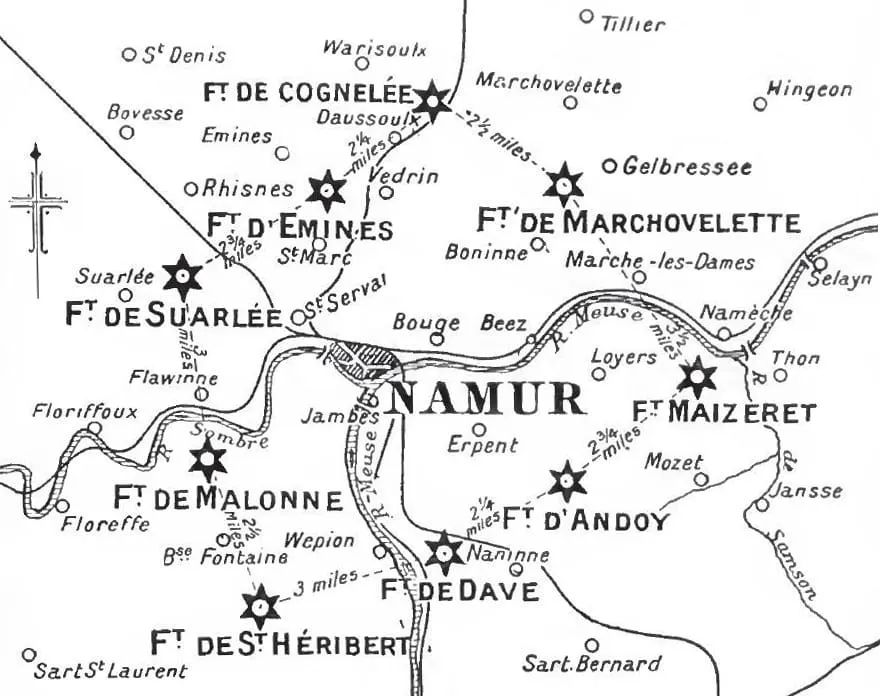
The siege of the fortress of Namur lasted from 20 to 25 August 1914. After Liège it was the second great Belgian fortress on the Germans’ road to France. It fell even faster, smashed by the heaviest siege artillery then available to the Central Powers.
A fortress at the confluence of rivers
Namur lies where the Sambre flows into the Meuse. The city barred the Meuse valley, one of the main routes from Germany into France. In 1888–1892 it was surrounded by a ring of nine forts designed by General Henri Brialmont, the same man who designed the forts of Liège. On the left bank of the Meuse stood the forts of Malonne, Saint-Héribert, Suarlée, Emines, Cognelée and Marchovelette, and on the right bank Maizeret, Andoy and Dave. Some of them had been modernised before the war, but none was prepared for 305 mm and 420 mm shells.
The fortress was defended by the Belgian 4th Division together with the fort garrisons, about 37,000 soldiers in all under General Édouard Michel. Against them the German Second Army of General Karl von Bülow detached the group of General Max von Gallwitz, numbering about 107,000 men. It comprised the Guard Reserve Corps, the XI Corps and part of the VII Reserve Corps. Most important of all, however, was the artillery: German 420 mm M-Gerät mortars brought from Liège, and Austro-Hungarian 305 mm Škoda mortars.
Course of the siege
On 20 August the German troops stood in full strength before the forts of the north-eastern and south-eastern sectors. That is why the siege is usually dated from that day, although the actual bombardment began a day later. On 21 August the artillery opened fire, at first hampered by fog. The German attack on the fortress coincided with the start of the Battle of the Sambre, in which the French Fifth Army was defending itself against the rest of Bülow’s forces. The French managed to send only small reinforcements to Namur.
On 22 August the 3rd Guard Division became embroiled in fighting near Fort Marchovelette, which delayed the main assault by a day. On 23 August heavy shells literally smashed the forts of the north-eastern sector. Around noon Fort Cognelée fell, soon afterwards Marchovelette, and then Maizeret. In the afternoon the Germans reached the northern outskirts of Namur. General Michel concluded that further defence was impossible and in the evening led the 4th Division out to the south, towards France. That day the Germans entered the city.
The forts held out after the division had gone. On 24 August Andoy, Malonne, taken by surprise, and Saint-Héribert fell. On 25 August the last three capitulated: Emines, Dave and Suarlée. The occupation of the city was accompanied by fires in which the town hall and part of the centre burned down.
Escape of the 4th Division
The only line of retreat was the region between the Sambre and the Meuse, to the south. On the night of 23–24 August the Belgian column marched on, harassed by the Germans from the rear and the flank. Its rearguard was surrounded at Ermeton-sur-Biert, but about 12,000 soldiers reached France via Mariembourg. From there they were taken to Le Havre and then by sea to Ostend, from where they rejoined the Belgian army in Antwerp.
Losses
According to various estimates the Belgians lost about 15,000 soldiers at Namur, of whom about 10,000 belonged to the 4th Division. About 5,700 Belgian and French soldiers were taken prisoner. German losses were far smaller, amounting to about 900 men, including about 300 killed.
Significance
The fall of Namur opened the Meuse valley to the Germans and coincided with the French defeat on the Sambre and the British retreat from Mons. The siege confirmed what Liège had already shown: late-19th-century fortresses could not withstand modern heavy artillery. The heavy mortars were soon moved to the French fortress of Maubeuge, and in the autumn to Antwerp.
Spotted a mistake?Report an error