Key event
Battle of Mons
- Category:
- Military operations
- Front:
- Western Front
- Date:
- 23 August 1914
- Author:
- Łukasz Skowroń
- Battle:
- Battle of Mons
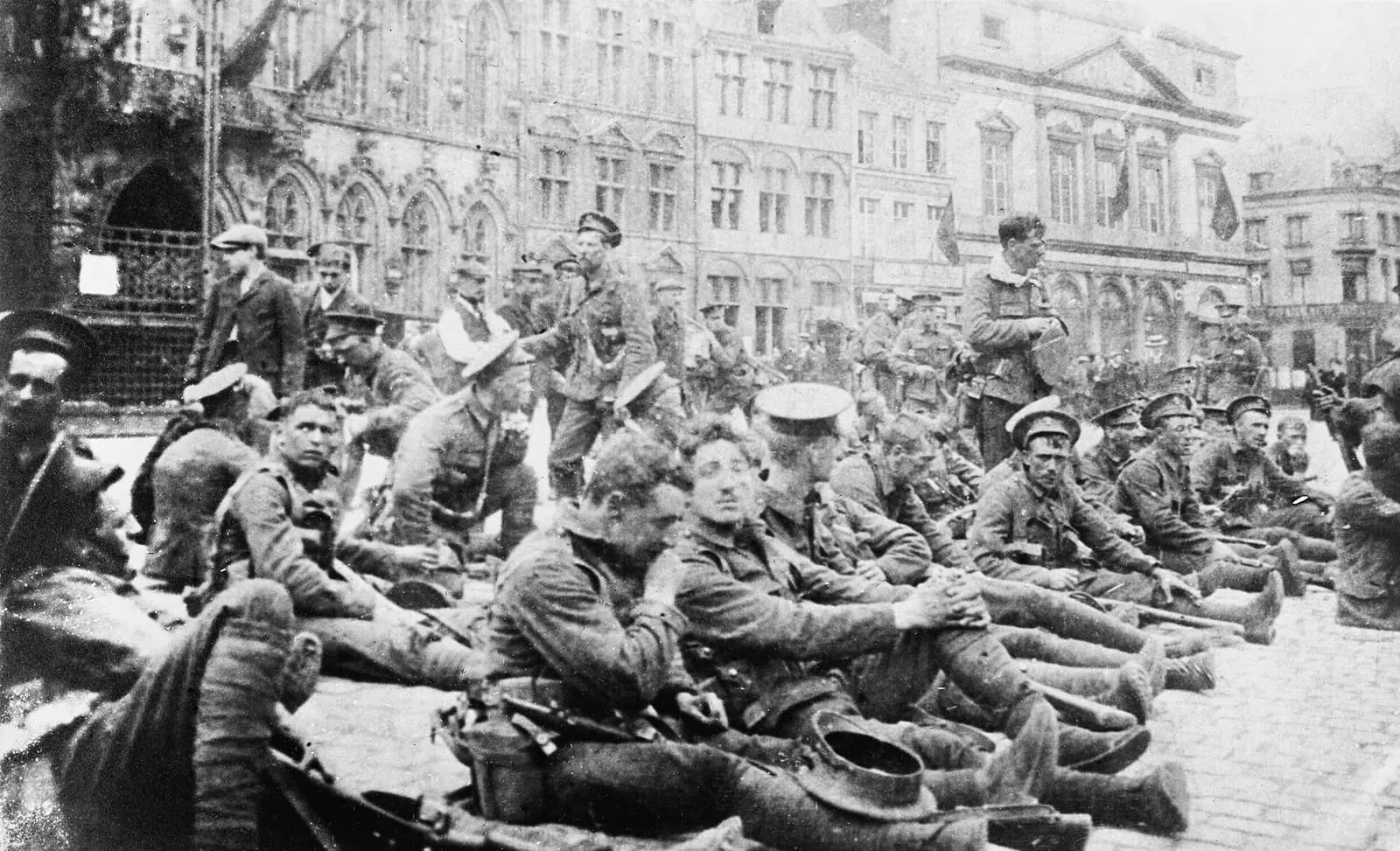
On 23 August 1914, near the Belgian town of Mons, the British Expeditionary Force fought its first battle of the war. It was the first time the British had fought in Western Europe since the Battle of Waterloo in 1815, fought, as it happens, not far away. The British official history noted that the two divisions that bore the brunt of the fighting numbered together just under 36,000 men, not many more than Wellington’s whole army at Waterloo.
Meeting Kluck’s army
The force, commanded by Field Marshal Sir John French, had completed its landing in France in mid-August and moved up on the left of the French Fifth Army. On 22 August General Horace Smith-Dorrien’s II Corps took up the line of the Mons–Condé canal, from Mons westwards, and General Douglas Haig’s I Corps stood to its right, facing north-east. Around Mons itself the canal formed a projecting loop that was hard to defend. That morning a patrol of the 4th Dragoon Guards near Casteau fired, according to the official history, the British army’s first shots on the Continent.
The British were to push on north towards Soignies. On the evening of 22 August, however, French learned that the French Fifth Army had fallen back from the Sambre, and called off the advance. At the request of General Lanrezac, delivered at about eleven at night, he agreed to hold the line of the canal for 24 hours. He did not know that heading straight for him was General Alexander von Kluck’s German First Army, the strongest of them all. Kluck did not know whom he would meet either: he believed the British had landed at Ostend, Dunkirk and Calais.
Sunday on the canal
23 August was a Sunday. In the morning the mist and rain gave way to fine weather, church bells were ringing, and the inhabitants of the nearby villages were going to church in their Sunday best. At about six in the morning German cavalry exchanged the first shots with British infantry near Obourg (PL). Before nine German guns were already shelling the loop of the canal, and the German IX Corps closed round it from Obourg to Nimy. At about eleven the III Corps came into action at Jemappes (PL) and Saint-Ghislain (PL).
At first the Germans attacked in dense masses, which fell under the fire. The British soldiers were professionals, trained in fast and accurate rifle fire. The official history writes that the Germans believed they were facing nothing but machine guns everywhere. The Brandenburg Grenadier regiment that attacked at Saint-Ghislain lost 25 officers and more than 500 men. One of its company commanders, the novelist Walter Bloem, recalled: “Our first battle is a heavy, unheard-of heavy defeat, and against the English, the English we laughed at.”
It was worst in the loop of the canal. In the afternoon the Germans crossed the canal west of Obourg and began to work round the battalions defending it. The 4th Battalion, Royal Fusiliers, held the bridges at Nimy, where the crews of two machine guns were killed or wounded to the last man. For this fight Lieutenant Maurice Dease and Private Sidney Godley received some of the war’s first Victoria Crosses. Dease died of his wounds. At about two in the afternoon the battalion withdrew from Nimy, and at three the Scots Fusiliers left Jemappes. At Mariette and Jemappes two more crosses went to sappers, Captain Theodore Wright and Lance-Corporal Charles Jarvis, who laid charges under the bridges under fire.
Withdrawal
By evening most of the II Corps had fallen back to a second line a few kilometres behind the canal, although some battalions held on at the water until night. The British lost that day just over 1,600 killed, wounded and missing, almost all in the II Corps, and half of them in the two battalions defending the loop of the canal. German losses are not known exactly but were much higher: the 75th (Bremen) Regiment alone lost 381 men in a single attack. At dusk the British heard German bugles sound the “cease fire”, as if on manoeuvres. Kluck expected to meet stubborn resistance again the next day.
At 8.40 p.m. French was still announcing that he would stand the attack on the ground he held. During the evening and just before midnight, however, news came from the French: Lanrezac’s Fifth Army, beaten on the Sambre, was retreating south, and fresh German columns were approaching from the west. The British were threatened with encirclement, and French decided to withdraw at once. The next day the Great Retreat began, which ended only on the Marne.
The battle delayed the march of Kluck’s army by a whole day and quickly became a legend in Britain. Soon there even appeared the story of the Angels of Mons, who were said to have shielded the retreating soldiers.
Remember the articles you have read? Only in this browser; nothing is sent anywhere.How it works
Read ·
A voice from the front
“And slowly, step by step, we begin the march back with our wretched freight. Through the wet ditches we had leapt across in the assault. And now and then a foot strikes something soft: a dead man. Weary bones want to give out. No help for it, it has to be done.”
Translated · Original (de)
Und langsam, Schub auf Schub, treten wir den Rückmarsch an mit unserer Jammerfracht. Durch die nassen Gräben hindurch, die wir stürmend übersprungen. Und ab und zu stößt der Fuß an etwas Weiches: ein Toter. Die müden Knochen wollen den Dienst versagen. Hilft nichts, muß geschafft werden.
Sources
Spotted a mistake?Report an error
Meanwhile
(04)Elsewhere in the same days.
- 23 August 1914 · Asia and the PacificJapan declares war on GermanyOn 23 August 1914 Japan declared war on Germany. The war spread to the Far East and the Pacific, and Japan reached for Germany's possessions in Asia.
- 23 August 1914 · Eastern FrontBattle of Tannenberg beginsOn 23 August 1914 Samsonov's Russian Second Army clashed with the Germans in southern East Prussia. Fighting began that would end in its encirclement.
- 23 August 1914 · Eastern FrontThe Battle of Kraśnik beginsOn 23 August 1914 the Austro-Hungarian First Army and the Russian Fourth Army clashed in the Lublin region. The great Battle of Galicia had begun.
- 23 August 1914 · Asia and the PacificGermany breaks off diplomatic relations with JapanOn 23 August 1914, after the Japanese ultimatum expired, Germany broke off relations with Japan. Ambassador Arthur von Rex left Tokyo.
Related events
(04)The same battle, people or subject.
- 24 August 1914 · Western FrontThe British retreat from MonsOn 24 August 1914 the British Expeditionary Force began its retreat from Mons. Rearguards fought heavy actions at Elouges and Audregnies.
- 26 August 1914 · Western FrontBattle of Le CateauOn 26 August 1914 Smith-Dorrien's II Corps stood and fought at Le Cateau against the wishes of GHQ. It paid a high price but halted the German pursuit.
- 29 August 1914 · Western FrontBattle of Guise beginsOn 29 August 1914 Lanrezac's French Fifth Army broke off its retreat and counter-attacked Bülow's German Second Army on the river Oise.
- 12 September 1914 · Western FrontBattle of the Aisne beginsOn 12 September 1914 the British and French, pursuing the Germans after the Marne, reached the Aisne. The Germans dug in on the heights beyond the river.