Key event
Battle of Charleroi begins
- Category:
- Military operations
- Front:
- Western Front
- Date:
- 21 August 1914
- Author:
- Łukasz Skowroń
- Battle:
- Battle of Charleroi
- Tags:
- Charleroi, France, Germany, Battle of the Frontiers
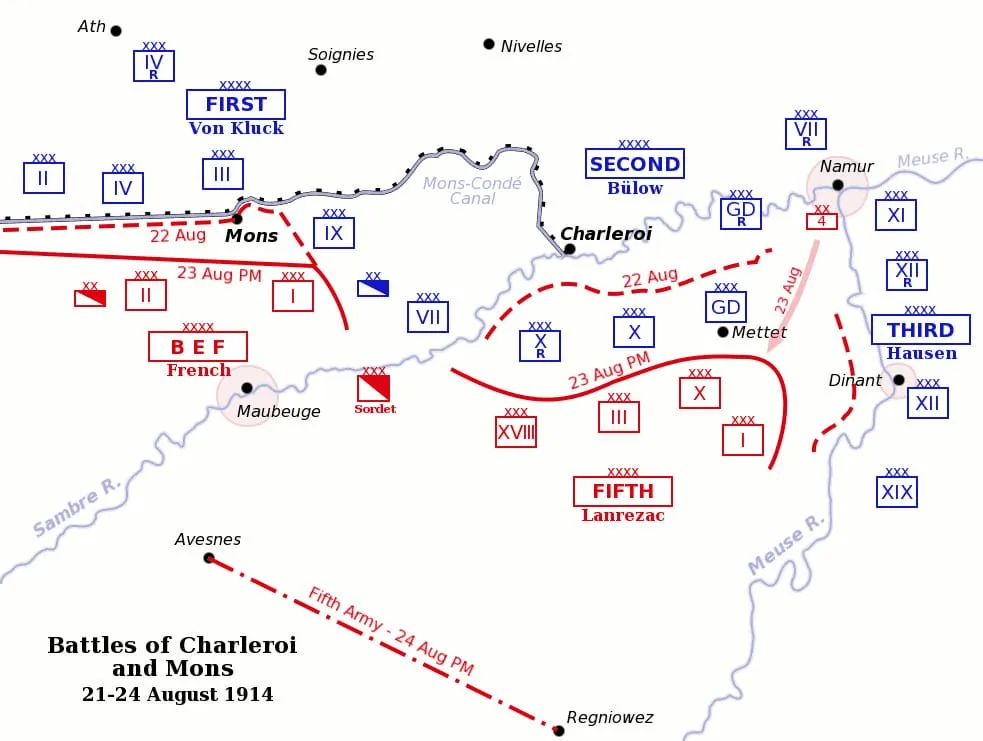
On 21 August 1914, on the river Sambre in the area of the Belgian town of Charleroi, a battle began between General Charles Lanrezac’s French Fifth Army and General Karl von Bülow’s German Second Army. It was one of the most important Battles of the Frontiers. It began against the plans of both commanders: the French were preparing to attack, the Germans were for the time being only to close up to the river, and the fighting broke out at the crossings before anyone had given the order for battle.
Unheeded warnings
From the start of the war Lanrezac had been warning the high command that the Germans were advancing through Belgium in much greater strength than was believed. For a long time Joffre would not accept this. Only on 15 August, after news of German crossings of the Meuse, did he send the main body of the Fifth Army north, into the angle between the Sambre and the Meuse, and he changed its composition at the last minute, giving it two divisions from Africa and a corps from Lorraine. On 20 August two corps, the X and III, stood along the Sambre between Namur and Charleroi, the I Corps was guarding the Meuse south of Namur, and the XVIII Corps stood to the rear on the left flank. The army’s front formed a projecting wedge, at whose apex lay the fortress of Namur. To the left, at Mons, the British Expeditionary Force was to take its place, and it was only just coming up.
French intelligence believed there were five German corps north of the Meuse. In fact there were thirteen.
Orders and doubts
On the morning of 21 August Fifth Army headquarters moved from France to Chimay (PL) in Belgium. That day Joffre, who the day before had lost the battle of Morhange and Sarrebourg, decided to regain the initiative in the north. In his Special Order No. 15 he announced that the Third and Fourth Armies were advancing through the Ardennes, and that the Fifth Army, resting on the Meuse and Namur, was to strike at the enemy’s northern group. The British were asked to march in the direction of Soignies.
Lanrezac did not want to cross the Sambre without support. In the early afternoon he replied that if his army, deprived of the I Corps left on the Meuse, moved off the next day, it might have to give battle alone, and that to act together with the British it would have to wait until 23 or even 24 August. He asked whether he was to cross the river. At eight in the evening Joffre answered that he left him “absolute judge” of the moment to begin the offensive. The British liaison officer Edward Spears, who that afternoon had listened to Lanrezac lecturing his officers in front of a map on the folly of leaving strong defensive positions to attack, became convinced that the general would be unwilling to attack.
The fight for the crossings
Meanwhile the fighting began of its own accord. Bülow had ordered his troops only to occupy the north bank of the Sambre, but some divisional commanders did not obey. The Prussian Guard found unguarded railway bridges between Auvelais and Tamines. Ludendorff, who watched the 2nd Guard Division crossing west of Namur, recalled seeing the “magnificent men of the Augusta Regiment” go into battle. German units struck the advance guard of the French X Corps in the bend of the river between Tamines and Auvelais. The first attack was repulsed, but at one in the afternoon the Germans crossed the river and moved on Arsimont.
The French counter-attacks were delivered as they had been taught before the war. The regiment sent to retake Auvelais (PL) advanced, according to Spears, in dense formation, with bugles blowing, drums beating and flags flying. It reached the edge of the village, but the Guardsmen had already organised its defence, and machine-gun and artillery fire drove the French back. After this check Tamines was abandoned. At about three in the afternoon, on the III Corps front, the Germans crossed at Roselies and broke into Aiseau, from which they were later driven out. At nine in the evening the X Corps also abandoned Arsimont, leaving the enemy the heights south of the river. In the west, General Sordet’s French cavalry lost the crossings of the canal at Luttre and Pont-à-Celles.
That same day German siege artillery began to shell the forts of Namur. When a French officer sent there reported in the evening that without help the fortress would not hold out another day, Lanrezac sent it three battalions of the I Corps during the night.
What came next
At headquarters in Chimay no one yet knew that a battle had begun. Even the next morning the staff believed that the Germans were merely feeling the French front, and was convinced that it could throw them back into the river whenever it wished. On 22 August the fighting flared up along the whole front, and French counter-attacks without artillery support ended in heavy losses. Civilians paid a high price for the fighting: on 21 August several dozen inhabitants were killed in Auvelais and Arsimont, and on 22 August the Germans shot several hundred in Tamines, 383 people according to French figures. When on 23 August the German Third Army forced the Meuse at Dinant, Lanrezac ordered a retreat. The defeat on the Sambre, together with the reverses in the Ardennes and at Mons, began the Great Retreat of the Allies, which halted only on the Marne.
Remember the articles you have read? Only in this browser; nothing is sent anywhere.How it works
Read ·
Sources
Spotted a mistake?Report an error
Meanwhile
(04)Elsewhere in the same days.
- 21 August 1914 · AfricaGermans cross the border of the Union of South AfricaIn August 1914 a detachment from German South West Africa took up positions on the South African side of the border, near Nakob.
- 21 August 1914 · MilitaryKitchener's first New Army is formedOn 21 August 1914 the British War Office ordered the formation of the first New Army, six divisions strong, from volunteers.
- 20 August 1914 · SocietyBritain modifies the Declaration of LondonOn 20 August 1914 Britain announced it would apply the Declaration of London on naval warfare, but with changes that tightened control of trade.
- 20 August 1914 · SocietyDeath of Pope Pius XOn 20 August 1914, in the first weeks of the war, Pope Pius X died. Witnesses said the outbreak of war had deeply shaken him. He was succeeded by Benedict XV.
Related events
(04)The same battle, people or subject.
- 24 August 1914 · Western FrontEnd of the Battle of CharleroiOn 24 August 1914 the French Fifth Army was retreating from the Sambre towards the French border. The Battle of Charleroi ended in a French defeat.
- 29 August 1914 · Western FrontBattle of Guise beginsOn 29 August 1914 Lanrezac's French Fifth Army broke off its retreat and counter-attacked Bülow's German Second Army on the river Oise.
- 30 August 1914 · Western FrontBattle of Guise endsOn 30 August 1914 the French Fifth Army broke off the fight with Bülow's army and withdrew behind the Serre. The Battle of Guise was over.
- 22 August 1914 · Western FrontBattle of the Ardennes beginsOn 22 August 1914 French armies advancing through the Ardennes ran into strong German forces. It was the bloodiest day in the history of the French army.