Russia · The Entente
Alexander Samsonov
Commander of the Russian 2nd Army (1914), general of cavalry
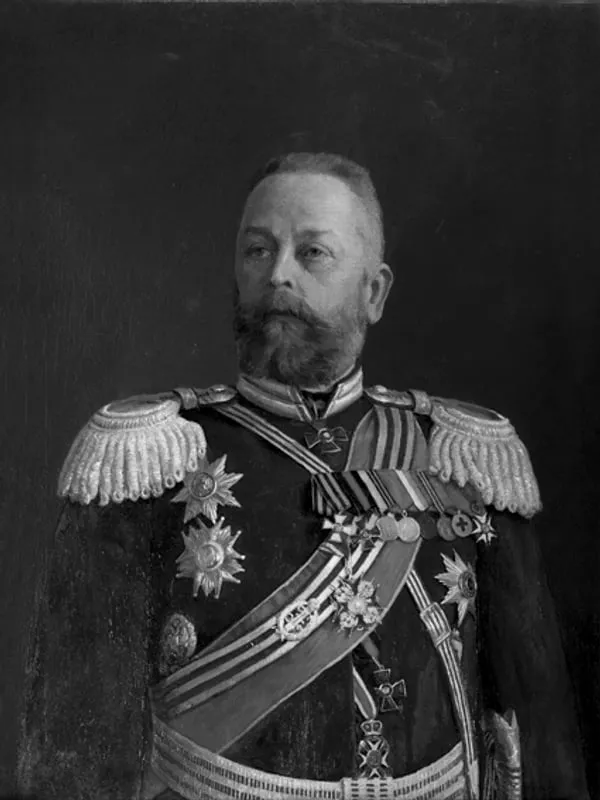
- Born:
- 14 November 1859, Kherson Governorate (Russian Empire, now Ukraine)
- Died:
- 30 August 1914, Near Willenberg (East Prussia)
- Author:
- Łukasz Skowroń
- Photo:
- unknown painter, domena publiczna, Wikimedia Commons

General Alexander Samsonov commanded the Russian 2nd Army in August 1914, in the first Russian offensive into East Prussia. Less than two weeks after crossing the border his army was encircled and destroyed at Tannenberg, and more than 90,000 soldiers were taken prisoner. Samsonov did not survive the defeat: on the night of 29–30 August he walked away from his staff in the forest near Willenberg (Wielbark) and shot himself. His name became a symbol of the catastrophe, to which, however, not only his own mistakes contributed, but also the plan, the haste and the chaos of command at every level of the Russian army.
Before the war
He was born on 14 November 1859 (2 November in the Julian calendar) in the Kherson Governorate, into a family of landed gentry. He completed the military gymnasium in Kiev and the Nicholas Cavalry School in St Petersburg, and as an eighteen-year-old cornet of hussars he fought in the Russo-Turkish War. In 1884 he graduated from the General Staff Academy. For several years he served on the staff of the Warsaw Military District, and in 1896–1904 he headed the cavalry cadet school at Yelisavetgrad.
The Russo-Japanese War brought him fame. In it he commanded the Ussuri Mounted Brigade and then the Siberian Cossack Division, with which he fought at Liaoyang, on the Shaho and at Mukden. He earned a reputation as an energetic and brave cavalry commander, although some observers doubted his strategic abilities. After the war he was chief of staff of the Warsaw Military District, in 1907–1909 appointed ataman of the Don Cossacks, and from 1909 governor-general of Turkestan and commander of the Turkestan Military District. In 1910 he was promoted to general of cavalry. He was a good administrator, but he had not commanded troops in the field for ten years and had never led an army made up of several corps.
For decades Russian tradition repeated the story of his bitter enmity with General Paul von Rennenkampf, with whom he was supposed to have come to blows after the Battle of Mukden. Its source was the memoirs of the German officer Max Hoffmann, who could not have witnessed the incident, and at the time given Rennenkampf was lying wounded in hospital. Historians today regard it as gossip.
The march into Prussia
The outbreak of war found Samsonov on leave in the Caucasus. From there he went straight to Warsaw, where on 5 August 1914 he took command of the 2nd Army. Under the plan agreed earlier with the French, it was to strike from the south, from the Narew, towards Allenstein, while Rennenkampf’s 1st Army advanced from the east. The two armies were to trap the German 8th Army in a pincer, but they were separated by the Masurian Lakes and more than a hundred kilometres. Their operations were to be coordinated by the commander of the North-Western Front, General Yakov Zhilinsky.
Russia had promised France a swift offensive, so the 2nd Army set out before mobilisation was complete and crossed the border on 20 August. Zhilinsky kept urging Samsonov on, and his soldiers, exhausted by marching along sandy roads, went hungry because the supply trains could not keep up. Communications between the corps were dreadful, and Russian staffs sent orders by radio in plain text. Samsonov, convinced that after their defeat at Gumbinnen the Germans were retreating behind the Vistula, shifted the direction of his advance to the north-west to cut off their escape. Rennenkampf, directed by Zhilinsky towards Königsberg, was moving away from him. A gap more than a hundred kilometres wide opened between the armies.
Tannenberg
Meanwhile Paul von Hindenburg and Erich Ludendorff took command of the German 8th Army. They adopted Hoffmann’s plan: to leave a weak screen against Rennenkampf and throw almost all their forces against Samsonov. On 23 August the Russian XV Corps clashed near Neidenburg with the German XX Corps, which after two days of fighting withdrew to new positions. Samsonov took this for a retreat and pushed his centre corps further north, unaware that he was walking into a trap.
On 26 August the Germans struck both wings in the Battle of Tannenberg. On the right wing the Russian VI Corps was beaten near Bischofsburg and began to fall back; on the left, General Leonid Artamonov’s I Corps withdrew towards Soldau after fighting at Usdau. Samsonov, indignant, removed Artamonov from command, but this did not avert the crisis. On the morning of 28 August, still counting on a breakthrough in the centre, he went up to the front line, to the headquarters of General Nikolai Martos’s XV Corps. Before leaving he informed Zhilinsky that he was taking down the telegraph apparatus and would be temporarily out of contact. The Russian military historian General Nikolai Golovin believed that at that moment the command of the 2nd Army came to an end.
Instead of directing the army, Samsonov found himself among the fighting corps, not knowing what was happening on the wings. The British liaison officer Alfred Knox, who was with him that day, recalled the calm and fatalism of the Russian officers. When he finally ordered the centre corps to retreat, it was already too late. On 29 August the German pincers closed behind XIII, XV and XXIII Corps in the forests between Hohenstein and Neidenburg.
Death
Samsonov and his staff tried to make their way south, towards the border. Near Willenberg his Cossack escort ran into German machine guns. On the evening of 29 August the general, seven staff officers and one soldier were left on their own and set off on foot through the forests and marshes. According to the army’s chief of staff, General Pyotr Postovsky, Samsonov said several times that his life as a soldier was over, and had already wanted to shoot himself earlier, but his companions had stopped him. During the night, at a halt in the forest near the Karolinenhof farmstead, he slipped away unnoticed. The officers heard a shot. They searched for him until dawn but did not find the body, and in the morning they had to flee from German patrols. There are also other accounts, according to which the general was killed by an artillery shell, but the suicide version is generally accepted.
For a long time the Russian authorities were uncertain of his fate, because the general’s name did not appear on the lists of prisoners. In 1915 his wife Yekaterina, who as a nursing sister was visiting prisoner-of-war camps in Germany, found the grave in the forest with the help of local people and recognised her husband by a medallion with a family photograph. The body was brought back to Russia and buried on the family estate in the Kherson Governorate. The crypt was later destroyed.
The cost of the defeat
On 31 August Hindenburg reported to the Kaiser the destruction of three Russian corps. According to later studies about 92,000 Russians were taken prisoner, and the total losses of the 2nd Army reached, depending on the estimate, 120,000–170,000 men. The wing corps, I and VI, escaped encirclement but withdrew badly mauled. A few days later the Germans struck Rennenkampf at the Masurian Lakes and drove the Russians out of East Prussia. The offensive did, however, fulfil its task towards the allies: the German high command transferred two corps from the Western Front to the east, and they were then missing in the Battle of the Marne.
Assessment
Zhilinsky wrote in his report that Samsonov’s conduct as a commander deserved severe condemnation, but that as a soldier he had behaved with dignity: he had personally directed the fighting under fire and had not wished to survive the defeat. Historians criticise him above all for the change in the direction of advance, which pulled the two armies apart, for ignoring warnings of the threat to his flanks, and for going to the front, which deprived the army of command in the decisive hours.
At the same time most scholars stress that Samsonov paid for other people’s mistakes. The offensive was launched before mobilisation was complete and without logistic support, Zhilinsky hurried him and misjudged the situation, and Rennenkampf marched in a different direction. Grand Duke Alexander Mikhailovich wrote years later that the so-called victory on the Marne was in reality the sacrifice of Samsonov’s army. The Russian historian Konstantin Pakhaliuk holds that the main blame for the defeat in East Prussia lies with Zhilinsky, and that Samsonov and Rennenkampf, capable commanders of divisions or corps, were out of place at the head of armies.
Sources
Spotted a mistake?Report an error
Commanded in battles
(01)Mentioned in battles
(01)Often appears with
People who appear in the same events.
On the timeline
(03)1914
August
- 23
- Battle of Tannenberg beginsOn 23 August 1914 Samsonov's Russian Second Army clashed with the Germans in southern East Prussia. Fighting began that would end in its encirclement.
- Hindenburg takes command of the Eighth ArmyOn 23 August 1914 General Paul von Hindenburg, recalled from retirement, took command of the Eighth Army in East Prussia, with Ludendorff as chief of staff.