Russia · The Entente
Paul von Rennenkampf
Commander of the Russian 1st Army (1914), general of cavalry
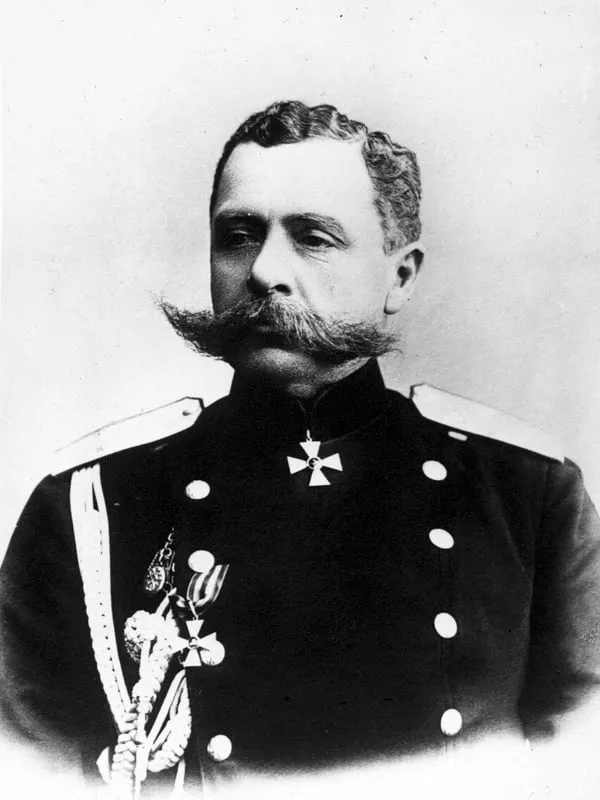
- Born:
- 29 April 1854, Konofer, today Konuvere (Governorate of Estonia, now Estonia)
- Died:
- 1 April 1918, Taganrog
- Author:
- Natalia
- Photo:
- autor nieznany, domena publiczna, Wikimedia Commons

In 1914 General Paul von Rennenkampf commanded the Russian 1st Army, which was the first to enter East Prussia and on 20 August won at Gumbinnen the only major Russian victory of that campaign. A few days later the Germans destroyed the neighbouring army of Alexander Samsonov at Tannenberg, and Rennenkampf, who had not come to its aid, became in the eyes of the public the chief culprit of the defeat. After the defeat at the Masurian Lakes and the failure to close the pocket at Łódź he lost his command, and his German surname brought him accusations of treason. Historians today judge him more leniently than his contemporaries did, pointing out that his superiors made the more serious mistakes.
Before the war
He was born on 29 April 1854 (17 April in the Julian calendar) on the Konofer estate in Estonia, into a Lutheran family of Baltic Germans. He graduated from the Junker school in Helsingfors and from the General Staff Academy, and then served for many years on staffs and in the cavalry. He won fame during the suppression of the Boxer Rebellion in Manchuria in 1900. With a few hundred Cossacks and a battery of artillery he covered hundreds of kilometres in a few weeks and took Qiqihar on the march, and then Jilin. For this expedition he received the Order of St George, 4th and 3rd class.
In the Russo-Japanese War he commanded the Transbaikal Cossack Division. In the summer of 1904 he was badly wounded in the leg, but returned to the front before the wound had healed, and at the Battle of Mukden he stubbornly defended the army’s left wing. In 1905–1906 he brutally suppressed revolutionary movements along the Trans-Siberian Railway and in Chita, which the left long held against him. Later he commanded corps, in 1910 became a general of cavalry, and in 1913 commander of the Vilna Military District. The troops of this district formed part of his army in 1914.
Connected with the Japanese war is the legend of his enmity with Samsonov. According to the German officer Max Hoffmann, the two generals publicly quarrelled and even came to blows on the platform at Mukden. Hoffmann, however, could not have seen this, and at the time he indicated Rennenkampf was lying wounded in hospital. Historians regard the story as gossip that Hoffmann used in his planning in 1914 to convince his superiors that Rennenkampf would not hurry to Samsonov’s aid.
Gumbinnen
At the outbreak of war Rennenkampf took command of the 1st Army, part of the North-Western Front of General Yakov Zhilinsky. Russia had promised France a swift offensive, so his army set off before it had completed mobilisation. On 17 August it crossed the border of East Prussia and the same day clashed at Stallupönen with the corps of General Hermann von François. Three days later the German Eighth Army attacked it at Gumbinnen. The attack of August von Mackensen’s corps in the centre collapsed under Russian artillery fire, and the battlefield remained in Russian hands. The German commander Maximilian von Prittwitz panicked and considered retreating behind the Vistula, for which he lost his post.
Tannenberg and the Masurian Lakes
Rennenkampf did not exploit his victory. For several days he put his army in order and replenished supplies, and then moved slowly westwards. Zhilinsky, convinced that the Germans were fleeing behind the Vistula, ordered him to direct his main forces towards Königsberg rather than towards a junction with Samsonov. Meanwhile Paul von Hindenburg and Erich Ludendorff left only a weak screen against the 1st Army and moved almost the whole Eighth Army south. Russian radio stations transmitted orders in plain text, so the Germans knew that Rennenkampf posed no threat to their rear. When at the end of August Samsonov’s army was encircled at Tannenberg, Rennenkampf’s corps were too far away and set off to help too late.
After his neighbour’s defeat Rennenkampf dug in on a line from the Deime to Lake Mamry. In September the Germans, reinforced from France, struck him at the Masurian Lakes and began to outflank his left wing. This time Rennenkampf reacted in time: he moved his reserves to the threatened sector and on 9 September, according to some sources a day later, ordered a retreat. The army fell back in haste, abandoning its trains and guns, and for a time the commander lost contact with his corps. It nevertheless escaped encirclement and by the middle of September withdrew behind the Niemen, where it quickly rebuilt its strength. At the end of the month the German attack across the river was repelled mainly by the new 10th Army of General Vasily Flug in the fighting on the Niemen, in which Rennenkampf’s units also took part. Zhilinsky lost his post, but Rennenkampf kept his.
Łódź and dismissal
In November 1914 the 1st Army covered the right flank of the Russian offensive towards Silesia, standing on the Vistula between Włocławek and Warsaw. On 11 November Mackensen struck its V Siberian Corps at Włocławek and broke into the gap between the 1st and 2nd Armies. In the Battle of Łódź the Germans almost encircled the 2nd Army, but were themselves caught in a trap. A group detached from Rennenkampf’s army, advancing from the direction of Łowicz, was to close the pocket around the German group of General Reinhard von Scheffer-Boyadel. It acted, however, slowly and chaotically, and on 24 November the Germans broke out at Brzeziny.
The commander of the North-Western Front, Nikolai Ruzsky, put the blame on Rennenkampf, and at the turn of November and December the general was removed from command; the 1st Army was taken over by General Alexander Litvinov. The affair was investigated by a special commission under General Pyotr Baranov. According to Russian studies it found that the main mistakes had been made by Ruzsky, but the Stavka did not restore Rennenkampf to service. In October 1915 he was retired “for domestic reasons”, with the right to wear uniform and to a pension.
The defeats in East Prussia and his German surname made him a traitor in the eyes of many Russians. He was insulted in the press and in the streets of Petrograd, and rumours of his supposed sympathy for the Germans circulated long after the war. The Chief of Staff of the Stavka, Nikolai Yanushkevich, wrote to the Minister of War that the mass of complaints about “Germans” in the army, including Rennenkampf, had led Grand Duke Nicholas Nikolaevich to choose as his successor a man with a Russian surname instead of General Pavel Plehve.
After the war
After the February Revolution Rennenkampf was arrested and imprisoned in the Peter and Paul Fortress. The revolutionaries remembered 1906 against him, but the investigating commission of the Provisional Government found no grounds for a charge. After the October Revolution he was released and went to Taganrog, his wife’s home town, where he hid under an assumed name, passing himself off, among other things, as a Greek. In March 1918 the Bolsheviks recognised and arrested him. According to accounts he was offered a command in the Red Army, and when he refused, Vladimir Antonov-Ovseyenko had him shot. The execution took place outside the town on the night before 1 April 1918. Some Russian authors give the date as 14 April, converting it to the New Style. The grave was found after the Whites took the town, and its probable location in the old cemetery in Taganrog was established by local researchers in 2015.
Assessment
For decades Rennenkampf was regarded as the symbol of the incompetence, even treason, of the Russian generals in 1914. This view was reinforced by Hoffmann’s accounts, by hostility towards a general with a German surname and by the need to find someone to blame for the defeat at Tannenberg. Modern Russian and Western historians usually defend him against the gravest charges. They point out that he won at Gumbinnen, that the direction of the march on Königsberg was set for him by Zhilinsky, and that at the Masurian Lakes he saved his army from encirclement.
This does not, however, absolve him of responsibility. After Gumbinnen he lost several valuable days, made poor use of his numerous cavalry for reconnaissance and failed to understand that the Germans had gone off against Samsonov. At Łódź his troops failed at the decisive moment. The Russian historian Konstantin Pakhaliuk put it this way: Rennenkampf and Samsonov were capable officers who at the head of corps or divisions would have earned nothing but praise, but at the head of armies they found themselves out of their depth.
Sources
Spotted a mistake?Report an error
Commanded in battles
(05)Often appears with
People who appear in the same events.