Key event
October Revolution
- Category:
- Politics
- Date:
- 7 November 1917
- Author:
- Łukasz Skowroń
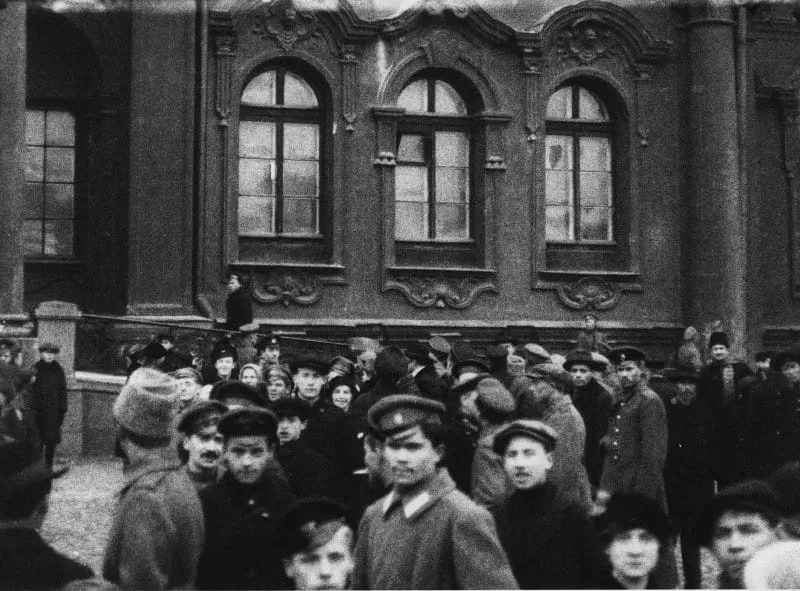
On 7 November 1917 (25 October in the Julian calendar) the Bolsheviks seized power in Petrograd. During the night and the day that followed, the units of the Military Revolutionary Committee (PL) of the Petrograd Soviet, that is Red Guards, soldiers of the garrison and sailors of the Baltic Fleet, occupied the bridges, railway stations, telegraph, telephone exchange, power station and State Bank almost without a fight. At ten in the morning the committee announced that the Provisional Government had been overthrown. The prime minister, Alexander Kerensky, left the city to look for troops at the front, while his ministers, shut up in the Winter Palace, waited for help that never came. At about 2.10 a.m. on the night of 7–8 November the palace was taken and the ministers arrested. At the same time the Second All-Russian Congress of Soviets was in session at the Smolny, and the Bolsheviks handed it the power they had won.
The British chronology of the war records the “Bolshevik coup d’état in Petrograd” under 8 November. That is the date on which news of the coup reached the Western capitals, and also the day on which the Winter Palace fell and the new government was formed. The rising itself, which gave the “October Revolution” its name, took place, however, on 7 November, or more precisely during the night of 6–7 November and the following twenty-four hours.
The road to the rising
After the collapse of the Kornilov revolt in September the Bolsheviks won a majority in the soviets of Petrograd and Moscow. At the beginning of October Leon Trotsky became chairman of the Petrograd Soviet. Kerensky’s government, which since September had been ruling a republic without a parliament and without any clear base of support, was losing the last of its authority. The army was disintegrating, there was a shortage of bread in the towns, and in the countryside the peasants were seizing the landowners’ estates on their own initiative. In October the Germans took the islands of the Gulf of Riga, and it seemed that they might march on the capital.
Vladimir Lenin, who since the July Days had been hiding near Petrograd and in Finland and in October had secretly returned to the capital, had been insisting since the end of September, in letters to the Central Committee, that power must be taken at once. On 23 October (10 October Old Style) the Central Committee resolved that an armed rising was on the agenda. Lev Kamenev and Grigory Zinoviev voted against, and soon made their opposition public in the press. All Petrograd therefore knew of the Bolsheviks’ plans, and every few days the government newspapers “fixed” the date of the rising.
The Military Revolutionary Committee became the instrument of the coup. The Petrograd Soviet set it up at the end of October, formally to defend the capital against the Germans and the “counter-revolution”. Its bureau included the Bolsheviks Nikolai Podvoisky and Vladimir Antonov-Ovseyenko as well as Left Socialist Revolutionaries, and in practice its work was directed by Trotsky. On 31 October (18 October Old Style) a meeting of regimental representatives resolved that the garrison would carry out the orders of the district staff only with the soviet’s consent. The committee sent its commissars to units and institutions. Once the soviet’s commissars had taken control of the barracks, the government was left without troops in the capital before the first shot was fired. The Bolsheviks wanted power to be taken formally by the congress of soviets, which had been summoned for 7 November. The rising was to present the congress with a fait accompli.
The night of 6–7 November
The government struck first. On the morning of 6 November (24 October Old Style) officer cadets occupied the printing works of the Bolshevik newspaper Rabochy Put, and Kerensky demanded that the Provisional Council of the Republic, the so-called Pre-Parliament, support him against the “rebels”. He obtained only half-hearted backing. The Military Revolutionary Committee retook the printing works, and when the government ordered the bridges over the Neva to be raised, the committee’s units began to seize them. In the afternoon they took the central telegraph office. Late in the evening Lenin, his face bandaged and wearing a wig, made his way from his hiding place in the working-class Vyborg district to the Smolny, a former institute for young ladies of noble birth, which housed the soviet and the committee.
During the night the committee’s units methodically occupied one point in the city after another. This was done without shots, as a “changing of the guard”: a commissar arrived with a detachment, and the government soldiers guarding the building either dispersed or joined the newcomers. Sailors were sailing in from Kronstadt and Helsingfors. At ten in the morning of 7 November the committee issued its proclamation “To the Citizens of Russia!”: power had passed into the hands of the organ of the Petrograd Soviet, and the cause for which the people had fought, namely the immediate offer of a democratic peace, the abolition of landlords’ ownership of land, workers’ control and soviet power, “is assured”.
At about eleven Kerensky left the Winter Palace by car for Gatchina, and from there went on to Pskov, to the headquarters of the Northern Front, to bring troops from the front. He was accompanied by a car from the American embassy flying the flag of the United States. At noon soldiers and sailors dispersed the Pre-Parliament from the Mariinsky Palace. In the afternoon Lenin appeared in public for the first time since July, at an extraordinary session of the Petrograd Soviet. According to the reports, he declared that the workers’ and peasants’ revolution, whose necessity the Bolsheviks had long spoken of, “has been accomplished”.
The storming of the Winter Palace
The government was left with only the Winter Palace. It was defended by officer cadets from the military schools of Peterhof and Oranienbaum, a company of the women’s Battalion of Death, Cossacks, artillerymen and invalid soldiers, holders of the Cross of St George. Estimates of their number range from a few hundred to about three thousand. In the evening most of the defenders drifted away: the battery of the artillery school left, and the Cossacks went at about 8 p.m. In the palace the ministers, presided over by the deputy prime minister Alexander Konovalov, waited for troops from the front and rejected the ultimatum that Antonov-Ovseyenko had sent them before seven in the evening from the Peter and Paul Fortress. At 9 p.m. the government broadcast by radio an appeal stating that the Petrograd Soviet was threatening to shell the palace from the guns of the fortress and the cruiser Aurora, but that the government could hand over power only to the Constituent Assembly and would therefore not surrender.
At about 9.40 p.m. the cruiser Aurora, anchored on the Neva, fired a single blank round from her bow gun. Soviet tradition made it the signal for the assault and a symbol of the revolution. In reality the cruiser could not fire on the palace from her position, and shooting around the building had already been going on before. At about 11 p.m. the guns of the fortress opened fire. According to Sergei Melgunov they fired some 35 live rounds, of which only two grazed the palace. The women’s company capitulated that same evening. Red Guards, soldiers and sailors made their way in growing numbers into the labyrinth of palace corridors, and the cadets no longer put up much resistance. At about 2.10 a.m. Antonov-Ovseyenko entered the room where the ministers were sitting and declared them under arrest. The prisoners were escorted to the Peter and Paul Fortress. Kerensky was not among them.
There were few casualties. There are no exact figures, but according to one Russian researcher, Vladimir Buldakov, six soldiers and one of the women of the battalion were killed in the assault. The looting of the palace began that same night. The storming, which later Soviet films showed as a mass battle, was in essence a long, chaotic siege of an almost defenceless building.
The Congress of Soviets
At 10.40 p.m., while shots were still being fired around the palace, the Menshevik Fyodor Dan opened the Second All-Russian Congress of Soviets of Workers’ and Soldiers’ Deputies at the Smolny. According to the figures of the factions’ bureau, about 650 delegates arrived, of whom the Bolsheviks had about 390, and together with the Left Socialist Revolutionaries a decisive majority. Kamenev became chairman of the presidium. Julius Martov proposed negotiations on a government of all the socialist parties, and his motion was adopted. Immediately afterwards, however, the Mensheviks, the Right Socialist Revolutionaries and the delegates of the Bund condemned the coup as a “military conspiracy” and left the hall. Trotsky dismissed them with the words that their place was “in the dustbin of history”. Their departure left the Bolsheviks a free hand.
At 3.10 a.m. Kamenev announced to the delegates that the Winter Palace had fallen and the ministers had been arrested. At about five in the morning the congress adopted Lenin’s appeal “To Workers, Soldiers and Peasants”: the Provisional Government had been overthrown, the congress was taking power into its own hands, and in the localities all power was passing to the soviets. The new authorities announced that they would immediately propose a democratic peace to all nations and an armistice on all fronts.
Why it succeeded
The coup was incomparably less bloody than the February Revolution. The Provisional Government had no reliable force in the capital. The garrison, which feared being sent to the front, recognised the soviet’s authority. The Cossacks remained neutral, and the officers, alienated by Kerensky’s treatment of Kornilov, were in no hurry to defend him. The Bolsheviks promised what most soldiers, workers and peasants wanted: peace, land and bread. In Lenin they also had a leader determined to take power, and in Trotsky an efficient organiser. They were not, however, assured of the country’s support. Their opponents spoke from the start of a coup d’état by a single party, and historians still argue over whether October was a popular revolution or a coup by a well-organised minority that exploited the paralysis of the state.
First reactions
Petrograd received the change of power with astonishing calm. The trams ran, the theatres played, and many inhabitants learnt what had happened from the newspapers. The Bolsheviks’ opponents, the right-wing socialists and the Kadets, began that same night to form the Committee for the Salvation of the Motherland and the Revolution in the city duma building, and counted on Kerensky returning with troops. Fighting was beginning in Moscow. In the West the news was fragmentary and contradictory. The American monthly Current History later wrote that after the first scanty reports of 8 November no reliable news came from Russia for ten days. For the Entente the coup meant the threat that its eastern ally would leave the war. For Germany it was the hope that it could at last move divisions from the east to the west.
Remember the articles you have read? Only in this browser; nothing is sent anywhere.How it works
Read ·
Voices from the front
“"Troops from all over, and from the front, who are coming to defend the Government," an officer tells me. […] Men? I say. No, children! They are very young recruits. These northern Russians look twelve at eighteen. They are beardless, tired kids who come along dragging their feet, volunteers all the same, to put themselves at the Government's service. It is pitiful and moving, this procession of boys who want to be heroic.”
Translated · Original (fr)
— Des troupes d'un peu partout, et du front, qui viennent défendre le Gouvernement, me dit un officier. […] Des hommes? dis-je. Non, des enfants! Ce sont de toutes jeunes recrues. Ces Russes du Nord, à dix-huit ans, ont l'air d'en avoir douze. Ce sont des gosses imberbes, fatigués, qui viennent là, traînant le pied, volontaires tout de même, pour se mettre au service du Gouvernement. C'est pitoyable et émouvant, ce défilé de gamins qui veulent être héroïques.
“Later. The news that the Bolsheviks have taken the Winter Palace is denied. The battle goes on. From the balcony flashes can be seen glittering in the sky, like frequent lightning. Dull thuds can be heard. It seems they are firing from the Palace too, at the Neva and at the Aurora. They are not surrendering. But they are almost naked: there are only cadets there, a shock battalion and the women's battalion. No one else.”
Translated · Original (ru)
Позднее. Опровергается весть о взятии б-ми Зимнего Дворца. Сраженье длится. С балкона видны сверкающие на небе вспышки, как частые молнии. Слышны глухие удары. Кажется, стреляют и из Дворца, по Неве и по Авроре. Не сдаются. Но — они почти голые: там лишь юнкера, ударный батальон и женский батальон. Больше никого.
Spotted a mistake?Report an error
Meanwhile
(04)Elsewhere in the same days.
- 7 November 1917 · Middle EastBritish take GazaOn 7 November 1917 the British entered Gaza, abandoned by the Turks, and broke their front at Tel esh Sheria. The pursuit northwards began.
- 6 November 1917 · Middle EastBritish occupy TikritOn the night of 5–6 November 1917 the Turks abandoned Tikrit on the Tigris, burning their stores. The British took the town but returned to Samarra days later.
- 6 November 1917 · Western FrontCanadians capture PasschendaeleOn 6 November 1917 two Canadian divisions took the ruins of Passchendaele, goal of the offensive since 31 July, in under 3 hours, and Mosselmarkt and Goudberg.
- 8 November 1917 · Italian FrontCadorna dismissedOn 8 November 1917 King Victor Emmanuel III removed General Luigi Cadorna after Caporetto. General Armando Diaz became the new Italian Army chief of staff.
Related events
(04)The same battle, people or subject.
- 12 November 1917 · Military operationsBattle of PulkovoOn 12 November 1917 Red Guards and sailors repelled Krasnov's Cossacks on the Pulkovo Heights. Kerensky's attempt to retake Petrograd collapsed.
- 21 November 1917 · Eastern FrontBolsheviks propose an armisticeOn 21 November 1917 Lenin's government told the high command to offer the enemy an armistice, and the Allied embassies got Trotsky's note. Dukhonin refused.
- 28 January 1918 · MilitaryCreation of the Red ArmyOn 28 January 1918 the Council of People's Commissars decided to create a volunteer Workers' and Peasants' Red Army in place of the disintegrating old army.
- 10 September 1917 · PoliticsKerensky declares Kornilov a traitorOn 10 September 1917 the newspapers declared General Kornilov a rebel. Kerensky, holding full powers, wavered all day, and found his support in the soviets.