Russia · The Entente
Leon Trotsky
Chairman of the Petrograd Soviet (1917), People's Commissar for Foreign Affairs (1917–1918), People's Commissar for War and Chairman of the Revolutionary Military Council (from 1918)
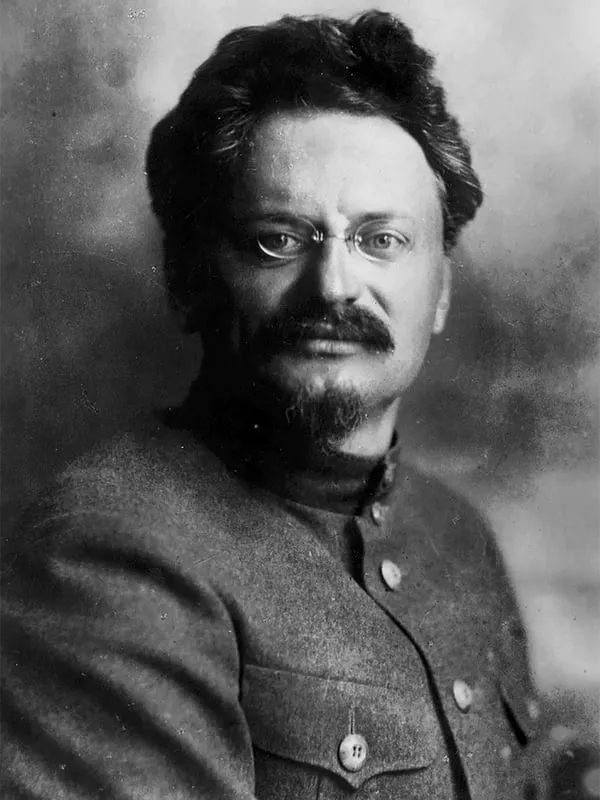
- Born:
- 7 November 1879, Yanovka, Kherson Governorate (Russian Empire)
- Died:
- 21 August 1940, Coyoacán (Mexico)
- Author:
- Natalia
- Photo:
- autor nieznany, domena publiczna, Wikimedia Commons

Lev Davidovich Bronstein, who went down in history under the pseudonym Trotsky, was, alongside Vladimir Lenin, the most important leader of the October Revolution. In the First World War he appeared in three roles. Until 1917 he was an émigré, a journalist and an opponent of the war, the author of the Zimmerwald manifesto. In the autumn of 1917, as chairman of the Petrograd Soviet, he prepared the coup that gave power to the Bolsheviks. Then, as commissar for foreign affairs, he conducted the negotiations with the Central Powers at Brest-Litovsk and proclaimed the famous formula “neither war nor peace”, which ended in a German offensive and a peace even harsher than the one he had rejected. From March 1918 he built the Red Army from scratch. He was on the side of the Entente only formally: together with Lenin he took Russia out of the war, breaking its obligations to its allies.
Before the war
He was born on 7 November 1879 (26 October in the Julian calendar) at Yanovka in the Kherson Governorate, in the south of present-day Ukraine, the son of a prosperous Jewish farmer-colonist, David Bronstein. He went to school in Odessa and in Nikolayev, where at the age of seventeen he came into contact with the revolutionary movement. In 1898 he was arrested and, after two years in prison, exiled to Siberia. In 1902 he escaped from exile on a false passport, entering in it the name Trotsky, which, according to his memoirs, had belonged to one of his Odessa prison warders. He made his way to London, to Lenin and the editorial board of Iskra. At the congress of 1903, however, he took a stand against Lenin, and then for years kept aloof from both factions, trying to reconcile them.
The revolution of 1905 brought him fame. The twenty-six-year-old Trotsky became first vice-chairman and then, after the chairman’s arrest, the de facto leader of the St Petersburg Soviet of Workers’ Deputies. For his part in it a court sentenced him to settlement in Siberia for life, but he escaped on the way to his place of exile. From 1907 he lived in Vienna, where he published the newspaper Pravda, wrote reports for the Russian press and developed the theory of “permanent revolution”: in backward Russia the democratic revolution was to pass at once into a socialist one, and it could survive only if it set off revolution in Europe. As a correspondent of a Kiev newspaper he reported on the Balkan Wars of 1912–1913, which gave him his first idea of modern war.
An émigré against the war
The outbreak of war forced him into a hurried flight from Vienna, where, as a Russian subject, he faced internment. Via Switzerland he reached Paris in November 1914 as a war correspondent of the newspaper Kievskaya Mysl. There he co-edited the Russian internationalist newspaper Nashe Slovo, which the French censorship constantly cut. Like Lenin, he believed that the socialists who supported their governments had betrayed the International, but he did not share Lenin’s slogan of the defeat of one’s own country. He called for a peace without annexations and for the unification of Europe under the rule of the workers.
In September 1915 he went to the Zimmerwald Conference and wrote much of its manifesto, which called on the proletariat of all countries to fight for peace. In the autumn of 1916 the French authorities, alarmed by anti-war agitation among the Russian troops in France, expelled him to Spain. From there he was sent on to the United States. In January 1917 he reached New York and wrote for the émigré newspaper Novy Mir.
1917: chairman of the Soviet
After the February Revolution he sailed from New York for Russia, but at the beginning of April the British took him off the ship at Halifax in Canada and interned him in a camp for German prisoners at Amherst. He was released at the end of April after the intervention of the Provisional Government, which was under pressure from the Petrograd Soviet. He arrived in Petrograd in May, a month after Lenin. He put himself at the head of a small group of social democrats known as the “Mezhraiontsy” and quickly drew close to the Bolsheviks. His dispute with Lenin over party organisation lost its significance, because both now wanted the same thing: power to the soviets and an immediate end to the war.
During the July Days he snatched the minister of agriculture, Viktor Chernov, from the hands of Kronstadt sailors who might have lynched him. When the government accused the Bolsheviks of acting on German orders, Trotsky publicly demanded to be treated in the same way as Lenin. At the beginning of August he was arrested. In prison he was formally admitted to the Bolshevik party, and his group merged with it at the party’s Sixth Congress. On 17 September, after the collapse of the Kornilov putsch, he was released on bail. At the beginning of October he became chairman of the Petrograd Soviet, in which the Bolsheviks now had a majority.
Lenin wanted an uprising at once. Trotsky argued that the coup should be carried out under the cover of the Soviet and tied to the Second Congress of Soviets, so that it would pass for a defence of the revolution rather than a conspiracy of a single party. The key was the Military Revolutionary Committee, set up by the Soviet, formally to defend the capital against the Germans. In the second half of October its commissars took control of the garrison regiments before a shot had been fired. On the night of 6–7 November the committee’s units took the city almost without a fight, and on the night of 7–8 November the Winter Palace. To the Mensheviks and Socialist Revolutionaries who left the congress in protest Trotsky declared that their place was “in the dustbin of history”. A few days later he was personally at Pulkovo, where Red Guards and sailors beat back the Cossacks marching on the capital with the deposed prime minister Alexander Kerensky.
Commissar for foreign affairs
In the Council of People’s Commissars he took charge of foreign affairs. He thought that a few proclamations to the peoples of the world would be enough, after which he would “shut up shop”. He did indeed begin by publishing the secret treaties from the ministry’s archives, including the agreements on the partition of the Ottoman Empire and on the rewards for Italy and Romania, which caused a storm throughout Europe. On 21 November he handed the Allied embassies a note proposing an immediate armistice on all fronts. The Allies did not reply, and Trotsky repeatedly blamed them for the fact that Russia was talking to the enemy on its own. The armistice was signed on 15 December at Brest. In December the first round of peace negotiations was conducted by Adolph Joffe.
When the Germans demanded the Polish, Lithuanian and Courland lands, Lenin sent Trotsky himself to Brest to drag out the negotiations in anticipation of revolution in Germany and Austria-Hungary. Trotsky arrived on 7 January 1918 and turned the talks into a verbal duel with the German State Secretary Richard von Kühlmann and the Austro-Hungarian minister Ottokar Czernin. He argued with them about the self-determination of nations and spoke over their heads to the workers of Europe. On 18 January General Max Hoffmann spread out before him a map with a blue line marking the future border. Trotsky returned to Petrograd and, in the dispute within the party, proposed a middle way between Lenin’s peace and the “revolutionary war” of the Left Communists: declare the war over, demobilise the army, but not sign a peace. The Central Committee adopted this formula.
The second round of negotiations brought disaster. On 9 February the Central Powers signed a peace with the Ukrainian People’s Republic, even though its government was just fleeing Kiev. On 10 February Trotsky announced that Russia was leaving the war and demobilising its army, but would not sign an annexationist peace. Hoffmann reacted with the exclamation “Unheard of!”. Trotsky counted on the Germans not daring to attack a country that had itself stopped fighting. He was wrong. On 18 February the German offensive began, and the Russian units fell apart without a fight. That evening Trotsky went over to Lenin’s side, and the Central Committee decided by one vote to accept the German terms. When even harsher terms arrived on 23 February, he abstained, securing Lenin a majority. On 22 February he tendered his resignation, he did not sign the Treaty of Brest-Litovsk, and on 13 March the Council of People’s Commissars handed foreign affairs to Georgy Chicherin.
For a few weeks in February and March Trotsky even considered help from the former Allies against Germany. He gave the Murmansk soviet permission to accept support from the Allied missions, which opened the way for the first British soldiers in northern Russia. He also talked with Britain’s unofficial representative, Robert Bruce Lockhart, and with the Americans about military aid. After the peace was ratified, the matter collapsed.
Commissar for war
Trotsky took over the war commissariat and became head of the Supreme Military Council (PL), and from September 1918 of the Revolutionary Military Council of the Republic. He found an army made up of volunteers and Red Guards, without discipline or commanders. He relied on compulsory conscription, the death penalty for desertion and the enlistment of tens of thousands of officers of the old tsarist army, watched over by political commissars and often also by hostages taken from their families. Many Bolsheviks regarded this as a betrayal of the principles of the revolution.
His telegram of 25 May 1918, ordering the disarming of the soldiers of the Czechoslovak Corps travelling through Siberia and the shooting of anyone caught with a weapon, provoked the revolt of the corps and one of the most dangerous crises of Soviet power. When in August the Czechoslovaks and the Whites took Kazan, Trotsky came to nearby Sviyazhsk in his armoured train, in which he afterwards spent much of the Civil War. By draconian methods, according to many accounts including the shooting of the commander, the commissar and every tenth soldier of a regiment that had fled the battlefield, he restored discipline, and on 10 September the Reds retook Kazan. By the end of the Civil War the Red Army had grown to several million men.
After the war
The Red Army defeated the Whites of Alexander Kolchak and Anton Denikin, and in the autumn of 1919 Trotsky personally organised the defence of Petrograd against the forces of General Nikolai Yudenich. In 1920 he was sceptical of the march on Warsaw, but did not block it. In March 1921 he directed the suppression of the revolt of the Kronstadt sailors, whom in 1917 he had called the pride and glory of the revolution. After Lenin’s death he lost the struggle for power to Joseph Stalin. In 1925 he lost the war commissariat, in 1927 he was expelled from the party, in 1928 he was exiled to Alma-Ata, and in 1929 he was deported from the country. He lived in Turkey, France and Norway, and from 1937 in Mexico. He wrote his memoirs and The History of the Russian Revolution, on which historians still draw today, though with caution. On 20 August 1940 the Soviet intelligence agent Ramón Mercader struck him with an ice axe in his house at Coyoacán near Mexico City. Trotsky died the following day.
Assessment
For decades assessments of Trotsky were hostage to politics. In the USSR under Stalin he was erased from the history of the revolution and from photographs, while in the West his followers presented him as a revolutionary faithful to his ideals who had been betrayed by Stalin. His biographer Isaac Deutscher wrote of the “prophet” of the revolution, while Robert Service and other critics point out that Trotsky was a co-founder of one-party dictatorship, the Red Terror and the militarisation of labour, and that his quarrel with Stalin was a quarrel about power, not about freedom.
In the history of the First World War his most important and most controversial act was the formula “neither war nor peace”. Some historians regard it as a costly mistake: it gave the Germans a pretext for an offensive in which they occupied Livonia, Estonia and Ukraine without a fight, and it brought a peace much harsher than the one offered in January. Others, such as John Wheeler-Bennett, see it as a bold attempt to expose Germany’s annexationist aims before the world, and regard the Brest negotiations under Trotsky’s leadership as the first attempt at diplomacy conducted openly, in full view of public opinion. No one, however, questions his talent as an organiser and orator. Without Trotsky the October coup would have looked different, and the Red Army might not have survived 1918.
Sources
Spotted a mistake?Report an error
Mentioned in battles
(01)Often appears with
People who appear in the same events.
On the timeline
(34)1917
1918
January
- 28
- Russia breaks off relations with RomaniaOn 28 January 1918 the Romanian minister had to leave Petrograd. After the Romanians entered Bessarabia, Lenin cut ties and seized Romania's gold in Moscow.
- Creation of the Red ArmyOn 28 January 1918 the Council of People's Commissars decided to create a volunteer Workers' and Peasants' Red Army in place of the disintegrating old army.