Russia · The Entente
Joseph Stalin
Member of the Bolshevik Central Committee (from 1912), People's Commissar for Nationalities (1917–1923), member of the Military Council of the North Caucasus Military District at Tsaritsyn (1918)
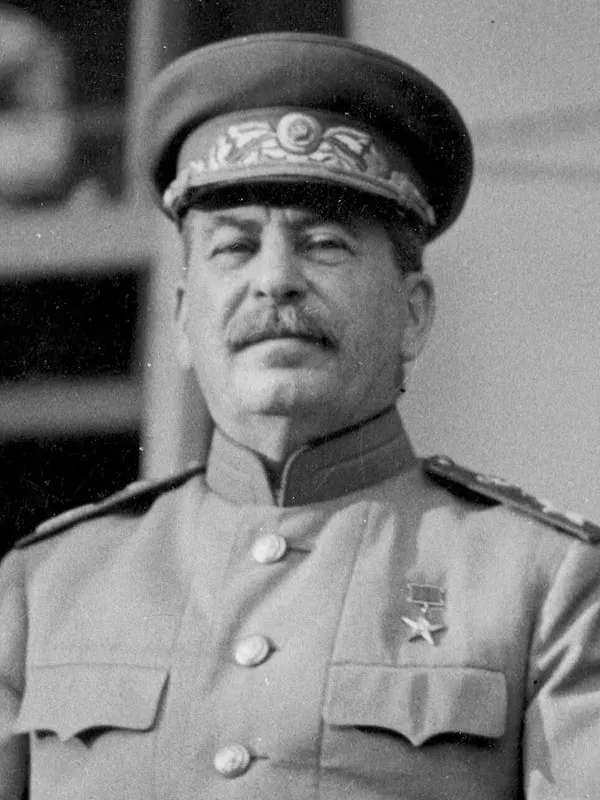
- Born:
- 18 December 1878, Gori, Tiflis Governorate (Russian Empire)
- Died:
- 5 March 1953, Kuntsevo near Moscow
- Author:
- Łukasz Skowroń
- Photo:
- Franklin D. Roosevelt Library, domena publiczna, Wikimedia Commons

Iosif Vissarionovich Dzhugashvili, known by the pseudonym Stalin, was a secondary figure in the years of the First World War. He spent almost the entire war in exile beyond the Arctic Circle, and the people who knew him in 1917 associated him with quiet editorial and party work rather than with rallies and the seizure of power. Even so, by November 1917 he already belonged to the narrow circle of Bolshevik leaders. As People’s Commissar for Nationalities he dealt with Finland, Ukraine and the other nations breaking away from Russia; in the dispute over the Brest peace he stood by Vladimir Lenin; and in the summer and autumn of 1918, in the defence of Tsaritsyn on the Volga, he wielded power over troops and the apparatus of terror for the first time. He was on the Entente side only formally: the government he belonged to took Russia out of the war and concluded a separate peace with Germany. The future dictator of the Soviet Union is described here above all as a participant in those events.
Before the war
He was born on 18 December 1878 (6 December in the Julian calendar) in Gori in Georgia, into the family of the shoemaker Vissarion Dzhugashvili and his wife Ekaterina. That is the date given in the parish register. From the 1920s official biographies gave 21 December 1879, and that date remained in force in the Soviet Union until the dictator’s death. His mother wanted to make a priest of him. After the church school in Gori, from 1894 he studied at the theological seminary in Tiflis, which he left in 1899, already drawn into Marxist circles.
From 1901 he worked in the Social Democratic underground in Tiflis, Batumi and Baku and from the outset sided with the Bolsheviks. He organised strikes, printing presses and fighting squads, which raised money for the party also through robberies and extortion. Time and again he was arrested and exiled, and time and again he escaped. In January 1912 Lenin co-opted him onto the Central Committee. That same year Dzhugashvili began signing himself “Stalin” and helped launch the Bolshevik daily Pravda in St Petersburg. At the beginning of 1913, in Vienna, at Lenin’s request he wrote the treatise “Marxism and the National Question”, which made him the party’s specialist on nationality affairs.
In February 1913 the police arrested him in St Petersburg on a denunciation by Roman Malinovsky, the leader of the Bolshevik group in the Duma and at the same time an Okhrana agent. He was sentenced to four years’ exile in the Turukhansk region on the lower Yenisei. In the spring of 1914 the authorities, fearing an escape, moved him to the settlement of Kureika beyond the Arctic Circle. For a time he lived there in the same house as Yakov Sverdlov. The two quickly came to dislike each other, and Sverdlov wrote in his letters about a disagreeable housemate.
The war in exile
The outbreak of war found Stalin in Kureika, and he spent most of it there. He lived on a government allowance and on what he caught in the Yenisei or hunted. He took little part in the party’s disputes over the attitude to the war and over Lenin’s slogan of the defeat of one’s own government, because letters took months. At the end of 1916 the authorities decided to call up exiles as well. Stalin travelled to Krasnoyarsk, where in February 1917 a medical board found him unfit for service because of a left arm that had been impaired since childhood. He was allowed to serve the rest of his exile in Achinsk. There the news of the February Revolution reached him.
1917: from Pravda to the coup
He returned to Petrograd on 25 March 1917 (12 March Old Style) together with Lev Kamenev. The two took over the editorship of Pravda and joined the executive committee of the Petrograd Soviet. The paper’s line in those weeks was moderate. Stalin rejected the slogan “down with the war” and wrote that pressure should be put on the Provisional Government to open peace negotiations immediately. The Bolsheviks were to support that government “insofar as” it carried out the gains of the revolution. Everything changed with Lenin’s return in April and his theses, which demanded a break with the government and power to the soviets. Stalin went over to Lenin’s side faster than Kamenev, and at the party conference at the end of April he was elected to the Central Committee.
During the July Days he assured the leaders of the soviets on behalf of the committee that the party was not organising the demonstrations. When the rising collapsed and the government accused the Bolsheviks of working for Germany, he helped hide Lenin, who fled via Razliv to Finland. In the absence of Lenin and of the arrested Leon Trotsky, Stalin led the party together with Sverdlov and in August delivered the main report at its Sixth Congress. On 23 October (10 October Old Style) he voted in the Central Committee for an armed rising, and a few days later he joined the party’s military-revolutionary centre. In the coup itself he played no visible part. The Menshevik Nikolai Sukhanov remembered him from 1917 as a “grey blur”, and Trotsky repeated for years that in October Stalin was nowhere to be seen. Some historians, such as Stephen Kotkin, nevertheless believe that as a member of the inner leadership and editor of the party press he was already one of the most important Bolsheviks.
Commissar for Nationalities
In the Council of People’s Commissars Stalin took over the new People’s Commissariat for Nationalities. He belonged to the group that, together with Lenin, Trotsky and Sverdlov, took the most urgent decisions, and he had an office next to Lenin’s in the Smolny. On the night of 21–22 November 1917 he was at the apparatus when Lenin and Nikolai Krylenko demanded that General Dukhonin immediately open armistice negotiations. In mid-November he and Lenin signed the Declaration of the Rights of the Peoples of Russia, which granted them the right to self-determination, up to and including secession from the state.
Practice proved more complicated than declarations. When Finland declared independence, on 4 January 1918 Stalin put a motion for its recognition to the All-Russian Central Executive Committee, but said openly that Soviet power had given freedom not to the Finnish proletariat but to the Finnish bourgeoisie. In the dispute with the Ukrainian Central Rada and in a speech at the Third Congress of Soviets in January 1918 he developed the formula that self-determination belonged to the working masses and not to the “bourgeoisie” of the nations. In practice this meant that the Bolsheviks recognised only those nation states in which their supporters ruled. On 1 March he signed, together with Lenin and Trotsky, the treaty with Red Finland, and at the end of March the agreement at Penza that allowed the Czechoslovak Legion to travel across Siberia to Vladivostok.
In the dispute over peace with the Central Powers he backed Lenin from the start. At the Central Committee meeting of 24 January 1918 (11 January Old Style) he said that in the West there was no revolutionary movement, only its potential, and that a policy could not be built on potential. Lenin, who still counted on a revolution in Germany, distanced himself from that remark, but the conclusion was shared: peace had to be made. On 18 February, the day of the German offensive, Stalin advised opening talks without signing anything at once, and in the evening voted to accept the German terms. On 23 February he supported accepting the even harsher ultimatum that ended in the Treaty of Brest-Litovsk. In the spring he headed the Soviet delegation that waited in Kursk for negotiations with Ukraine, and at the beginning of May he and Lenin announced the armistice at Korenevo, which halted the German march east on that sector.
1918: Tsaritsyn
On 29 May 1918 the Council of People’s Commissars sent Stalin to southern Russia as extraordinary plenipotentiary for food supply. He was to obtain grain from the North Caucasus and send it to starving Moscow and Petrograd. The route through Ukraine and the Don had been closed by the Germans and the Cossacks, so the key became Tsaritsyn, a railway junction and port on the Volga. Stalin arrived there on 6 June and quickly took up military matters, for which he had no authority. He grew close to the commander of the units that had fought their way out of the Donbas, Kliment Voroshilov, and to the cavalryman Semyon Budyonny. These men later became the core of his following in the army. On 7 July, the day after the assassination of Mirbach, he assured Lenin in a telegram that as far as the “hysterics” were concerned, his hand would not tremble. He also kept in touch with the Baku Commune: its leader Stepan Shaumian reported to him on the fighting with the Turks.
In July Stalin became head of the military council of the North Caucasus Military District. He treated with suspicion the officers of the old tsarist army whom Trotsky was drafting into the Red Army. He regarded the district commander, General Andrei Snesarev, as Trotsky’s man. On Stalin’s orders the local Cheka arrested part of the district staff and other “specialists”, and according to many accounts they were held on a barge on the Volga, where some of them died. Snesarev was saved by an intervention from Moscow. In Tsaritsyn people suspected of plots were shot without trial, and notices of uncovered treason were posted around the town. Stephen Kotkin sees in those weeks the first trial of the methods Stalin later applied on the scale of the whole state.
In the summer and autumn of 1918 Tsaritsyn held out against the Don Cossacks of Ataman Pyotr Krasnov. In Soviet propaganda the defence of the city later grew into a “Red Verdun”, and Stalin into its chief hero. Many studies point out, however, that his arbitrary decisions and attacks at heavy cost weakened the whole front. In September Stalin and Voroshilov refused to submit to the new commander of the Southern Front, the former tsarist general Pavel Sytin, and to the commander-in-chief Jukums Vācietis. Trotsky demanded Stalin’s recall, and Stalin sent Lenin telegrams complaining about Trotsky. The Central Committee reminded him that he had to obey the Revolutionary Military Council of the Republic, and in October he was brought back to Moscow. The dispute over Tsaritsyn was the beginning of the enmity between Stalin and Trotsky that lasted until the latter’s death.
At the end of 1918 Stalin joined the new Council of Workers’ and Peasants’ Defence chaired by Lenin. When in December the Whites of Alexander Kolchak took Perm, the Central Committee sent him to the Urals together with Felix Dzerzhinsky. Their report blamed the defeat on treason by officers, the disintegration of the rear and the mistakes of the Revolutionary Military Council of the Republic headed by Trotsky.
After the war
In the Civil War and in the war with Poland Stalin was a member of the military councils of successive fronts. In the summer of 1920, as commissar of the South-Western Front, he pressed on towards Lviv and delayed handing over troops to help Mikhail Tukhachevsky’s armies advancing on Warsaw, for which he was blamed after the defeat. In April 1922 he became the party’s general secretary. Lenin in his last notes advised removing him from that post, but this never happened. After Lenin’s death Stalin defeated in turn Trotsky, Kamenev and Grigory Zinoviev, and then Nikolai Bukharin, and by the end of the 1920s he was sole ruler. The forced collectivisation of the countryside caused a famine that in 1932–1933 killed millions of people, above all in Ukraine and Kazakhstan, and during the Great Purge of 1937–1938 hundreds of thousands were shot. In 1939 he concluded a pact with Hitler, and on 17 September his troops entered Poland. In 1940 he approved the order to shoot Polish prisoners of war that led to the Katyn massacre. After Germany’s attack in 1941 he led the Soviet Union to victory in the Second World War and imposed communism on Central and Eastern Europe. He died on 5 March 1953 at his dacha in Kuntsevo near Moscow.
Assessment
Stalin’s role in 1914–1918 was for decades the subject of falsification. Under his rule Soviet historians presented him as the leader of the revolution second only to Lenin, and Tsaritsyn, renamed Stalingrad in 1925, as proof of his military talent. Trotsky and his followers answered with the image of a mediocre bureaucrat who in 1917 stood on the sidelines and in Tsaritsyn did harm to the army. Both versions served politics.
Modern biographers such as Robert Service, Oleg Khlevniuk and Stephen Kotkin see the Stalin of these years as one of Lenin’s few closest collaborators: less brilliant than Trotsky and a poorer speaker, but hard-working, tough and valued by Lenin for his effectiveness. They agree that at Tsaritsyn the traits of his later rule came to light: distrust of experts, a tendency to detect conspiracies, readiness for terror and disobedience towards everyone but Lenin. In the history of the Great War he remained a secondary figure. In the history of the twentieth century his importance can hardly be overstated.
Sources
Spotted a mistake?Report an error
Mentioned in battles
(01)Often appears with
People who appear in the same events.