Russia · The Entente
Alexander Kolchak
Commander of the Black Sea Fleet (1916–1917), Supreme Ruler of Russia (1918–1920)
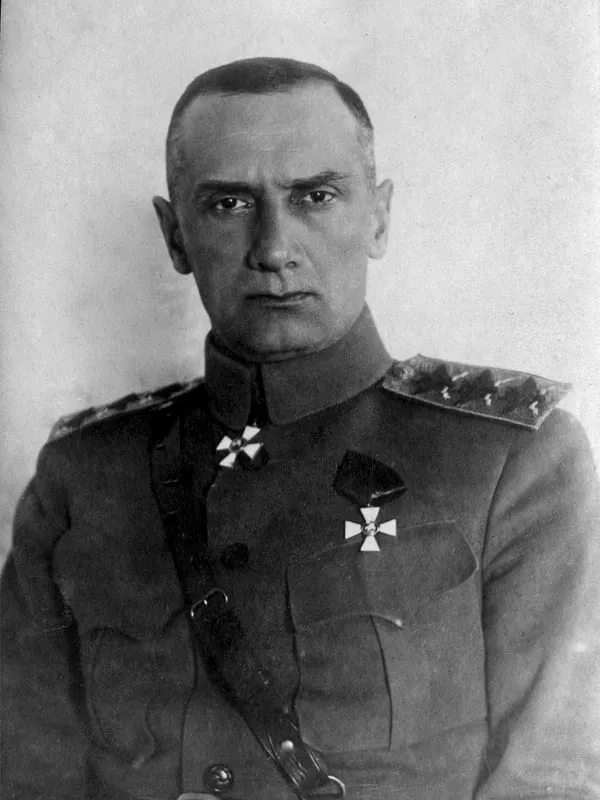
- Born:
- 16 November 1874, St Petersburg
- Died:
- 7 February 1920, Irkutsk
- Author:
- Łukasz Skowroń
- Photo:
- autor nieznany, domena publiczna, Wikimedia Commons

Admiral Alexander Kolchak was the ablest Russian naval commander of this war and one of the most tragic figures of the Russian Revolution. Before he became a fighting officer, he won fame as an Arctic explorer. In 1914–1916, as a staff officer and commander of the Mine Division of the Baltic Fleet, he was the principal author of Russia’s mine war against Germany. From the summer of 1916, as the youngest fleet commander among the belligerent powers, he led the Black Sea Fleet, which bottled up the Turks and Germans in the Bosporus. In June 1917 mutinous sailors took his command from him. After the Bolshevik coup, refusing to accept Russia’s withdrawal from the war, he volunteered for service with the British, and in November 1918 in Omsk he became head of White Russia as Supreme Ruler. He was shot by the Bolsheviks.
Before the war
He was born on 16 November 1874 (4 November in the Julian calendar) near St Petersburg, into the family of a naval artillery officer, a veteran of the defence of Sevastopol in 1854–1855. In 1894 he graduated with distinction from the Naval Cadet Corps. He sailed in the Pacific and published papers on hydrology. In 1900–1902 he took part as hydrologist in Baron Eduard Toll’s polar expedition aboard the Zarya and explored the New Siberian Islands. When Toll went missing, Kolchak organised a rescue expedition in 1903, which found traces of the missing men but not the men themselves. From then on he was known in Russia as “Kolchak the Polar”.
During the war with Japan he took part in the defence of Port Arthur, today’s Lüshunkou. He commanded the destroyer Serdity and laid mines, and according to Russian authors the Japanese cruiser Takasago sank on one of them. He then commanded a shore battery, was wounded, and after the fortress capitulated was taken prisoner to Nagasaki. After the war he was one of the founders of the Naval General Staff, spoke in the Duma as an advocate of rebuilding the fleet, and in 1909–1910 commanded the icebreaker Vaygach on a hydrographic expedition in the Arctic Ocean. From 1912 he served in the Baltic Fleet, where Admiral Nikolai von Essen made him head of the operations section of his staff.
Mine warfare in the Baltic
Russian plans assumed that the weaker Baltic Fleet would defend the Gulf of Finland and the capital behind minefields. On the eve of the war it was Kolchak who prepared the orders for laying them. Essen, however, did not want merely to defend. In the autumn of 1914 Kolchak’s staff prepared offensive mining of the approaches to German ports. Russian destroyers and cruisers laid mines at night off Memel, near Bornholm and Rügen, and in the Bay of Danzig. Kolchak, who believed that the author of a plan should take part in carrying it out, went out on these operations himself. In November 1914 the armoured cruiser Friedrich Carl sank on Russian mines, and further German ships were damaged. In February 1915 Kolchak himself led four destroyers that laid mines through the ice in the Bay of Danzig.
Minefields also played an important part in the defence of the Gulf of Riga. In August 1915 the German fleet tried to force its way in and lost several minesweepers and destroyers on mines. In the autumn Kolchak took over, at first temporarily, the Mine Division, the fleet’s most active formation. He supported with naval gunfire the Russian 12th Army defending the coast of Courland, and in October carried out a successful landing behind German lines at Cape Domesnes. In April 1916 he became a rear admiral. His destroyers hunted German convoys carrying iron ore from Sweden, although the result of the best known of these raids, at the end of May 1916, was modest.
Black Sea Fleet
In the summer of 1916 the Tsar promoted the 41-year-old Kolchak to vice admiral over the heads of many more senior officers and entrusted him with the Black Sea Fleet. The new commander adopted the principle that mines should be laid not in front of one’s own ports but right off the enemy’s coast, in several layers, faster than the enemy could sweep them. Submarines and minelayers blocked the exit from the Bosporus and the Bulgarian port of Varna. The German battlecruiser Goeben and the light cruiser Breslau, which since 1914 had been raiding the Russian coast under the Turkish flag, only occasionally dared to put to sea, and two German submarines were sunk on mines off Varna and at the entrance to the Bosporus. Russian ships destroyed Turkish vessels carrying coal from Zonguldak to Constantinople and protected transports for the army fighting in the Caucasus.
The heaviest loss of this period was the explosion of the new battleship Imperatritsa Mariya at Sevastopol on 20 October 1916. Kolchak came aboard the burning ship and directed the rescue himself, but the ship could not be saved. The cause of the explosion was never established. In the winter he prepared a great landing on the Bosporus, planned for the spring of 1917, and supported with his ships the defence of the Danube delta after Romania’s defeat. The landing never took place: the revolution put an end to it.
Revolution and mutiny at Sevastopol
When on 15 March 1917 General Alekseyev asked the commanders of the fronts and fleets for their views on the Tsar’s abdication, Kolchak did not reply. Once the fall of the monarchy was a fact, he himself announced the news from the capital to the crews and recognised the Provisional Government. At Sevastopol, unlike in Helsingfors and Kronstadt, where sailors murdered their officers, no blood was shed. Through his personal authority the admiral kept the fleet obedient for several months. In May, in a much publicised speech, he warned that the army and navy were perishing and that the Baltic Fleet had ceased to exist as a fighting force.
In June agitators arrived from the Baltic, many of them Bolsheviks. On 19 June 1917 the sailors demanded that the officers be disarmed. Kolchak forbade resistance, assembled the crew of the flagship, declared that he no longer wished to command them, and threw his sword into the sea, the gold sword awarded for the defence of Port Arthur. The gesture went round the press of Russia and the Allied countries. Summoned to Petrograd, he set out for the government his view that the only salvation lay in restoring strict discipline and the death penalty in the army. The right-wing press and secret officers’ organisations began to see him as a candidate for dictator. Prime Minister Alexander Kerensky was glad to get him out of the country. In August the admiral left on a naval mission to Great Britain and the United States, where the mission of Senator Elihu Root had invited him as an adviser on planned operations against the Straits.
Between the war and the civil war
In London he was received by the First Sea Lord, Admiral John Jellicoe; in the United States he visited ports and ships, but the Americans had already abandoned plans for action against the Straits. News of the Bolshevik coup reached him on his way back, in Japan. Kolchak believed that Russia was still bound by its alliance, and he regarded the peace with Germany that Lenin’s government was seeking as a disgrace. In December 1917 he went to the British embassy in Tokyo offering to serve “unconditionally and in any capacity”, even as a private soldier. The British accepted the offer and sent him to the Mesopotamian front.
In Singapore in March 1918 he received new orders. He was to return to Manchuria, where scattered Russian anti-Bolshevik units were gathering along the Chinese Eastern Railway in Harbin. He joined the railway’s board but failed to unite the forces, which were at odds with General Horvat’s administration and with Ataman Grigory Semyonov, who was backed by the Japanese. Embittered, he left for Japan in the summer. In the autumn he set out westwards via Vladivostok to join the Whites in southern Russia, and on 13 October 1918 he arrived in Omsk.
Supreme Ruler
In Omsk at the beginning of November he became Minister of War and Marine in the Provisional All-Russian Government, known as the Directory. On the night of 17–18 November 1918, a week after the Armistice of Compiègne, Cossack officers arrested the Socialist Revolutionary members of the Directory, and the Council of Ministers handed power to Kolchak, made him a full admiral and appointed him Supreme Ruler of Russia. Whether he knew of the plot beforehand remains disputed. His authority was later recognised by other White leaders, including Generals Anton Denikin and Nikolai Yudenich. In December his troops captured Perm, and in the spring of 1919 they approached the Volga.
After the war
The offensive collapsed in the summer of 1919. The Red Army crossed the Urals and in November took Omsk. Kolchak retreated along the Trans-Siberian Railway, carrying the gold reserve of the former empire. Neither the British, nor the French, nor the Americans formally recognised his government, the Japanese acted on their own account, and the Czechoslovak Legion wanted only to go home. In January 1920 the Czechoslovaks, with the consent of the head of the Allied mission, General Maurice Janin, handed the admiral over to the left-wing authorities of Irkutsk, who soon passed power to the Bolsheviks. After nine days of interrogation, on the night of 6–7 February 1920, Kolchak and his prime minister Viktor Pepelyayev were shot, and their bodies were pushed under the ice of the Angara.
Assessment
As a sailor Kolchak is rated highly almost unanimously. He was one of the best mine-warfare specialists of his time, a brave and inventive commander to whom Russia owed its best results at sea in this war. The Baltic minefields inflicted clearly greater losses on the Germans than on the Russians, and the Black Sea Fleet under his command dominated the Black Sea. Critics point to the loss of the Imperatritsa Mariya and to the fact that he commanded a battle fleet without experience of large ships.
He is judged far more harshly as a politician. The British General Alfred Knox praised his character and patriotism, but even people well disposed towards him described him as a nervous idealist, easily swayed by advisers and a stranger to politics. Richard Pipes and other historians point out that his government failed to win the support of the peasants, alienated the socialists and could not control the lawlessness of the atamans and officers who perpetrated a cruel White Terror in Siberia. Soviet historiography saw him as a dictator in the service of the Entente; Russian émigrés and some present-day authors in Russia see him as a martyr of the national cause. Court attempts to rehabilitate him in Russia have failed. For the history of the First World War, what matters most is that to the end he considered himself an ally of the Entente and never accepted Russia’s withdrawal from the war.
Sources
Spotted a mistake?Report an error
Often appears with
People who appear in the same events.