Czechoslovakia · The Entente
Radola Gajda
Commander in the Czechoslovak Legion in Russia (1917–1918), commander of Admiral Kolchak's Siberian Army (1918–1919)
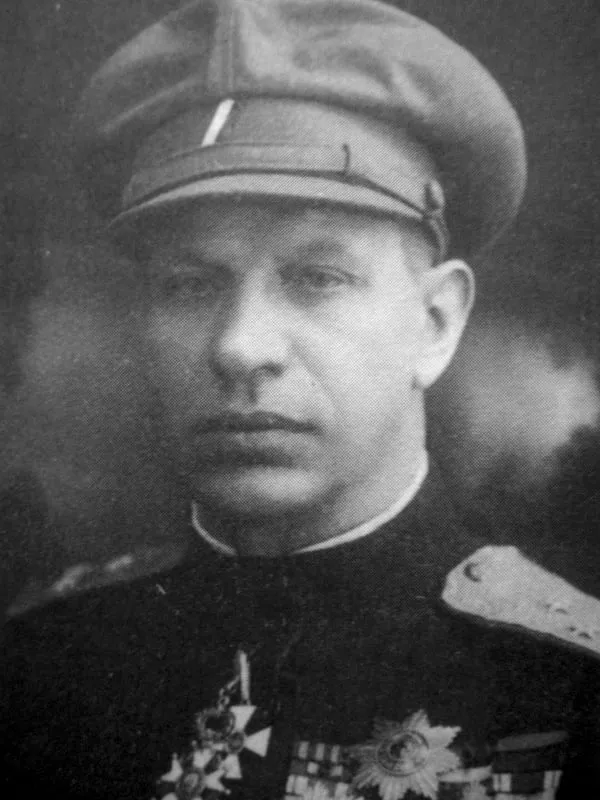
- Born:
- 14 February 1892, Kotor (Dalmatia, Austria)
- Died:
- 15 April 1948, Prague
- Author:
- Natalia
- Photo:
- neznamy, CC BY-SA 3.0, Wikimedia Commons

Radola Gajda was the most daring and the most controversial commander of the Czechoslovak forces in Russia. In 1915 he was serving as a reservist in the Austro-Hungarian army, and by September 1918, at the age of 26, he was a general. In the spring and summer of 1918 his troops seized the central section of the Trans-Siberian Railway and fought their way east beyond Lake Baikal. He later entered the service of Admiral Alexander Kolchak, took Perm in December 1918 and commanded the Siberian Army. His life story, full of changed names, false titles and sudden reversals, ends less gloriously: in independent Czechoslovakia he became the leader of the fascist movement.
Before the war and in the Balkans
He was born on 14 February 1892 in Kotor in Dalmatia as Rudolf Geidl, the son of an Austrian non-commissioned officer and, according to his biographers, an impoverished Montenegrin noblewoman. He spent his childhood in Moravia, in Kyjov, where he attended the gymnasium but did not finish it, and trained as a druggist. In 1910–1911 he did his compulsory military service in Mostar. He then went to the Balkans. In 1913 he married in Shkodër and settled there. Some biographers believe that he took part in the Balkan Wars, but this is not certain.
After the outbreak of war he was called up into the Austro-Hungarian army, in which he served in Dalmatia and Bosnia. In September 1915 he ended up on the Montenegrin side. According to some sources he was taken prisoner, according to others he went over to the enemy of his own accord. In the Montenegrin army he passed himself off as a doctor and served as one with the rank of captain, although all he knew was the druggist’s trade. He also changed his first name to the Slavonic-sounding Radola. After the fall of Montenegro at the beginning of 1916 he made his way to Russia on false papers. In Odessa he became regimental doctor in one of the Serbian volunteer units, which at the end of 1916 suffered heavy losses in the fighting in Dobruja.
Zborov
At the beginning of 1917 he joined the Czechoslovak brigade in the Russian army. On 26 March he took command of a company in the 2nd Rifle Regiment. In the Battle of Zborov on 2 July 1917 he distinguished himself so much that, according to Czech biographers, during the attack he was in effect directing operations on its entire southern sector. For this battle he received the Order of St. George, 4th class, and was rapidly promoted. When after Zborov the brigade grew into the Czechoslovak Legion, Gajda was among its most promising officers. On 28 March 1918, when the corps was already withdrawing from Ukraine before the Germans, he took command of the 7th Tatra Rifle Regiment.
Revolt on the railway
In the spring of 1918 the corps’ trains stretched across Siberia towards Vladivostok, and Gajda’s regiment was stationed around Novonikolayevsk, today’s Novosibirsk. In May he was a delegate to the congress of the Czechoslovak army in Chelyabinsk and became a member of the provisional executive committee elected there, which decided not to surrender its weapons to the Bolsheviks. Gajda was among those who pressed hardest for an armed solution. When on 25 May Leon Trotsky ordered the Czechoslovaks to be disarmed, Gajda gave the signal for action. That day his men seized the station at Mariinsk, and during the night of 25/26 May they occupied Novonikolayevsk, where power was taken over by an anti-Bolshevik organisation of Russian officers. He often acted against the instructions of representatives of the National Council and of French officers, who were still trying to calm the conflict, and against the line of Tomáš Masaryk, who wanted the corps not to become involved in the Russian Civil War.
His group, several thousand strong, fought east and west of Novonikolayevsk. After the fall of Omsk it joined up with the western groupings of the corps, and then moved east along the railway to break through to Vladivostok. Together with volunteers of the newly forming Siberian Army, commanded by Anatoly Pepelyayev, Gajda’s Czechoslovaks entered Irkutsk on 11 July. Russian works attribute this capture mainly to Pepelyayev, Czech and Western ones above all to Gajda. In the following weeks his troops fought for the tunnels of the railway around Lake Baikal, which the Reds were trying to blow up. At the end of August, in Transbaikalia, Gajda linked up with the legionaries coming from Vladivostok. Almost the entire Trans-Siberian Railway, from the Volga to the Pacific, was now in the hands of the Bolsheviks’ opponents. In September 1918 he was promoted to major-general.
In the Urals and with Kolchak
In the autumn Gajda took command on the Ural front, with his headquarters in Yekaterinburg. There he commanded a group of Czechoslovak and Russian troops. It was he who, during the celebrations in Yekaterinburg in November 1918, when the legionaries were celebrating the birth of their state, led the regimental colours onto the square. The weary legionaries, however, were less and less willing to fight, and the war for which they had come to Russia was just ending. Gajda staked his future on the Russians. After the coup in Omsk, in which Kolchak took power as Supreme Ruler, Gajda, on his orders, dispersed the congress of former members of the Constituent Assembly in Yekaterinburg and arrested its leaders, although he released them a few days later. The Czechoslovak National Council in Russia condemned the coup, and Gajda, with the consent of the Minister of War, Milan Rastislav Štefánik, transferred to Russian service.
At the end of November his Yekaterinburg group struck at Perm, forestalling an attack the Reds were preparing. In frosts reaching minus 30 degrees the Red Third Army disintegrated, and during the night of 24/25 December the Whites entered Perm, taking, according to various sources, from 20,000 to more than 30,000 prisoners. The Bolsheviks spoke of the “Perm catastrophe”. Gajda received the Order of St. George, 3rd class, and Kolchak entrusted him with command of the new Siberian Army. His soldiers called him the “Siberian ataman”.
Fall from favour with Kolchak
In the spring of 1919 the Siberian Army advanced west, towards Vyatka and Kazan, in the hope of linking up with the Allied forces in northern Russia. When the offensive of the neighbouring Western Army collapsed under the blows of the Reds, Gajda refused to shift his forces to help it, and his relations with Kolchak and his staff quickly deteriorated. At the beginning of July 1919 the admiral removed him from command, and in September dismissed him from the service and stripped him of his Russian decorations. On 17 November 1919 Gajda placed himself at the head of a Socialist Revolutionary uprising against Kolchak in Vladivostok. It was crushed the next day, and Gajda was released at the demand of the Allied missions on condition that he leave Russia.
After the war
In February 1920 he returned to Czechoslovakia, where he was taken into the army with the rank of general. He studied at the French École Supérieure de Guerre, commanded a division in Košice, and in 1926 briefly headed the General Staff. In the same year, under pressure from Masaryk, who feared his ambitions and his sympathy for Italian fascism, he was suspended and retired after accusations of spying for Soviet Russia, which a military commission did not confirm. From 1927 he led the National Fascist Community, and after a failed putsch by its members in Brno in 1933 he was sentenced to six months in prison. After the Second World War, in 1947, a court sentenced him to two years in prison for his activities in the time of the Second Republic and in March 1939. He came out of prison almost blind and died in Prague on 15 April 1948.
Assessment
Historians agree that Gajda was a talented, brave commander, popular with his soldiers, who in 1918 played a great part in seizing the Trans-Siberian Railway and in saving the scattered corps. At the same time he was an adventurer and a pretender who invented an education for himself, could not bear subordination and readily disregarded his superiors’ orders. His decisions of May 1918 hastened the drawing of the Czechoslovaks into the Russian Civil War, which Masaryk had wanted to avoid. Under Kolchak the swift victory at Perm made him a hero, but his insubordination in the spring of 1919 contributed, according to some historians, to the defeat of the Whites in the Urals. The Czech historians Antonín Klimek and Petr Hofman entitled his biography “The Victor Who Lost”.
Sources
Spotted a mistake?Report an error
Often appears with
People who appear in the same events.