Czechoslovakia · The Entente
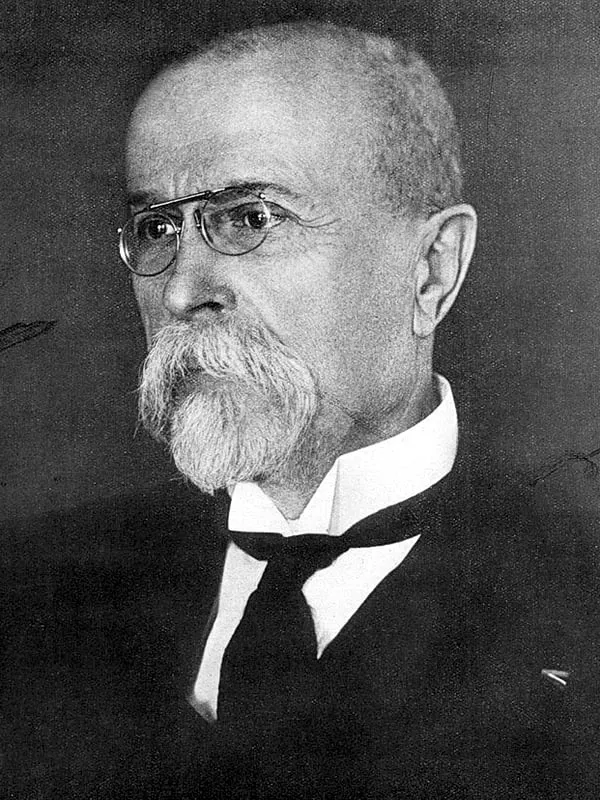
Tomáš Masaryk
Chairman of the Czechoslovak National Council (1916–1918), President of Czechoslovakia (1918–1935)
- Born:
- 7 March 1850, Hodonín (Moravia)
- Died:
- 14 September 1937, Lány (Bohemia)
- Author:
- Łukasz Skowroń
- Photo:
- autor nieznany, domena publiczna, Wikimedia Commons

When the war broke out, Tomáš Garrigue Masaryk was 64, a professor of philosophy at the Czech university in Prague and a deputy in the Vienna parliament, better known for his polemics than for any political influence. Over the next four years, without a state, money or a formal mandate, he persuaded the Entente governments that Austria-Hungary must be broken up and an independent state of Czechs and Slovaks founded on its ruins. He headed the Czechoslovak National Council in exile, built an army out of prisoners of war in Russia and sought President Wilson’s support in the United States. In November 1918, while still across the ocean, he was elected the first President of Czechoslovakia. The Czechs called him the “President Liberator”, and historians still argue only about how much of the fall of the Habsburg monarchy was his doing and how much the result of the military defeat of the Central Powers.
Before the war
He was born on 7 March 1850 in Hodonín in Moravia. His father, a Slovak, was a coachman on an imperial estate; his mother was a Moravian brought up in German culture. The son of a poor family, he was apprenticed as a locksmith and a blacksmith before, with the help of his teachers, he got into a gymnasium in Brno and then in Vienna. At the university there he studied philosophy under Franz Brentano, and in Leipzig he met an American, Charlotte Garrigue. He married her in 1878 and took her surname as his middle name. In 1882 he took up the chair of philosophy at the newly founded Czech university in Prague.
In Prague he quickly gained a reputation as a destroyer of national myths. He backed the evidence that the Dvůr Králové (PL) and Zelená Hora manuscripts, supposedly medieval, were forgeries, and in 1899 he came to the defence of Leopold Hilsner, a Jew convicted in a trial based on an accusation of ritual murder. Twice he brought upon himself the anger of a large part of Czech opinion. In 1891–1893 he sat in the Imperial Council for the Young Czech party; in 1900 he founded his own small party of Realists (the Czech People’s Party, later the Progressive Party), and from 1907 he was again a deputy, elected in Moravian Wallachia. In 1909 he showed that the documents on which a treason trial of Serbian and Croatian politicians had been based were forged in Austro-Hungarian diplomatic circles. He knew Russia well, on which he wrote an extensive study, and the United States, where he lectured in Chicago. Until 1914, however, he was not in favour of breaking up the monarchy. He hoped that it could be rebuilt as a federation of nations with equal rights.
The decision to go into exile
According to his later memoirs, the war convinced him that reform of the monarchy was impossible and that Austria-Hungary had become a tool of German policy. In the autumn of 1914 he twice travelled to neutral Holland. In Rotterdam he gave the British historian Robert Seton-Watson the first draft of a programme for the independence of the Czech lands, which reached the Foreign Office. In December 1914 he left with his daughter Olga for Italy, and from there for Switzerland. In Geneva a warning reached him from friends in Prague that he would be arrested if he returned. He decided to stay in exile. He kept in touch with home through a secret organisation which its members called the “Maffie”, one of whose organisers was his former student Edvard Beneš.
His family paid for his exile. In March 1915 Masaryk’s elder son, the painter Herbert, died in Prague. In the autumn of 1915 the authorities arrested his daughter Alice and held her in prison in Vienna for many months. She was released in the summer of 1916, partly under pressure from American diplomacy. His wife Charlotte, who had stayed in Prague, fell seriously ill.
On 6 July 1915, the five hundredth anniversary of the burning of Jan Hus at the stake, Masaryk spoke publicly in Geneva and announced a struggle against Habsburg rule. In September 1915 Beneš joined him and the two divided the work: Beneš settled in Paris, Masaryk moved to London. On 19 October 1915 he gave the inaugural lecture at King’s College on “the problem of small nations in the European crisis”. He lectured there for a year and a half, wrote memoranda for British politicians, and in 1916 founded with Seton-Watson the weekly The New Europe, which called for Central Europe to be rebuilt on the national principle. On 14 November 1915 the Czech committee abroad issued a manifesto announcing a struggle against the monarchy until independence was won. Beneš later called it a declaration of war on Austria-Hungary.
The National Council
In February 1916 the committee was transformed into the Czechoslovak National Council, based in Paris. Masaryk became its chairman, Josef Dürich and Milan Rastislav Štefánik its vice-chairmen, and Beneš its secretary-general. At the beginning of February, thanks to Štefánik’s connections, Masaryk was received by the French Prime Minister Aristide Briand. Masaryk argued that Austria-Hungary was not a counterweight to Germany but its vassal, and that only a belt of independent states from the Baltic to the Adriatic could stop the German drive to the east. A communiqué on the talk appeared in the press. Masaryk also credited Briand’s efforts with the fact that in January 1917 the Allies listed the liberation of the Czechoslovaks among their war aims in their reply to Wilson’s note. It was the first joint Entente document to name them.
Masaryk did not believe that diplomacy alone would win independence. He held that a nation which wanted a state must have its own army fighting on the side of the Allies. A Czech volunteer unit had existed in the Russian army since 1914, but the tsarist authorities did not allow mass recruitment among the hundreds of thousands of prisoners from the Austro-Hungarian army. Dürich was also active in Russia, seeking the support of the tsarist government, and at the turn of 1916 and 1917 he put himself at the head of a rival council under its patronage, for which the National Council expelled him. The dispute over the leadership of the movement in Russia was settled only by the February Revolution.
Russia: an army of prisoners
In May 1917 Masaryk arrived in Petrograd. He was helped by an old acquaintance, the Provisional Government’s Foreign Minister Pavel Milyukov, although Milyukov soon lost his post. Masaryk travelled to headquarters at Mogilev, to prisoner-of-war camps, hospitals and units. The first great test of the Czechoslovak brigade was the Battle of Zborov on 2 July 1917, one of the few successes of the Kerensky Offensive. After it the Russian authorities agreed to recruitment in the camps. The brigade grew into two divisions and in the autumn into the Czechoslovak Corps, which by the end of the year numbered several tens of thousands of soldiers. The legionaries treated Masaryk as their commander-in-chief and called him “tatíček”, daddy.
The Bolshevik coup put the corps in a difficult position. Masaryk declared that his army would not interfere in Russia’s internal affairs and pressed for it to be moved to the Western Front. In December 1917 the French government created an autonomous Czechoslovak army in France, and the corps in Russia was recognised as part of it. When the Germans were occupying Ukraine after the Treaty of Brest-Litovsk, the corps’ 1st Division covered the withdrawal of the trains carrying the legionaries at Bakhmach in March 1918. Masaryk left Moscow on 7 March, his 68th birthday. It was decided that the corps would follow in his footsteps across Siberia to Vladivostok and from there by ship to France. At that time Masaryk advised the Allies to recognise the Bolshevik government de facto and opposed armed intervention in Russia. When in May the corps rose in revolt against the order to disarm, he was already far away.
America and the declaration of independence
Travelling across Siberia, Korea and Japan, he reached Vancouver on 29 April 1918. On 5 May in Chicago, the largest community of Czech emigrants in America, tens of thousands of people welcomed him. At the end of May in Pittsburgh, representatives of Czech and Slovak emigrant organisations concluded in his presence the Pittsburgh Agreement, which promised the Slovaks their own administration, diet and courts in the future state. Masaryk signed it but regarded it as an agreement among emigrants that did not bind the future authorities of the state. For this reason the Slovaks reproached him with it for the next two decades.
Washington mattered most. Masaryk had influential friends, among them the industrialist Charles Crane, whose son was secretary to Secretary of State Robert Lansing. On 19 June President Woodrow Wilson received him at the White House. They talked above all about Russia, as Wilson valued Masaryk as an expert on it, but the fate of the corps in Siberia made the Czechoslovak question urgent for the Americans. In June the State Department declared itself in favour of freeing the Slavs from German and Austrian rule. Masaryk and Beneš worked in tandem: after French recognition of the National Council in June and British recognition in August, Masaryk persuaded Lansing to adopt an even stronger formula. On 3 September the United States recognised the Council as a de facto belligerent government.
In October Vienna asked Wilson for peace, and Emperor Charles I promised in a manifesto to rebuild Austria as a federal state. Masaryk wanted an unequivocal statement by the Czechs and Slovaks to be lying in Washington before Wilson replied. With the help of American friends he wrote the Washington Declaration, which he handed to the State Department on 18 October as prime minister of the provisional government. It proclaimed independence and a republic, broke with the Habsburgs and promised a democratic constitution, civil liberties, land reform and equal rights for minorities. The next day Wilson wrote back to Vienna that mere autonomy for the nations of the monarchy was no longer enough. Masaryk called this note a death sentence on Austria-Hungary. On 26 October he presided in Philadelphia over a congress of representatives of the nations of Central Europe.
President
Masaryk learnt in America of the coup in Prague, where the National Committee took power on 28 October. On 14 November 1918 the Revolutionary National Assembly proclaimed a republic and unanimously elected him president. He returned via London, Paris and Italy, where he visited the Czechoslovak legionaries. He arrived in Prague on 21 December, and a day later, in his first address, called the Germans of Bohemia descendants of colonists, which the Germans there long remembered.
After the war
He was president for seventeen years, elected in 1920, 1927 and 1934. Formally he had few powers, but his authority and his informal circle, known as the “Castle” (Hrad), made him the most important figure in a state in which governments changed often. Czechoslovakia was the only state of Central Europe to keep its democracy throughout the interwar period. He distrusted the far right, and it was under his pressure that in 1926 the hero of Siberia, General Radola Gajda, was removed from the army. In December 1935, in poor health, he resigned, and Beneš succeeded him. He died on 14 September 1937 at the castle in Lány, a year before the Munich conference.
Assessment
For Czechs and Slovaks Masaryk is the founding father of the state, and in Western historiography he is regarded as a model of the intellectual in politics and one of the most effective exile leaders in history. Historians stress that he managed to combine three things: the authority of a scholar known in the English-speaking world, a network of personal acquaintances among journalists and politicians, and an army whose deeds in Siberia impressed the Allies more than any memorandum.
There are, however, critical voices. Some historians, especially Austrian ones, believe that the role of the exiles is overrated and that the fate of the monarchy was decided by military defeat, hunger and the decay of the state from within, not by lectures in London. Critics point out that the image of Austria-Hungary as a “prison of nations”, which Masaryk spread in the West, was simplified. Slovak autonomists reproached him for not honouring the Pittsburgh Agreement and for the idea of a single “Czechoslovak nation”, and the Sudeten Germans for the fact that the state was created without their participation and against their will. Even so, even his critics admit that without his persistence Czechoslovakia would not have been recognised by the Allies in 1918 before it had even come into being on the spot.
Sources
Spotted a mistake?Report an error
Often appears with
People who appear in the same events.
On the timeline
(11)1917
1918
May
August
September
October
- 18
- Wilson's reply to Austria-HungaryIn October 1918 Wilson rejected Austria-Hungary's request for an armistice. Autonomy for its peoples was no longer enough; they were to decide their own fate.
- The Washington DeclarationOn 18 October 1918 Masaryk handed in Czechoslovakia's declaration of independence in Washington. It proclaimed a republic and broke with the Habsburgs.