Czechoslovakia · The Entente
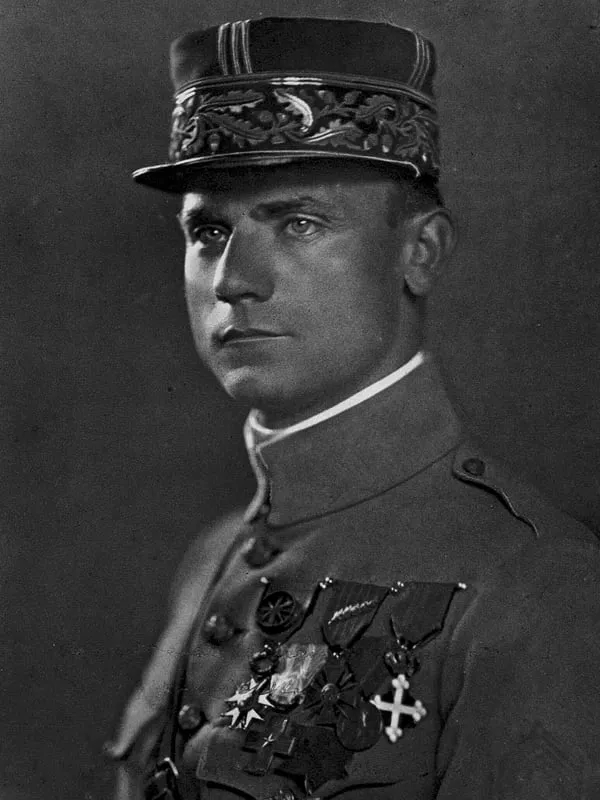
Milan Rastislav Štefánik
Vice-chairman of the Czechoslovak National Council, general of the French army, Czechoslovak minister of war (1918–1919)
- Born:
- 21 July 1880, Košariská (Slovakia)
- Died:
- 4 May 1919, Ivanka pri Dunaji (Slovakia)
- Author:
- Łukasz Skowroń
- Photo:
- autor nieznany, domena publiczna, Wikimedia Commons

Milan Rastislav Štefánik was the third founding father of Czechoslovakia, alongside Tomáš Masaryk and Edvard Beneš, and the only Slovak among them. The son of a village pastor from Upper Hungary, he made a career in France as an astronomer, and during the war became an airman and a general of the French army. His connections in the Paris salons opened the way for Masaryk to the French government, and his journeys to Russia, Romania, America and Italy gave the Czechoslovak movement what it needed most: soldiers. He was killed in an air crash in May 1919, while flying to his homeland for the first time since the war. Slovaks regard him as their greatest national hero.
Before the war
He was born on 21 July 1880 in Košariská in western Slovakia, then part of the Kingdom of Hungary, one of the twelve children of the local Lutheran pastor. He attended Lutheran grammar schools in Bratislava, Sopron and Szarvas. In 1898 he went to study in Prague, first at the polytechnic, then at the university, where he studied astronomy and mathematics and attended Masaryk’s lectures. From him he took the conviction that Czechs and Slovaks should act together. His studies were largely funded by Czech associations, because his family could not afford them.
In 1904, with a doctorate and no money, he went to Paris. Thanks to the astrophysicist Pierre Janssen he found work at the Meudon observatory. He researched the solar corona, climbed Mont Blanc, where Janssen’s observatory stood, several times, and in 1907 received a prize from the French Astronomical Society. After Janssen’s death he travelled all over the world on behalf of French institutions: he observed solar eclipses and Halley’s Comet in Turkestan, on Tahiti and in Brazil, built meteorological and telegraph stations in Ecuador, and carried out diplomatic tasks along the way. In 1912 he obtained French citizenship, and in 1914 the Legion of Honour. His circle of acquaintances ranged from scientists and industrialists to politicians. All his life he suffered from a serious stomach illness, for which he was operated on several times.
Airman
The war found him in Morocco. He believed that the defeat of Austria-Hungary would give Czechs and Slovaks a chance of independence, and he wanted to fight. Because of his health he reached the front only at the beginning of 1915, after training at the flying school in Chartres, where he gained his pilot’s licence in May. As a pilot of the MF 54 reconnaissance squadron he flew over Artois during the Second Battle of Artois. He made pioneering meteorological measurements from an aircraft and drew up a plan for a military meteorological service. He turned down an offer to head it and at his own request was transferred to Serbia.
He arrived on the Serbian front at the end of September 1915, just before the German-Austrian and Bulgarian offensive that ended in the conquest of Serbia. During the retreat, seriously ill, he crashed his aircraft. He was evacuated by air, according to many accounts in an aircraft flown by the well-known aviator Louis Paulhan, and taken to hospital in Rome.
Paris and the National Council
Back in Paris, Štefánik looked for people who thought as he did. On 13 December 1915 he met Beneš, and the two agreed that their plans coincided with Masaryk’s programme. Štefánik introduced them into the political salons. Through an acquaintance, the writer Claire de Jouvenel, he met Prime Minister Aristide Briand and Philippe Berthelot, one of the most influential officials of French diplomacy. It was Štefánik who arranged a meeting between Masaryk and Briand at the beginning of February 1916, after which France began to take the émigrés seriously. In the same month the Czechoslovak National Council was founded, and he became one of its vice-chairmen. He called Masaryk “little father”, which embarrassed the professor.
Military missions
Štefánik believed that the future state needed an army above all. In 1916 he flew briefly over the Italian front, dropping leaflets to Czech and Slovak soldiers, and in the summer he set off for Russia. On 25 August at headquarters in Mogilev the head of the French mission, General Maurice Janin, introduced him to the chief of staff, Mikhail Alekseyev, and to Tsar Nicholas II. A few days later in Kiev he persuaded representatives of the Czech and Slovak organisations in Russia to recognise the National Council as the leadership of the whole movement. He then went on to Romania, where he recruited about one and a half thousand volunteers among the prisoners of war. In Russia, however, he became entangled in disputes with the Council’s vice-chairman Josef Dürich, who preferred to work with the tsarist government rather than with Paris. Only the February Revolution strengthened the Council’s position.
In June 1917 he sailed to the United States to recruit volunteers among the emigrants. This proved harder than he had thought: America had itself entered the war, and Štefánik was allowed to recruit only those not liable to American conscription. By the end of the war just over two thousand volunteers had sailed from America to France. After returning to Paris, Štefánik and Beneš drafted the decree by which the French government in December 1917 created an autonomous Czechoslovak army in France. Janin became its commander and Štefánik his deputy for political affairs.
He accomplished his most difficult mission in Italy, where he went in February 1918. The government in Rome, attached to the promises of the Treaty of London, looked with mistrust on the nations of the Habsburg monarchy. Štefánik nevertheless managed to win over even the reluctant foreign minister Sidney Sonnino. After the Congress of Oppressed Nationalities in April he signed with Prime Minister Vittorio Emanuele Orlando a convention on forming a Czechoslovak army from prisoners of war in Italy, politically subordinate to the National Council. Some Allied diplomats saw in it the first de facto recognition of the future state by one of the Great Powers. On 24 May Orlando presented him with the legion’s colours in Rome. On 18 June 1918 Štefánik was made a brigadier general of the French army.
Siberia
In the summer of 1918 Štefánik set off for the Far East by way of the United States, where he conferred with Masaryk. The Czechoslovak Corps, which had risen against the Bolsheviks, was in the eyes of the Allies the nucleus of a new Eastern Front, and Štefánik was to keep up its spirits. In Japan he fell ill again and spent several weeks there. Meanwhile the National Council turned itself into a provisional government, in which he was entrusted with the war portfolio, and his signature appeared under the Washington Declaration of 18 October, although according to some accounts he knew nothing about it. He learned of the founding of the state and the end of the war in Japan. On 14 November he became minister of war in the first government of Czechoslovakia.
He arrived in Vladivostok in November together with Janin, who was to take command of the Allied forces in Russia. On the spot he realised that the plan for a new front was unrealistic. The legionaries were tired, wanted to return to a country that already existed, and had no intention of shedding blood for Russian generals. In December Štefánik visited Yekaterinburg, but failed to raise the soldiers’ spirits and ordered the corps to be withdrawn from the front to guard the Trans-Siberian Railway. He dissolved the Russian branch of the National Council and abolished by order the soldiers’ democratically elected representatives, a measure meant to turn the volunteer corps into a regular army. This provoked fierce opposition among the legionaries. He also agreed that General Radola Gajda should enter Russian service under Admiral Alexander Kolchak. He left Siberia in January 1919 convinced that the corps had to be brought home as soon as possible.
Death
He reached Paris in mid-March 1919 and took up the matter of bringing the legionaries home from Russia. He was also to settle a dispute between the French and Italian military missions in Czechoslovakia. Štefánik, who felt a bond with Italy and had a fiancée there, the Marchesa Giuliana Benzoni, quarrelled sharply over this with Beneš, who had put his money on France. On 4 May 1919 he took off from Campoformido airfield near Udine in an Italian Caproni bomber to fly to Bratislava. While coming in to land near Ivanka pri Dunaji the aircraft crashed. Štefánik and the three Italian crew members were killed. He was buried with the Italian airmen on Bradlo hill above his native Košariská, where in 1928 a monumental mound designed by Dušan Jurkovič was erected.
The cause of the crash was never explained. Commissions pointed to an accident caused by a mechanical failure, a gust of wind or pilot error. Other versions soon appeared, however: that the aircraft had been shot down by mistake by Czechoslovak soldiers, who took the Italian colours for Hungarian ones, as war with the Hungarian Soviet Republic was under way, or even that it was an assassination. None of these hypotheses has been proved.
Assessment
Štefánik was a colourful, ambitious and impatient man with aristocratic tastes, and politically a monarchist who reportedly would most have liked to see an Italian prince on the throne of Czechoslovakia. Historians agree that his connections in France and Italy and his energy as an organiser of troops were irreplaceable for the independence movement, and that the Italian convention was his personal achievement. After his death he became a legend, especially in Slovakia, where in 2019 he was voted the greatest Slovak in history. Slovak autonomists sometimes portrayed him as a victim of Czech centralism and of Beneš. Some historians, however, consider that the disputes between them have been exaggerated, and point to his warm telegrams to Masaryk and Beneš of December 1918. In communist Czechoslovakia his memory was suppressed for years and his monuments were torn down.
Sources
Spotted a mistake?Report an error
Often appears with
People who appear in the same events.