Czechoslovakia · The Entente
Edvard Beneš
Secretary-general of the Czechoslovak National Council (1916–1918), Foreign Minister of Czechoslovakia (1918–1935)
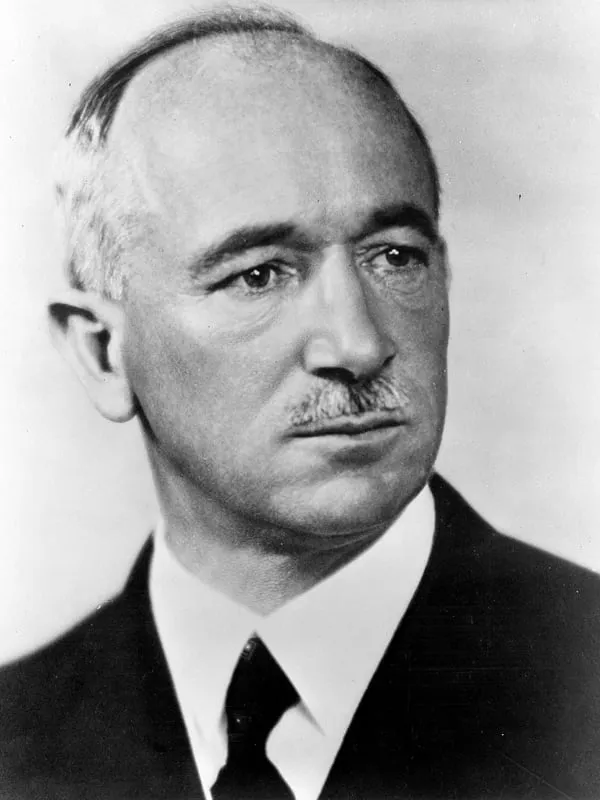
- Born:
- 28 May 1884, Kožlany (Bohemia)
- Died:
- 3 September 1948, Sezimovo Ústí (Czechoslovakia)
- Author:
- Natalia
- Photo:
- United States Office of War Information, domena publiczna, Wikimedia Commons

Edvard Beneš was the youngest of the three leaders of the Czechoslovak independence movement in exile and the one who did the greatest share of the day-to-day work. When he fled Prague in 1915, he was 31 and a little-known lecturer in sociology. For three years in Paris he ran the office of the Czechoslovak National Council, wrote articles and memoranda, maintained secret contact with the homeland and negotiated with French and British officials. In the summer of 1918 it was he who won recognition in Paris and London of the Council as the nucleus of a government, and in October he announced the formation of a Czechoslovak provisional government. For the next seventeen years he directed the foreign policy of the state he had helped to create, and later he was its president in its most tragic years.
Before the war
He was born on 28 May 1884 in Kožlany near Plzeň, the tenth child of a farmer. He attended the grammar school in Prague’s Vinohrady district and played football for Slavia Prague. He studied philosophy at the Czech university in Prague, where he attended the lectures of Tomáš Masaryk, and then in Paris at the Sorbonne and the school of political science. In 1908 he defended a doctorate in law in Dijon on the Austrian problem and the Czech question. He was an ardent Francophile and all his life regarded Paris as his city. In 1909 he married Hana Vlčková (PL). He taught at a commercial academy and, from 1912, at the university as a lecturer in sociology. Politically he started out in social democratic circles, then joined Masaryk’s small Progressive Party. Before the war, like his mentor, he did not yet call for the break-up of the monarchy.
The Maffie and escape
After the outbreak of war Beneš became one of the organisers of the conspiracy its members called the “Maffie”. The group of Prague politicians and intellectuals gathered information about the mood at home and in the army and about the authorities’ plans, and passed it on to Masaryk, who had been abroad since December 1914. Beneš travelled to Switzerland several times as a courier, carrying documents and messages. From May 1915 the authorities arrested one Czech politician after another, including the Young Czech leader Karel Kramář, and the circle of suspicion was closing in on Beneš as well. At the beginning of September 1915 Beneš crossed the border on a false passport and reached Switzerland. The authorities arrested his wife and held her in prison for several months.
Masaryk entrusted him with affairs in France and himself left for London. In Paris Beneš lectured on the Slavs, wrote for French newspapers and in 1916 published the pamphlet “Détruisez l’Autriche-Hongrie!” (“Destroy Austria-Hungary!”). He rebuilt the courier link with the “Maffie”, through which news from Prague reached Paris throughout the war. In December 1915 he met Milan Rastislav Štefánik, a Slovak in the uniform of a French airman who had access to the most important salons and offices in Paris. Although they differed in temperament, the two became an inseparable pair for several years.
Secretary-general
In February 1916 the Czechoslovak National Council was founded with Masaryk as chairman, and Beneš became its secretary-general. Since Masaryk was first in London and from May 1917 in Russia and America, and Štefánik was constantly travelling, it was Beneš who ran the movement’s headquarters in Paris. According to his memoirs, he and Štefánik lobbied the foreign ministry for the Allies to mention the liberation of the Czechoslovaks in their reply to Wilson’s note in January 1917. Masaryk attributed this achievement above all to the Prime Minister, Aristide Briand.
The most important goal was an army of their own. In December 1917 the French government issued a decree, prepared according to Slovak historians by Beneš and Štefánik, creating an autonomous Czechoslovak army in France, subordinate to the French command in all military matters and politically to the National Council. Formally the Czechoslovak Legion in Russia also belonged to it. In April 1918 Beneš and Štefánik represented the Council at the Congress of Oppressed Nationalities of Austria-Hungary in Rome, after which Italy agreed to a Czechoslovak army of its own on its front.
Summer 1918: recognition
In the spring of 1918 the Czechoslovak cause gained publicity thanks to the legionaries who, after their revolt against the Bolsheviks, seized the Trans-Siberian Railway. Beneš made use of this without hesitation. On 30 June he was at Darney when the soldiers of the Czechoslovak brigade in France swore an oath on a flag presented by President Raymond Poincaré. That day France recognised the National Council as the supreme body of the Czechoslovak movement and backed the aspiration to independence. In July he held talks in London. He spoke with the Foreign Secretary, Arthur Balfour, and Lord Robert Cecil. He found the first British draft too modest and presented his own, which the British accepted with minor changes. The declaration of 9 August recognised the Czechoslovaks as an Allied nation, their three armies as one Allied army, and the Council as “trustee of the future Czechoslovak Government”. Beneš regarded it as the movement’s greatest diplomatic success during the war.
The next steps were taken by Masaryk in Washington, where on 3 September the United States recognised the Council as a de facto belligerent government. On 14 October Beneš announced in Paris that the Council was turning itself into a provisional government, in which Masaryk was prime minister, Štefánik minister of war, and he himself minister of foreign affairs and of the interior. France recognised this government the next day. Four days later Masaryk proclaimed the declaration of independence in Washington, on whose text Beneš had also worked.
Geneva and the end of the war
On 28 October, as the National Committee was taking power in Prague, Beneš was beginning talks in Geneva with a delegation of politicians from the homeland led by Kramář. For the first time in three years the émigrés met people from home. It was agreed that the state would be a republic, that Masaryk would be president and Kramář prime minister. Kramář wrote to Prague that if people could see how Beneš commanded world affairs, they would take their hats off to him. On 4 November Beneš took part, on behalf of the Czechoslovaks, in the Paris meeting of Entente leaders at which Foch was entrusted with the direction of the war against Germany on all fronts. He also mediated in the talks between the Serbs and the Yugoslavs during the Geneva conference. On 14 November in Prague he was appointed foreign minister in Kramář’s government, but instead of returning home he stayed in Paris, where he prepared for the peace conference.
After the war
At the Paris Peace Conference he won for Czechoslovakia the frontiers of the historic Czech lands, with the Sudeten Germans, and the southern border of Slovakia. In the dispute with Poland over Cieszyn Silesia in January 1919 he opposed the armed entry of Czechoslovak troops, because he sensed the Allies’ disapproval, and in 1920 he secured a partition of the region favourable to Prague. He returned home only in September 1919. In the spring of 1919, according to many accounts, he quarrelled sharply with Štefánik, who reproached him for building the army solely on France and leaving out Italy. He was foreign minister without a break until 1935, and in 1921–1922 also prime minister. He was a co-founder of the Little Entente and one of the leading figures of the League of Nations. In 1935 he succeeded Masaryk as president. After the Munich Agreement in 1938 he resigned and went into exile; during the Second World War he headed the Czechoslovak government in London, and in 1945–1948 he was president again. After the Communists took power he resigned in June 1948 and died on 3 September that year at his villa in Sezimovo Ústí.
Assessment
Beneš’s role in 1915–1918 is rarely questioned. Historians agree in seeing him as the organiser without whom Masaryk’s ideas and Štefánik’s connections would not have been turned into documents, agreements and decrees. He was exceptionally hard-working, methodical and patient; he knew how to persuade officials and to find formulas their governments could accept, such as the British “trustee of the future Czechoslovak Government”. He himself regarded politics as practical sociology that could be conducted scientifically.
His critics see the same qualities as a weakness. They reproach him for excessive faith in documents and diplomatic formulas, cold legalism and a lack of feeling for the mood of ordinary people, and also for having incorporated into the state in Paris in 1919 millions of Germans and Hungarians whose loyalty it was later unable to win. His record in the Great War is, however, usually judged separately from the decisions of 1938 and 1948, over which the dispute in the Czech Republic and Slovakia continues to this day.
Sources
Spotted a mistake?Report an error
Often appears with
People who appear in the same events.
On the timeline
(11)1918
April
June
August
- 13
- Key eventCzechoslovaks declare war on GermanyOn 13 August 1918, per the British chronology, the Czechoslovaks declared war on Germany too. They had three armies, in Russia, France and Italy.
- Britain recognises the CzechoslovaksOn 13 August 1918 the Balfour note of 9 August was published. Britain recognised the Czechoslovaks as an Allied nation and their council as a proto-government.