France · The Entente
Aristide Briand
Prime Minister and Minister of Foreign Affairs of France (1915–1917)
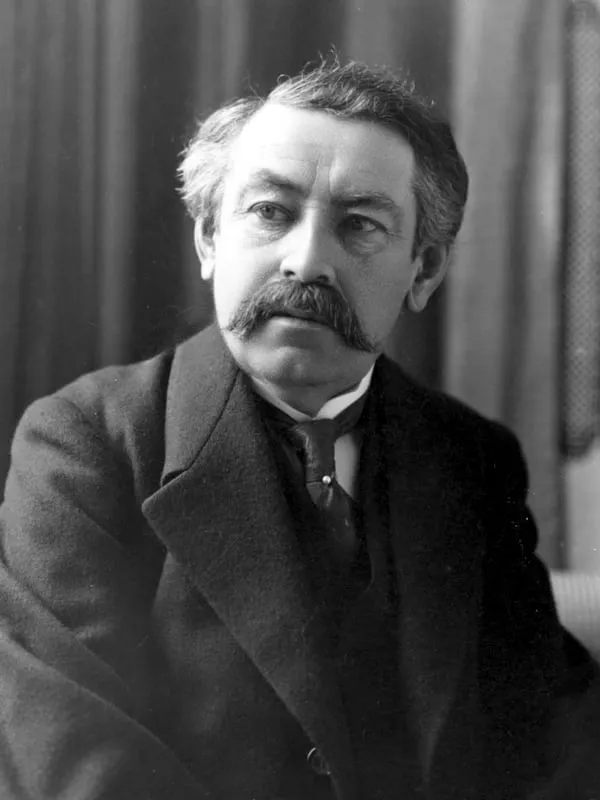
- Born:
- 28 March 1862, Nantes (France)
- Died:
- 7 March 1932, Paris
- Author:
- Łukasz Skowroń
- Photo:
- autor nieznany, domena publiczna, Wikimedia Commons

Aristide Briand was France’s longest-serving Prime Minister during the war. He governed from October 1915 to March 1917, and thus through Verdun, the Somme, the entry into the war and defeat of Romania, and the fiercest disputes over who should direct the war: the government, parliament or the high command. A former socialist and a master of parliamentary compromise, he could reconcile quarrelling factions, but was not always able to take hard decisions. He was the chief champion of the Salonika expedition and of the policy that turned Greece into a battlefield of diplomats. He removed Joffre from command and staked everything on Nivelle, which turned against him. After the war, as Foreign Minister for many years, he became the symbol of reconciliation with Germany and in 1926 received the Nobel Peace Prize.
Before the war
Aristide Pierre Henri Briand was born on 28 March 1862 in Nantes, into the family of an innkeeper. He studied law in Paris and was a lawyer and journalist, and in the 1890s he was among the most radical socialist activists: he preached the idea of the general strike and worked with Jean Jaurès, with whom in 1904 he founded the daily L’Humanité. He became a deputy in 1902. He made his name as rapporteur of the 1905 law on the separation of the Churches and the State, which he carried through in a spirit of moderation, softening the harshest anticlerical proposals.
In 1906 he accepted the portfolio of Minister of Public Instruction and Worship in a Radical cabinet, for which the socialists expelled him from their party. From then on he went his own way, ever closer to the centre. In 1909–1911 he was Prime Minister, and in 1910 he broke the railway strike by calling the strikers up into the army, something the left long refused to forgive him. He headed the government again at the beginning of 1913. He was regarded as a brilliant orator who spoke without notes, and as a politician who could persuade anyone but was reluctant to read files. In August 1914, when René Viviani was building the government of the Sacred Union, Briand became its Minister of Justice and Deputy Prime Minister.
Salonika
Briand soon concluded that the war on the Western Front would be hard to decide, and looked for a solution in the Balkans. As early as the winter of 1914–1915 he argued that the Entente should send troops through Salonika to help Serbia and win over Greece, Romania and Bulgaria. He found an ally in David Lloyd George, with whom he discussed the matter at length in February 1915, and in Generals Gallieni and Franchet d’Espèrey. Joffre and the British generals regarded such plans as diverting forces from the most important front. In the summer of 1915 Briand persuaded General Maurice Sarrail, who had been removed from the front, to take command of the expedition to the East, and in the autumn, when Bulgaria entered the war, the French and British landed at Salonika.
At the end of October 1915, after the fall of the Viviani government, Briand formed his own cabinet and at the same time took the Ministry of Foreign Affairs. It was a government of exceptionally broad coalition, with seven former prime ministers, and its watchword was “unity of front”, including in relations with the allies. From his first days the new Prime Minister defended the Salonika expedition. When Serbia collapsed and the British wanted to evacuate Salonika, Briand insisted at the conferences in Calais and Paris at the beginning of December that the allies remain in Macedonia. Nor would he agree to the evacuation of the Gallipoli peninsula without an understanding with France. In the spring of 1916 he chaired the first great inter-allied conference in Paris, and in June the economic conference, which was to prepare economic war against the Central Powers.
His policy towards Greece became his most controversial legacy. Briand wavered between pressure on King Constantine I and attempts to reach an understanding with him. He agreed to the state of siege in Salonika and to the blockade, but for a long time did not want openly to support Eleftherios Venizelos, fearing that recognition of his government in Salonika would enrage Athens. Many critics thought him too accommodating towards the court. It was rumoured that he was influenced by Princess Marie Bonaparte, wife of Prince George of Greece, with whom he was then having an affair. The December fighting in Athens showed that this policy had failed.
Verdun and the dispute over command
Briand’s hardest task was keeping the balance between the Commander-in-Chief Joseph Joffre and the men who wanted to control him. In December 1915, at the request of the War Minister Gallieni, the government made Joffre commander-in-chief of all the French armies. Briand hoped that in this way Joffre would stop blocking the reinforcement of the troops in Macedonia. After the German attack at Verdun Gallieni demanded in March 1916 that the high command be subordinated to the civil power. Briand feared that such an indictment in the middle of the battle would undermine the army’s morale and bring down the government. The ministers did not back Gallieni, and he resigned.
Parliament, however, gave him no peace. In June 1916, at the first secret session of the Chamber of Deputies, devoted to Verdun, Briand won a vote of confidence by 440 votes to 80, but had to promise closer supervision of the army. In the autumn came the modest results of the Somme, the defeat of Romania, whose entry into the war had also been his diplomatic success, and the War Minister Pierre Roques’s report from Salonika. At the second secret session, from 28 November to 7 December, Briand survived only by 344 votes to 160. On 12 December he reconstructed the government: he reduced it in size, created a small war committee on the British model, made General Hubert Lyautey War Minister, and entrusted command of the armies in France to General Robert Nivelle. Joffre, to whom he had promised the role of adviser to the government, left after two weeks with a marshal’s baton.
Fall
In the winter of 1916–1917 Briand conducted on behalf of the allies the reply to the German peace offer and to President Wilson’s note, in which the allies for the first time publicly listed their war aims. In February 1917 his envoy Gaston Doumergue obtained in Petrograd the Tsar’s consent to French plans for the left bank of the Rhine, which, when later revealed, caused France trouble. At Calais on 26 and 27 February Briand, together with Lloyd George, tried to subordinate the British commander Douglas Haig to General Nivelle.
The government fell for a reason that seemed secondary. On 14 March Lyautey, shouted down in the Chamber of Deputies, resigned. Briand failed to find a successor and on 17 March 1917 tendered the resignation of the whole cabinet. The new government was formed by Alexandre Ribot, and Briand did not join it. In the autumn of 1917 a German proposal for talks reached him through Belgian intermediaries, passed on by Baron Oskar von der Lancken from occupied Brussels. Briand took it seriously, but the Ribot government, after consulting the allies, regarded the whole affair as an attempt to split the coalition and closed it. In November Briand opposed entrusting the government to Clemenceau and remained on the sidelines until the end of the war.
After the war
He returned to power in January 1921 as Prime Minister and Foreign Minister. A year later he fell after the Cannes conference, where the press portrayed him as a politician too compliant towards the British. From 1925 until January 1932, almost until his death, with a short break, he directed French diplomacy. He negotiated the Locarno Treaties of 1925, for which in 1926 he received the Nobel Peace Prize together with Gustav Stresemann. In 1928, with the American Secretary of State Frank Kellogg, he brought about the pact renouncing war, and in 1929 at the League of Nations he proposed a European federation. In all he headed the government eleven times. In May 1931 he lost the presidential election to Paul Doumer. He died in Paris on 7 March 1932.
Assessment
Briand aroused extreme emotions. His perennial opponent Clemenceau is credited with the barbed remark that Briand knows nothing but understands everything. British politicians valued his charm and intuition, but complained of his vague promises. Historians credit him with building allied cooperation, though Elizabeth Greenhalgh points out that it was he who blocked the British idea of a permanent coalition secretariat. His defence of the Salonika front, against Joffre and the British, was long seen as a politician’s costly whim, but the victory on the Vardar in 1918 to some extent proved him right. The most serious charge remains the choice of Nivelle, for which the French army paid in the spring of 1917.
Sources
Spotted a mistake?Report an error
Mentioned in battles
(01)Often appears with
People who appear in the same events.
On the timeline
(51)The 40 most important of 51 events. All tagged “Aristide Briand” (16) →
1914
1915
1916
January
February
March
April
June
July
August
September
October
November
December
- 12
- Key eventGerman peace offerOn 12 December 1916 Germany and her allies proposed peace negotiations to the Entente. The note contained no terms, but plenty of boasting.
- Nivelle becomes commander-in-chiefOn 12 December 1916 Briand reshaped his government and set up a five-man war committee. Nivelle replaced Joffre in command of the French armies in France.
- 26
- London conference on the peace notesOn 26–28 December 1916 British and French ministers met in London to discuss the reply to the peace notes, Salonika and the Nivelle plan.
- Joffre becomes Marshal of FranceOn 26 December 1916 Joffre gave up the last of his authority over the army and was made Marshal of France, the first since 1870. It was a consolation prize.