Greece · The Entente
Constantine I of Greece
King of Greece (1913–1917 and 1920–1922)
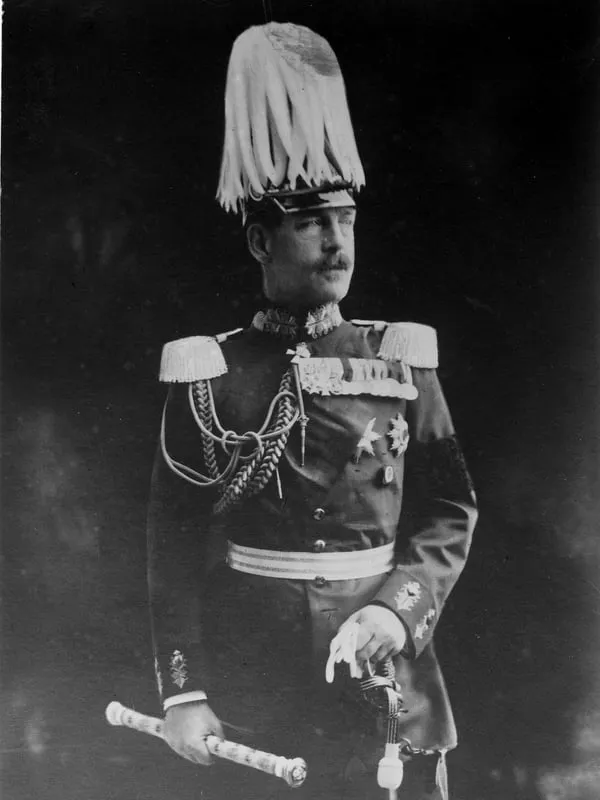
- Born:
- 2 August 1868, Athens (Greece)
- Died:
- 11 January 1923, Palermo (Italy)
- Author:
- Łukasz Skowroń
- Photo:
- George Grantham Bain Collection, domena publiczna, Wikimedia Commons

Constantine I came to the throne in 1913 as the most popular man in Greece: the commander who in the Balkan Wars had taken Salonika and Ioannina and almost doubled the state’s territory. Four years later a French commissioner sent him into exile. Throughout that time the king held to one conviction: Greece should not enter the Great War, and certainly not against Germany, whose army he admired and feared. This stance led him into open conflict with the prime minister Eleftherios Venizelos, whom he twice forced to resign, and with the Entente powers, which from 1915 were fighting on Greek soil. From the quarrel between king and prime minister grew the National Schism, a rift that divided the Greeks for decades to come. Formally, Greece entered the war on the side of the Entente, but only after Constantine had been removed.
Before the war
He was born on 2 August 1868 (21 July in the Julian calendar, which Greece used until 1923) in Athens, the eldest son of King George I, a Danish prince placed on the Greek throne by the powers, and the Russian Grand Duchess Olga. He was the first member of the dynasty born in Greece, and his name, given at the wish of the crowds, recalled the legend of a King Constantine who would recover Constantinople. He graduated from the Greek military academy and then studied in Germany: he served in a Berlin Guards regiment and studied at Heidelberg and Leipzig. In 1889 he married Sophia, daughter of Emperor Frederick III and sister of Wilhelm II. This marriage and his German education later weighed on how he was seen in Paris and London.
The first war in which he held command ended in defeat. In the war with Turkey in 1897 the crown prince’s Army of Thessaly was routed, and the royal princes were blamed. After the officers’ coup at Goudi in 1909 he had to leave the army for a time. He was reinstated by Venizelos, who in 1910 came from Crete to take office as prime minister and sought an understanding with the court. In the First Balkan War Constantine commanded the main army of the Greek offensive. He defeated the Turks at Sarantaporo and Giannitsa, although he went to Salonika only on the prime minister’s express order, as he himself preferred to march on Bitola. The city surrendered to the Greeks on 8 November 1912, a few hours before the Bulgarians arrived. In early March 1913, after moving the main forces to Epirus, he took the fortress of Bizani and Ioannina. In March 1913, after his father was assassinated in Salonika, he became king, and in the summer he led the army against the Bulgarians in the Second Balkan War.
He was then at the height of his popularity. In the autumn of 1913 Wilhelm II made him a field marshal of the Prussian army, and Constantine, accepting the baton in Germany, attributed the Greek victories to the German military school. In France, whose mission was at that very time training the Greek army, this was received with indignation.
1914–1915: neutrality and Venizelos’s two resignations
When the Great War broke out, Wilhelm II called on his brother-in-law to stand at Germany’s side. Constantine refused: he wrote that his sympathies lay with Germany, but that Greece, whose coasts and islands lay within reach of the British and French fleets, could not risk war with the masters of the Mediterranean. That, in short, was his programme for the next three years: a neutrality which he himself considered the only safe policy, and his opponents considered benevolent towards Berlin. Venizelos wanted from the start to go with the Entente and, according to some accounts, offered it the Greek army as early as August 1914, but Edward Grey, who did not want to provoke Turkey and Bulgaria, declined.
The first serious clash came in January 1915. London promised Greece gains in Asia Minor if it helped Serbia, and Venizelos was ready to buy Bulgaria’s participation in the war even by ceding Kavala to it. The king would not hear of giving up Greek land and would accept war only together with Romania. When Bucharest refused, Greece declined to help Serbia. In March the same thing happened on a larger scale. Venizelos wanted to send the fleet and a corps to the Dardanelles, and later at least one division. The general staff, with Colonel Ioannis Metaxas, judged the expedition hopeless, and Constantine, after two sessions of the Crown Council, sided with the soldiers. On 6 March Venizelos resigned, and power passed to his opponent Dimitrios Gounaris. The king’s supporters later regarded the bloody failure of the Gallipoli landings as the best proof that he had been right.
In the spring of 1915 Constantine fell gravely ill with pleurisy and pneumonia and for several weeks was close to death. Venizelos’s Liberals won the elections in June, but the king’s illness, and according to the Venizelists also a delay convenient to the court, meant that Venizelos returned to power only in August. In September, when Bulgaria announced mobilisation, the king signed the decree mobilising the Greek army, but treated it as armed neutrality. According to Venizelos’s account, he kept repeating at the time: “I do not want to fight. The Germans will beat us.” He held that the 1913 alliance with Serbia applied only to a Balkan war and was not binding, since Serbia could not field the promised 150,000 troops against Bulgaria. Sources disagree on how far he himself consented to bringing Entente troops to Salonika. What is certain is that when the prime minister announced in parliament that Greece would honour the alliance even if it meant war with Germany, Constantine on 5 October, the day of the Allied landing at Salonika, withdrew his support. Venizelos resigned a second time, although he had only just won a vote of confidence.
From then on the king ruled through cabinets of his own men. The government of Alexandros Zaimis declared armed neutrality and, as Serbia was falling under the blows of the Central Powers and Bulgaria, rejected even a British offer of Cyprus. In November, after Zaimis fell, the king entrusted the government to the aged Stefanos Skouloudis and for the second time in a year dissolved the chamber. The Liberals boycotted the December elections, regarding the dissolution of the parliament elected in June as an assault on the constitution.
1916: between the Entente and Berlin
Relations with the Entente grew steadily worse. The king, who had personally given his word to Herbert Kitchener that retreating Allied troops would not be interned, told the French minister in December 1915: “Do as you think fit. I shall protest for form’s sake.” Yet he protested ever more loudly. In January 1916, after the occupation of Corfu, he listed to an American journalist the Greek islands and ports occupied one after another by the Allies and compared the fate of Greece with that of Belgium. In May the Skouloudis government surrendered Fort Rupel without a fight to the Germans and Bulgarians, whose intentions it had known beforehand. In the eyes of the Entente this was proof of collusion with the enemy. In June the Allies blockaded the Greek coasts and by an ultimatum forced the demobilisation of the army, and the king, faced with warships off the coast, gave way. The discharged reservists, however, formed leagues loyal to the crown. In July, in a forest fire around the summer residence of Tatoi, the king and his family barely escaped with their lives. The royalists blamed French agents for the arson, but this was never proved.
In the summer the Bulgarians entered eastern Macedonia, and the Greek IV Corps at Kavala gave itself up to the Germans and was taken away to Görlitz. For Venizelos’s supporters this was treason. At the end of August the National Defence coup broke out in Salonika, and in September Venizelos himself left Athens and formed a provisional government, which declared war on Germany and Bulgaria. Constantine was still negotiating with the Allies over the terms of entering the war, but neither side trusted the other any longer.
The crisis peaked on 1 December 1916. A French admiral landed a force at Piraeus to compel the surrender of arms, and in Athens there was fighting with Greek troops and reservists. When warships shelled the city and shells fell near the palace, the king greeted the Entente ministers with the question: “Are these your arguments, gentlemen?” The Allies withdrew humiliated, and the next day the royalists attacked the Venizelists. Venizelos, against whom an arrest warrant had been issued, was anathematised on Christmas Day. The Entente responded with a blockade, which cut royal Greece off from grain and coal, and with recognition of the government in Salonika.
Exile
In January 1917 Athens apologised to the Allies, but the king’s fate was already sealed. After the fall of the Tsar he lost his only protector in the Entente camp, and the new French government wanted him removed. At the London conference the British gave way to the French. On 11 June the High Commissioner Charles Jonnart demanded his abdication, threatening in case of resistance the bombardment of Athens and the fall of the dynasty. Constantine judged resistance pointless. He did not, however, sign an act of abdication. He merely declared that he was leaving the country together with the heir to the throne, and left the crown to his younger son Alexander, because the Allies considered the eldest, George, a Germanophile. On 12 June a crowd surrounded the palace to prevent him from leaving. The family slipped away only in the afternoon, and on 14 June sailed for Italy and from there to Switzerland. Two weeks later Venizelos took over the government, and Greece entered the war. The royalists believed that Alexander was merely keeping his father’s crown for him.
After the war
In Switzerland Constantine lived to see the end of the war and the triumphs of Venizelos, who in the Treaty of Sèvres secured Smyrna and Eastern Thrace for Greece. In October 1920 King Alexander died after being bitten by a monkey, and in November the Venizelists lost the elections. A plebiscite in which, according to the official results, almost all voters favoured the king’s return opened the way home for him. On 19 December 1920 Constantine returned to the throne. France and Britain received this with hostility and refused Greece their support, while the war with Turkey, inherited from Venizelos, went on. In the summer of 1921 the king travelled to Asia Minor to raise the spirits of the army, which advanced on Ankara and was halted on the Sakarya. In August 1922 the army of Mustafa Kemal routed the Greeks, and at the end of September mutinous officers forced Constantine to abdicate, this time formally, in favour of his son George. He died in exile in Palermo on 11 January 1923. In 1936 his remains were brought back to Greece and buried at Tatoi.
Assessment
Constantine remains one of the most contested figures in Greek history, because the dispute over him was a political dispute from the start. For the Venizelists and the Entente press he was a Germanophile, the Kaiser’s brother-in-law, who under the cover of neutrality played into Berlin’s hands, handed Rupel and Kavala to the Bulgarians and betrayed allied Serbia. Their most serious charge, however, concerned the constitution: the king twice rejected the policy of a government that had a majority in parliament, twice dissolved the chamber and in practice took over the direction of foreign policy. The British official historian Cyril Falls conceded at the same time that the violation of the constitution was for the powers more a pretext than the real reason for removing the king.
Constantine’s defenders, such as the British writer George F. Abbott and Admiral Mark Kerr, commander of the Greek fleet in the first months of the war, saw him as the victim of a smear campaign and of pressure from great powers that were violating Greek neutrality, and Abbott compared the occupation of Corfu with the invasion of Belgium. They stressed that Constantine had also refused Germany, that his assessment of the Dardanelles expedition and of the Entente’s Balkan prospects in 1915 proved accurate, and that his fear of sharing the fate of Serbia and Romania was justified. Modern historians usually reject the image of a traitor, but nor do they see him merely as a victim. The king, who wanted to protect his country from war, managed neither to maintain true neutrality nor to prevent Greece from becoming a theatre of foreign operations and a field of civil war. The most lasting result of his reign was the rift between “Old Greece”, loyal to the crown, and the “New Lands”, which followed Venizelos. This division weighed on Greek politics until the Second World War.
Sources
Spotted a mistake?Report an error
Mentioned in battles
(02)Often appears with
People who appear in the same events.
On the timeline
(81)1913
1914
1915
January
March
- 09
- Dimitrios Gounaris becomes prime minister of GreeceOn 9 March 1915 King Constantine I appointed Dimitrios Gounaris prime minister of Greece. He was an opponent of Venizelos and a supporter of neutrality.
- British reply on LemnosOn 9 March 1915 London replied to the Greek request for an explanation of the occupation of the island of Lemnos, citing military necessity.
April
July
August
September
October
- 05
- Key eventEntente landing at SalonikaOn 5 October 1915 the French 156th Division and British 10th Division began landing at Salonika to save Serbia, but that day Venizelos's government fell.
- Venizelos resigns againOn 5 October 1915 King Constantine I refused to back Venizelos's policy, although Parliament had given him a vote of confidence. The premier resigned again.
- 06
- Alexandros Zaimis becomes prime minister of GreeceOn 6 October 1915, a day after Venizelos resigned, Alexandros Zaimis was forming a new government in Athens. Its members opposed war on Serbia's side.
- Constantine gives assurances of Greek neutralityIn early October 1915 King Constantine I assured the British minister that Greece would stay neutral. Mobilisation and the Entente landing were to go on.
November
December
1916
January
May
June
- 21
- Entente ultimatum to GreeceOn 21 June 1916 the ministers of France, Britain and Russia demanded that Greece demobilise, form a non-party government and hold elections. Athens gave in.
- Resignation of the Skouloudis governmentOn 21 June 1916, the day the Entente demanded a change of government in Greece, Prime Minister Stefanos Skouloudis resigned after less than eight months.
- Zaimis prime minister of Greece againOn 21 June 1916 King Constantine entrusted the government to Alexandros Zaimis, who accepted all the Entente's demands and formed a cabinet of officials.
August
September
- 11
- Zaimis resignsOn 11 September 1916 the Greek prime minister Alexandros Zaimis resigned. Talks on entering the war had stalled, and French pressure on Athens kept growing.
- Surrender of the Greek IV Corps at KavalaOn 11 September 1916 the Greek IV Corps, trapped in Kavala, gave itself up to the Germans to avoid Bulgarian captivity. The Bulgarians took the town next day.