1915: The Dardanelles
Dardanelles naval operation
- Dates:
- 19 February – 18 March 1915
- Front:
- Middle East
- Location:
- The Dardanelles strait and its entrance, between the Gallipoli peninsula and the Asian shore of TurkeyOn the battle map →
- Sides:
- United Kingdom and FranceSackville Carden, John de Robeck, Émile Guépratte, Roger KeyesOttoman EmpireCevat Pasha, Guido von Usedom
- Result:
- Ottoman victory. The Allies destroyed the forts at the entrance to the strait but did not break through the minefields. On 18 March they lost three battleships, and three others were badly damaged.
- Author:
- Łukasz Skowroń
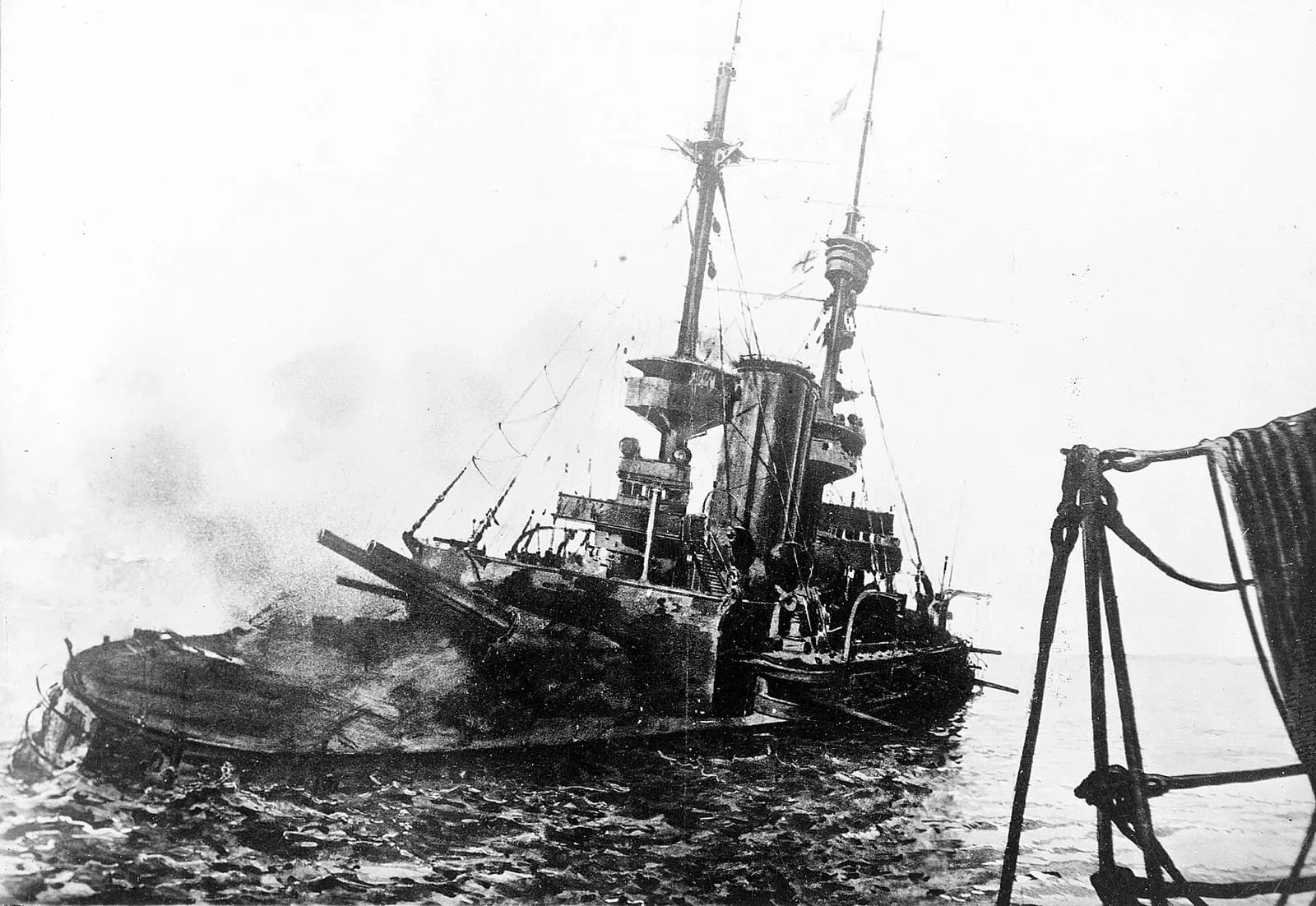
The naval operation in the Dardanelles was an attempt by the British and French fleets to force the strait without the help of land forces. The ships were to destroy the Turkish forts, clear the strait of mines, enter the Sea of Marmara and appear off Constantinople. The British hoped that the sight of battleships off the capital would provoke a coup in Turkey or force it out of the war, and that the straits would open a sea route to Russia. For four weeks the fleet gradually worked its way deeper into the Dardanelles, but it was stopped in front of the minefields at the narrowest point of the strait. The great attack of 18 March ended with three battleships sunk and settled that the Dardanelles would have to be fought for on land.
Name and dates
On this page we use the dates 19 February – 18 March 1915, from the first day of the bombardment of the forts at the entrance to the strait to the failed attempt to break its defences. After 18 March the fleet did not resume an attack on its own. The ships continued to operate off the Dardanelles, but in support of the landing that followed on 25 April. The earlier bombardment of 3 November 1914 was a one-off demonstration and was not part of this operation. Times are given in local time, as used in the British official history, that is, Eastern European time.
Background
The idea of a strike at the Dardanelles revived at the beginning of 1915, when Grand Duke Nicholas asked the British for an action that would relieve the Russians in the Caucasus. On 13 January the British War Council instructed the Admiralty to prepare an expedition, and on 28 January it gave its final approval, despite the opposition of the First Sea Lord, Admiral John Fisher. The chief advocate of the operation was the First Lord of the Admiralty, Winston Churchill.
The plan was drawn up by Vice-Admiral Sackville Carden, commander of the squadron that since August 1914 had been watching the exit of the strait, where Goeben and Breslau had taken refuge. Sixteen capital ships gathered under his orders, including four French ones under Rear-Admiral Émile Guépratte. Among them were the newest British dreadnought, Queen Elizabeth, with 381 mm (15-inch) guns, and the battlecruiser Inflexible, but most were old pre-dreadnought battleships. The fleet was accompanied by cruisers, destroyers, submarines, the seaplane carrier Ark Royal and minesweepers. The last were converted fishing trawlers with civilian crews.
The defence of the strait consisted of three parts. At the entrance stood four forts: Sedd el Bahr and Helles on the European shore, Kum Kale and Orkanie on the Asian shore. Further in, up to the Narrows at Çanakkale, stretched lines of mines, covered by mobile howitzers and field batteries hidden on the slopes. In the Narrows themselves stood the strongest forts. The defence was commanded by the commandant of the Dardanelles fortifications, Cevat Pasha, and the Germans, above all Admiral Guido von Usedom, had a large part in organising it. The Turks, however, were short of ammunition, and the bombardment of November 1914 had warned them of an attack. A few weeks later the British submarine B11 sank the old battleship Mesudiye in the strait.
The forts at the entrance
The bombardment began on 19 February at 9.51 a.m. All day the ships fired at the forts from long range, and in the afternoon they moved closer. In the evening, when the forts seemed destroyed, the Helles and Orkanie batteries unexpectedly opened fire on the approaching battleship Vengeance of Rear-Admiral John de Robeck. At dusk Carden broke off the action. The first day showed that a gun in an earthwork fort could be put out of action only by a direct hit.
Then a gale blew up for almost a week. The ships returned on 25 February. The Helles battery hit the battleship Agamemnon seven times, killing three sailors, but together with Queen Elizabeth she put both guns of that battery out of action. Then the battleships came close to the entrance and shelled the forts at short range. In the afternoon all four forts fell silent and the Turks withdrew from them. The minesweepers began to sweep the entrance to the strait.
On 26 February and the following days parties of sailors and Royal Marines went ashore and blew up the abandoned guns. Near Kum Kale Lieutenant-Commander Eric Robinson reached the Orkanie battery alone with an explosive charge and destroyed its last gun, for which he received the Victoria Cross. Resistance, however, was growing. On 4 March two companies of Royal Marines that had landed near Kum Kale and Sedd el Bahr ran into heavy fire and had to withdraw to the ships, losing several dozen killed and wounded.
Stopped by the mines
The second phase, clearing the strait of mines up to the Narrows, proved much harder. The minesweepers, weak and slow, struggled to make headway against the current flowing out of the Dardanelles. By day they could not work under the fire of the batteries, and at night they were blinded by searchlights and shelled by hidden guns. The civilian fishermen did not want to work under fire. The battleships could not locate the mobile howitzers, which kept changing position. At the beginning of March Queen Elizabeth shelled the forts in the Narrows with indirect fire over the peninsula from the Aegean Sea, but without much effect. Neither the bombardment of the Turkish fortifications on the Gulf of Saros nor the operations of British ships off Smyrna brought a decision.
In mid-March the minesweepers, now partly manned by naval volunteers, made another attempt under the cover of the light cruiser Amethyst. The cruiser was badly hit and lost about 20 killed, and only a few of the minesweepers managed to put out their sweeps. The Admiralty, pressed by Churchill, demanded more determination. Carden prepared a plan for a great attack, but in mid-March he fell ill and had to hand over command to de Robeck.
Meanwhile it was becoming ever clearer that the fleet alone would not be enough. As early as 16 February British ministers decided to send troops to the island of Lemnos, where a base for the expedition was being set up in Mudros Bay. At the beginning of March the Australian 3rd Brigade arrived there from Egypt, and by the middle of the month the Royal Naval Division and a French division. The Secretary of State for War, Lord Herbert Kitchener, agreed on 10 March to send the 29th Division and gave command of the land forces to General Ian Hamilton, who arrived off the Dardanelles on 17 March.
18 March
On the morning of 18 March the whole fleet entered the strait. The first line, made up of Queen Elizabeth, Agamemnon, Lord Nelson and Inflexible, opened fire on the forts in the Narrows at about 11.30 a.m. Later Guépratte’s French battleships joined in, coming closer. At about 1.25 p.m. the fire of the Turkish forts clearly slackened, and de Robeck ordered the French to be relieved by the next line of British battleships.
The withdrawing French ships passed through Eren Köy Bay by the Asian shore. On the night of 7–8 March the Turkish minelayer Nusret had secretly laid a line of 20 mines there (according to some sources 26), parallel to the shore, in the place where the Allied ships turned after their bombardments. The British had not detected it. At about 1.54 p.m. the battleship Bouvet struck a mine, capsized and sank within a few minutes. More than 600 sailors were killed and a few dozen were rescued. After 4 p.m. Inflexible and the battleship Irresistible struck mines in the same area. Inflexible, with over 30 dead and her bow full of water, barely made it to Tenedos. Irresistible lost power and drifted under the fire of the Turkish batteries. The battleship Ocean, which was to take her in tow, also struck a mine at about 6.05 p.m. Destroyers took off the crews of both ships, and the ships themselves sank during the night. The French battleships Gaulois and Suffren were also badly damaged. Gaulois had to be beached.
According to the most commonly given figures, the Turks lost about 120 killed and wounded, and most of their guns survived. By dusk de Robeck had recalled the fleet. Of the sixteen capital ships three had sunk and three more were put out of action for a long time.
Significance
18 March ended the attempt to force the Dardanelles with the fleet alone. De Robeck at first intended to renew the attack, but on 22 March, after a conference with Hamilton, both concluded that troops first had to be landed on the Gallipoli peninsula. The landing, which took place on 25 April 1915, began the months-long Gallipoli campaign, which ended with the Allied evacuation in January 1916.
Historians still argue over whether a further attack by the fleet could have succeeded. On 18 March the Turks used up a large part of their ammunition for the heavy guns, and some participants, such as Carden’s chief of staff, Commodore Roger Keyes, were convinced that the fleet had been one step from victory. Others point out that the minefields in the Narrows remained intact and that the minesweepers could not clear them under fire. What is certain is that the old battleships proved helpless against the combination of mines, mobile batteries and fire from the fortifications. In Turkey the defence of the Dardanelles became one of the most important national symbols, and 18 March is celebrated as the day of the victory at Çanakkale.
Spotted a mistake?Report an error