United Kingdom · The Entente
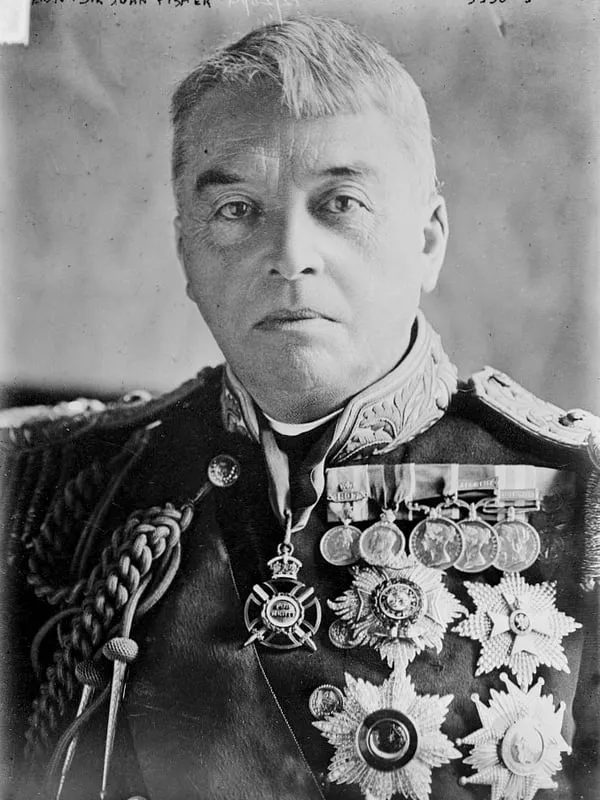
John Fisher
First Sea Lord (1904–1910 and 1914–1915), Chairman of the Board of Invention and Research (1915–1918)
- Born:
- 25 January 1841, Ramboda (Ceylon)
- Died:
- 10 July 1920, London
- Author:
- Łukasz Skowroń
- Photo:
- Underwood & Underwood, domena publiczna, Wikimedia Commons

John Arbuthnot Fisher, from 1909 Lord Fisher of Kilverstone, was the most influential and the most quarrelsome admiral of his age. As First Sea Lord, the professional head of the Royal Navy, from 1904 to 1910 he rebuilt the fleet for a war with Germany and gave it the battleship Dreadnought, which gave its name to a whole new generation of warships. In October 1914, aged 73, he returned to the Admiralty alongside Winston Churchill. He quickly avenged the defeat at Coronel and launched an enormous shipbuilding programme, but the Dardanelles expedition wrecked his partnership with Churchill. His sudden departure in May 1915 helped bring down the Liberal government of H. H. Asquith and ended his career.
Before the war
He was born on 25 January 1841 in Ramboda in Ceylon, into the family of an army officer who had become a coffee planter. At the age of six he was sent to his grandparents in London, and in 1854, aged thirteen, he joined the navy, still in the days of sailing ships. He served in the Baltic during the Crimean War and in China during the Second Opium War. He early made a name for himself as a champion of innovations: long-range gunnery, torpedoes and later submarines. In 1882 he commanded the battleship Inflexible during the bombardment of Alexandria.
After that he rose quickly: he was Controller of the Navy, responsible for shipbuilding, commander of the Mediterranean Fleet, Second Sea Lord and commander at Portsmouth. In October 1904 he became First Sea Lord. He ruthlessly sold or put into reserve some 150 obsolete ships which in his view were “too weak to fight and too slow to run away”, and directed the men and money saved to new vessels. He concentrated the best forces in home waters, against the growing German fleet. Under his pressure HMS Dreadnought was launched in 1906, the first fast battleship armed exclusively with heavy guns, and soon afterwards the first battlecruisers, which combined a battleship’s guns with a cruiser’s speed at the cost of weaker armour. He also supported submarines and the fleet’s conversion from coal to oil.
The reforms split the navy into Fisher’s supporters and his bitter enemies. The most notorious was his long-running feud with Admiral Charles Beresford. In 1909 he was made a baron, with the motto “Fear God and dread nought”, a pun on the Dreadnought. In January 1911, on his seventieth birthday, he retired, but did not stop influencing the fleet. When Churchill became First Lord of the Admiralty, Fisher became his informal adviser, and in 1912 he chaired the royal commission that prepared the fleet’s conversion to liquid fuel.
Return to the Admiralty
At the end of October 1914 an anti-German press campaign forced Prince Louis of Battenberg to resign. Churchill wanted a strong professional at his side and chose Fisher, although King George V had reservations. On 30 October 1914 the 73-year-old admiral took up the post of First Sea Lord for the second time. The Times wrote that he had never been younger or more energetic.
Two days later came the news of the defeat of a British squadron at the Battle of Coronel. Fisher reacted immediately. He sent two battlecruisers, Invincible and Inflexible, from the Grand Fleet to the South Atlantic under the command of Admiral Doveton Sturdee, with whom he was in fact at odds. On 8 December they destroyed the squadron of Admiral Maximilian von Spee at the Battle of the Falkland Islands. Fisher was, however, displeased that the cruiser Dresden had escaped. After the Battle of Dogger Bank in January 1915 he sharply criticised Admiral Archibald Moore, who had let the German battlecruisers escape.
At the same time he launched a great shipbuilding programme: hundreds of destroyers, submarines, monitors and landing craft. He also ordered two new battlecruisers, Renown and Repulse, and the so-called large light cruisers Courageous, Glorious and Furious, fast and of shallow draught. They were to serve his favourite plan of a great operation in the Baltic, which was to open the way for landing troops on the German coast of Pomerania. The plan never got beyond paper.
The Dardanelles
Fisher was not opposed to a blow against Turkey. At the beginning of January 1915 he himself proposed a great combined operation of the army and the fleet, and the dispatch of the new super-dreadnought Queen Elizabeth to the Dardanelles is attributed to him. He did not believe, however, that ships alone would force the straits, and he feared that the expedition would draw forces away from the North Sea, where the fate of the war at sea was being decided. At the meeting of the War Council on 13 January he remained silent, explaining later that the experts were to speak only when asked. On 25 January he sent the Prime Minister a memorandum against dispersing the fleet, and on 28 January, when he realised that the final decision was being taken, he rose from the table intending to resign. He was stopped by Lord Kitchener. In the afternoon Churchill persuaded him to lead the operation. Fisher said afterwards that once he had decided, he went the whole hog.
The doubts soon returned. After the failed naval attack on 18 March and the landing at Gallipoli the Admiralty had to send ever more ships, men and ammunition to the straits. In one of his letters to Churchill Fisher wrote: “Damn the Dardanelles! They will be our grave.” The two men worked to completely different rhythms. Fisher began his day before dawn and was exhausted by the evening, while Churchill worked late into the night and often issued orders that the First Sea Lord learned of only in the morning. On 14 May, at a meeting of the War Council, Fisher declared that he had been opposed to the expedition from the start. When before dawn the next day he found Churchill’s minutes on sending more ships to the Dardanelles, he decided he had had enough.
On 15 May 1915 he wrote to Churchill that he could no longer be his colleague, and simply walked out of the Admiralty. The Prime Minister sent after him a written order to return to his post in the King’s name, but Fisher refused. A few days later he sent Asquith a list of conditions for his return that would have given him practically exclusive authority over the fleet, its commanders and shipbuilding. Asquith took this as proof that the admiral had lost his balance and accepted his resignation. The departure of Fisher, who for the public embodied the fighting spirit of the navy, coincided with the shell crisis and settled the formation of a coalition government. Churchill lost the Admiralty and his place was taken by Arthur Balfour. Henry Jackson became First Sea Lord.
On the sidelines
In the summer of 1915 Fisher became head of the new Board of Invention and Research, in which scientists assessed technical ideas for the fleet, among them methods of detecting submarines. He led it until the end of the war, but it was not an office that gave any influence over the conduct of the war. Fisher did not accept being sidelined. He bombarded politicians with letters and hoped to return to the Admiralty. On 7 March 1916 Churchill himself, on leave from the front, surprised the House of Commons by calling for Fisher to be reinstated as First Sea Lord. The speech earned him only ridicule, and Fisher did not return to the Admiralty. In 1916 he gave evidence to the commission investigating the course of the Dardanelles expedition, defending himself on the grounds that the experts had not been asked for their opinion.
The Battle of Jutland in 1916 was a test of the fleet that Fisher had built. It also revealed the weakness of his beloved battlecruisers: three of them, Invincible among them, blew up after hits from German shells. The large light cruisers of his programme, Courageous, Glorious and Furious, were eventually converted into aircraft carriers.
After the war
In July 1918 his wife Frances, whom he had married in 1866, died. In 1919 Fisher published two volumes of memoirs, Memories and Records, written as colourfully as his letters, full of underlinings, exclamation marks and quotations from the Bible. In one of his letters to Churchill in 1917 he used the abbreviation “O.M.G.”, which is cited today as one of the earliest examples of the expression. He died of cancer on 10 July 1920 in London. He was given a funeral with honours in Westminster Abbey, and his ashes were laid in his wife’s grave at Kilverstone in Norfolk.
Assessment
For his admirers, led by the American naval historian Arthur Marder, Fisher was the greatest British admiral since Nelson: the man who ten years before the war prepared the fleet for a clash with Germany and thanks to whom in 1914 the Royal Navy had a crushing superiority in the North Sea. Even Wilhelm II is said to have remarked that in his place he would have done the same. Critics point to the weaknesses of his work: the battlecruisers proved too fragile, and the naval staff, which Fisher did not want to create, was weak in 1914. They also reproach him for his despotism (“Whoever opposes me, I crush”, he used to say) and for splitting the officer corps into hostile camps.
Historians judge his second term in office in 1914–1915 more ambiguously. To his credit were the swift response to Coronel and the scale of the shipbuilding programme. But Fisher, who knew the flaws of the Dardanelles plan, did not state them clearly to the War Council, and then for months agreed to further steps, only to abandon his post in the middle of the campaign. Biographers such as Ruddock Mackay see in this the fatigue of an old man who could no longer work in a team. Others defend him on the grounds that he alone in the Admiralty foresaw how an attack on the straits by ships alone would end.
Sources
Spotted a mistake?Report an error
Mentioned in battles
(05)Often appears with
People who appear in the same events.
On the timeline
(11)1906
1914
1915
January
May
- 28
- Arthur Balfour becomes First Lord of the AdmiraltyIn late May 1915 the former prime minister Arthur Balfour replaced Churchill at the Admiralty. He was the only Conservative with real influence on the war.
- Henry Jackson becomes First Sea LordAt the end of May 1915 Admiral Henry Jackson, a wireless pioneer and planner of overseas expeditions, succeeded Fisher as professional head of the Royal Navy.