1914: The war at sea
Battle of Coronel
- Dates:
- 1 November 1914
- Front:
- War at sea
- Location:
- Pacific Ocean, off the coast of Chile, west of the port of CoronelOn the battle map →
- Sides:
- United KingdomChristopher CradockGerman EmpireMaximilian von Spee
- Result:
- German victory. The British lost two armoured cruisers with all hands; the Germans lost no ship.
- Author:
- Łukasz Skowroń
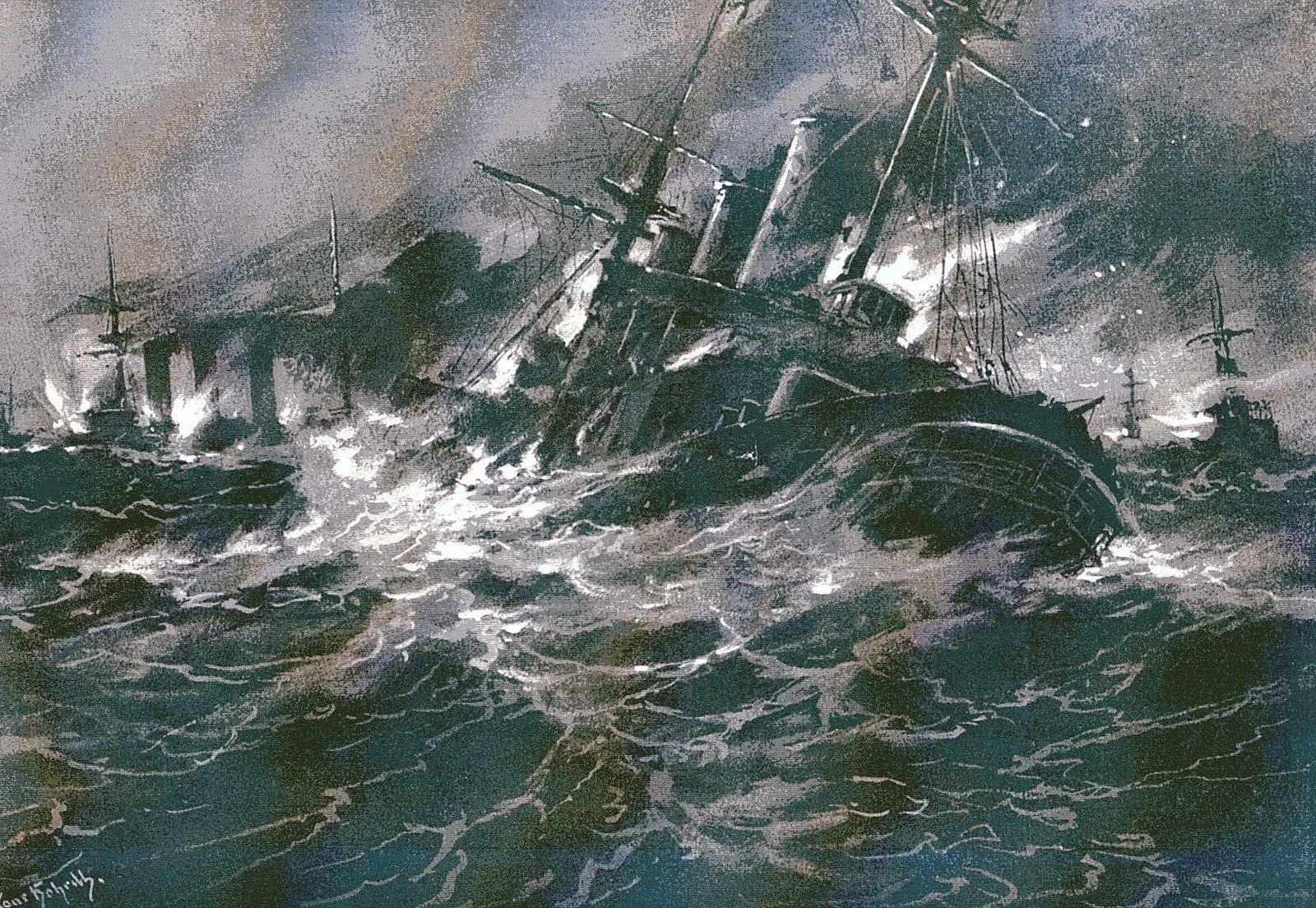
The Battle of Coronel was fought on the evening of 1 November 1914 in the Pacific, off the coast of central Chile. The German East Asia Squadron of Vice-Admiral Maximilian von Spee destroyed the British force of Rear-Admiral Christopher Cradock. Two British armoured cruisers went down with all hands, while the Germans had only three wounded. It was the first defeat of the Royal Navy in a naval battle in more than a hundred years.
The chase across the Pacific
From the start of the war von Spee’s squadron was one of the greatest worries of the British Admiralty. After leaving Pohnpei in August, the German ships vanished into the vastness of the Pacific. Only the bombardment of Papeete on Tahiti on 22 September showed that Spee was sailing east, towards South America. In October, off Easter Island, he was joined by the light cruisers Dresden and Leipzig. From then on the squadron had five ships: the armoured cruisers Scharnhorst and Gneisenau and the light cruisers Leipzig, Dresden and Nürnberg. The crews of both armoured cruisers were among the best trained in the German navy and were famous for the accuracy of their gunnery.
In the South Atlantic and South American waters the command was held by Cradock, the same man whose ships had chased the cruiser Karlsruhe in August. The Admiralty ordered him to find and destroy the German cruisers, but gave him weak forces to do it. The core of his force was two old armoured cruisers: the flagship HMS Good Hope and HMS Monmouth. Their crews consisted largely of reservists who had had no time to work up or practise gunnery. Only Good Hope had two heavy 234 mm guns; the rest of the two ships’ armament was 152 mm guns, many of them mounted low in the sides, so that they could not be fired in a heavy sea. The force was completed by the modern light cruiser HMS Glasgow and the armed merchant cruiser Otranto, an armed passenger liner that was unfit to fight warships.
Cradock’s most powerful ship was the old pre-dreadnought HMS Canopus. Her heavy guns could match the German ones, but the ship was slow, and because of reported engine trouble she was sailing even more slowly than usual. With Canopus Cradock had no chance of catching the faster Germans. He therefore left her behind to escort the colliers and set off north along the coast of Chile. Meanwhile the Admiralty sent him orders that were unclear and sometimes contradictory. His request for reinforcement by the modern armoured cruiser HMS Defence was not granted.
The encounter
On 31 October Glasgow put into the Chilean port of Coronel to collect telegrams. News of her presence quickly reached the Germans, and Spee decided to intercept the lone cruiser. Cradock in turn, hearing Leipzig’s wireless signals, believed he was dealing with a single German light cruiser. Neither side knew that the enemy’s main force was nearby.
In the afternoon of 1 November, at about 4.20 p.m., the two squadrons sighted each other. Cradock could still have retreated south, towards Canopus, which according to British accounts was then about 250 nautical miles behind. He nevertheless chose to fight. He was an officer of the old school and most probably judged that the Admiralty’s orders and the honour of the navy did not allow him to avoid action. He formed his ships into line and turned towards the Germans, trying to engage before sunset, while the sun was in the eyes of the German gunners.
Spee, whose ships were faster, kept his distance and waited. A strong wind was blowing, the sea was high, and the British were on the open-sea side, west of the Germans. When the sun set, the situation was reversed. The silhouettes of the British ships stood out sharply against the still bright sky, while the German ships were lost in the gloom against the Chilean coast.
The battle
At about 7 p.m., at a range of about 11 kilometres, the German armoured cruisers opened fire. Scharnhorst fired at Good Hope, Gneisenau at Monmouth. The very first salvoes found their mark. On Good Hope a hit in the first minutes of the action probably disabled one of the two heavy guns, and both British cruisers were soon ablaze. Cradock’s ships, rolling in the swell, fired slowly and inaccurately, and in the deepening darkness their gunners could see only the flashes of the German guns.
Good Hope, hit at least 35 times by German reckoning, still tried to close with the enemy. At about 7.50 p.m. she ceased firing. Soon afterwards a huge explosion occurred in her bow and the ship disappeared into the darkness. No one saw her sink. Her whole crew of more than 900 men was lost, and with them Admiral Cradock.
The badly damaged Monmouth, listing and with her bow on fire, left the line. Glasgow, hit five times, kept fighting for a while, but her captain, John Luce, realised that the Germans were aiming at the flashes of his guns and that he could not help Monmouth. He withdrew into the darkness to warn Canopus. Otranto had already made off earlier. At about 9 p.m. the drifting Monmouth was found by Nürnberg, which had arrived too late for the battle. The German cruiser lit up the British ensign with a searchlight, giving the enemy a chance to surrender. When there was no answer, she opened fire at close range. Monmouth capsized and sank. In the rough sea the Germans could not pick up survivors. Of a crew of more than 700 men, no one survived.
Losses
About 1,600 British sailors were killed in the battle, by some counts more than 1,650. No one was saved from either armoured cruiser. Glasgow and Otranto escaped without serious losses, and Canopus, warned by Glasgow, turned back south. The Germans received only a few hits. On Gneisenau there were three wounded, and on Scharnhorst no one was hurt.
The victory nevertheless came at a price for the Germans. Scharnhorst and Gneisenau had fired roughly half their heavy-gun ammunition, and on the far side of the world there was nowhere to replenish it. Spee understood that his squadron was condemned to fight alone against superior enemy forces. When on 3 November he entered Chilean Valparaíso with part of his ships and the local Germans presented him with flowers, he is said to have remarked that they would do for his grave.
Significance
The defeat at Coronel was a huge shock for the British. For the first time since the Napoleonic Wars and the war with the United States of 1812–1815, a British squadron had lost a battle at sea. In Germany the victory was greeted with enthusiasm, and Spee became a national hero. After the battle there was a debate in Britain about who was to blame: Cradock, who had attacked a stronger enemy without Canopus, or the Admiralty, which had sent him to fight with forces too weak and orders too vague.
The Admiralty’s response was swift. The new First Sea Lord, Admiral John Fisher, who had taken office only two days before the battle, detached two battlecruisers from the Grand Fleet, HMS Invincible and HMS Inflexible, under Vice-Admiral Doveton Sturdee. On every ocean the hunt for von Spee’s squadron began. The German admiral meanwhile decided to round Cape Horn and pass into the Atlantic. Five weeks after Coronel, on 8 December 1914, his squadron ran into Sturdee’s ships off the Falklands.
Spotted a mistake?Report an error