German Empire · The Central Powers
Maximilian von Spee
Commander of the East Asia Squadron (1912–1914), vice-admiral
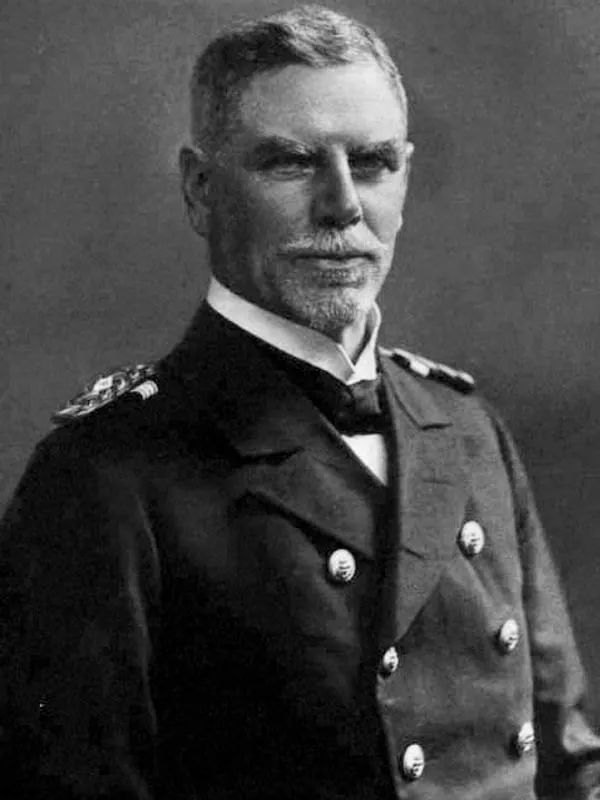
- Born:
- 22 June 1861, Copenhagen (Denmark)
- Died:
- 8 December 1914, South Atlantic, off the Falkland Islands
- Author:
- Łukasz Skowroń
- Photo:
- Ferdinand Urbahns, domena publiczna, Wikimedia Commons

Maximilian Graf von Spee commanded the only permanent formation of the German navy outside Europe, the East Asia Squadron. When war broke out his ships were at the other end of the world, without a base and without assured coal supplies. Spee led them across the whole Pacific Ocean, on 1 November 1914 off the coast of Chile he inflicted on the Royal Navy its first defeat in a naval battle in more than a hundred years, and five weeks later he was killed together with most of the squadron and both his sons in the Battle of the Falkland Islands. His campaign lasted only four months, but during that time it tied down dozens of Allied ships on every ocean.
Before the war
He was born on 22 June 1861 in Copenhagen, into a Catholic Rhineland family of counts. He went to school in, among other places, Lucerne in Switzerland. In 1878 he joined the Kaiserliche Marine. As a young officer he sailed off the coast of West Africa in the years when Germany was founding colonies in Togo and Kamerun, and in 1887 he became port commandant at Douala. There he fell ill with rheumatic fever and had to return home. Rheumatism troubled him for the rest of his life. In 1889 he married Baroness Margaretha von der Osten-Sacken. They had two sons, Otto and Heinrich, and a daughter, Huberta.
At the end of 1897, just after Germany had seized Kiautschou Bay with the port of Qingdao, then called Tsingtao, he joined the staff of the East Asia Squadron. Later he commanded several ships in turn, including from 1905 the battleship Wittelsbach, was chief of staff of the North Sea naval station, and in 1910, as a rear-admiral, became deputy commander of the scouting forces of the High Seas Fleet.
On 4 December 1912 he took command of the East Asia Squadron, and in November 1913 he was promoted to vice-admiral. The core of the squadron consisted of two armoured cruisers, the flagship Scharnhorst and Gneisenau, whose crews were renowned for their gunnery. Spee made cruises around East Asia and the Pacific: in 1913 he visited Emperor Taishō in Japan, then Siam, and in May 1914 in Peking he spoke with the President of China, Yuan Shikai. On 20 June 1914 he sailed from Tsingtao on a cruise of the German islands in the Pacific. The news of the assassination in Sarajevo reached him on the way, and from 17 July he lay with the armoured cruisers in the Carolines, in the harbour on the island of Pohnpei, from where he followed the mounting crisis in Europe by radio.
Across the Pacific
When war broke out Spee had both armoured cruisers at hand, and on 6 August the light cruiser Nürnberg joined him. That same day the squadron left Pohnpei and headed for the island of Pagan in the Marianas, where it gathered colliers and the cruiser Emden. Spee knew that he could not hold out long in the western Pacific. Ranged against him were the Australian battlecruiser Australia and British ships from Hong Kong, and soon Japan presented Germany with an ultimatum and entered the war. Tsingtao, the squadron’s only base, was doomed to a siege.
The admiral decided to take the squadron east, towards the coast of South America, where he could count on coal from neutral ports and on ships of German shipowners. At the conference at Pagan the captain of Emden, Karl von Müller, persuaded him to detach one fast cruiser for an independent war on commerce in the Indian Ocean. Spee agreed. He believed that the whole squadron could not wage such a war, as it would need too much coal, but that a single cruiser stood a chance. Emden’s raid became one of the most famous episodes of the war at sea.
The main force set off east through the Marshall Islands. Every stop meant many hours of exhausting coaling from the colliers accompanying the squadron. On the way Spee simplified life aboard the ships and relaxed some of the formalities. On 14 September Scharnhorst and Gneisenau appeared off Apia in Samoa, which the New Zealanders had occupied two weeks earlier. The admiral hoped to surprise Allied ships, but there were none in the harbour. He refrained from a bombardment so as not to kill Samoans or destroy German property.
On 22 September the squadron shelled Papeete on French Tahiti. The French managed to burn the coal stocks, and Spee, fearing mines, did not enter the harbour. The attack achieved little, used up some of the ammunition that could not be replenished anywhere and, above all, revealed to the British where the squadron was heading. After a stop in the Marquesas, where the ships took on food, in mid-October off Easter Island Spee was joined by the light cruisers Dresden and Leipzig, which until then had operated off the coasts of the Americas.
Coronel
At the end of October the squadron arrived off the coast of Chile. When Spee learned that the lone British cruiser Glasgow was lying in the port of Coronel, he decided to intercept her. On the afternoon of 1 November, however, he came upon the whole squadron of Rear-Admiral Christopher Cradock: two old armoured cruisers, Good Hope and Monmouth, Glasgow and the auxiliary cruiser Otranto.
The Battle of Coronel was a display of tactical superiority. Spee, whose ships were faster, kept his distance and waited for the sun to set. The silhouettes of the British ships were then outlined against the bright sky, while the German ones vanished into the gloom against the coast. At about 7 p.m. Scharnhorst and Gneisenau opened fire and began hitting almost at once. Good Hope sank with all hands and Admiral Cradock, and Monmouth, later finished off by Nürnberg, went down leaving no survivors. About 1,600 British sailors were killed, while the Germans had three wounded.
The victory, however, cost the squadron roughly half its ammunition for the heavy guns. On 3 November Spee entered neutral Valparaíso with three ships. The local Germans presented him with flowers, and he is said to have replied that they would do for his grave. He also said that he was “quite homeless”: he could not reach Germany, he had no safe port, and he would fight until he ran out of ammunition or a much stronger enemy caught him. The Admiralty Staff in Berlin instructed him to try to break through to home. Meanwhile on 7 November Tsingtao fell, and in London Admiral John Fisher, who had returned to the Admiralty a few days earlier, sent two battlecruisers against the squadron under Vice-Admiral Doveton Sturdee.
The Falklands
Spee remained in Chilean waters for several weeks, taking on coal off the island of Más Afuera and in the Gulf of Penas. He set off south only on 26 November, rounded Cape Horn on the night of 1–2 December, and then for three days off Picton Island transferred coal from a captured British sailing ship. On 6 December, at a conference aboard Scharnhorst, he presented a plan for a raid on the Falklands, where he wanted to destroy the radio station and the coal stores. According to the information available to him there were no British warships at Port Stanley. Some of the captains opposed the raid and preferred to bypass the islands, but the admiral stuck to his decision.
On the morning of 8 December Gneisenau and Nürnberg, sent ahead, approached Port Stanley. They came under fire from the old battleship Canopus, hidden in the harbour, and lookouts spotted the tripod masts that only modern capital ships had. Sturdee had arrived the day before. Spee broke off the attack and made off at full speed to the south-east, but the much faster battlecruisers Invincible and Inflexible closed on him all day in exceptionally good visibility. Shortly after 1 p.m. the admiral ordered the light cruisers to scatter and flee, while he himself turned back to fight with Scharnhorst and Gneisenau to give them time.
In the Battle of the Falkland Islands Spee manoeuvred skilfully and several times forced the British to change course, but his 210 mm guns were no match for the British 305 mm guns. Scharnhorst, burning and listing ever more heavily, sank at 4.17 p.m. with all hands and the admiral. His last signal ordered Gneisenau to save herself by flight. Gneisenau, Nürnberg and Leipzig also went down. About 1,900 German sailors were killed, by some counts as many as 2,200, among them both the admiral’s sons: Otto in Nürnberg and Heinrich in Gneisenau. Only Dresden escaped; in March 1915 her crew scuttled her off the Juan Fernández Islands.
Memory
In Germany Spee became a national hero, and the press glorified the crews who had not struck their colours. In 1917 his widow christened the battlecruiser Graf Spee, which was not completed before the end of the war. In 1934 his name was given to the so-called pocket battleship Admiral Graf Spee, christened by the admiral’s daughter. That ship was scuttled by her crew in December 1939 off the coast of Uruguay. In 2019, almost exactly 105 years after the battle, a research expedition found the wreck of Scharnhorst on the ocean floor south-east of the Falklands. The head of the von Spee family called the discovery “bittersweet”: the family had lost a father and two sons in a single day.
Assessment
Historians of naval warfare generally rate Spee highly as a commander. Taking the squadron across the whole Pacific without a base, with coal supplies dependent on accompanying colliers and neutral ports, is regarded as a great organisational achievement. The Battle of Coronel is cited as an example of skilful exploitation of superior speed, light and weather. Even critics admit that his position was hopeless from the outset: without ports in which to repair his ships and replenish his ammunition, the squadron could only postpone its end.
His decisions after the victory are more controversial. The shelling of Papeete revealed the squadron’s direction of travel, and the stay of several weeks off the coast of Chile and the three-day stop off Picton Island gave the Admiralty time to send the battlecruisers. Most often criticised is the raid on the Falklands, undertaken against the views of some of the captains and without reconnaissance, although the squadron already had enough coal to head north at once. Emperor Wilhelm II himself noted on the report of the battle that it remained a mystery what had induced Spee to make this attack. Some authors point out, however, that a coincidence contributed to the defeat: had the squadron arrived a day earlier, it would not have found Sturdee in port, and had it arrived a day later, the British would already have been looking for it in the Pacific.
Sources
Spotted a mistake?Report an error
Commanded in battles
(02)Mentioned in battles
(01)On the timeline
(12)1914
July
August
- 06
- Auxiliary cruiser Prinz Eitel Friedrich sails from TsingtaoIn early August 1914 the armed liner Prinz Eitel Friedrich left the German base of Tsingtao in China to join Admiral von Spee's squadron.
- Admiral von Spee's squadron leaves PohnpeiOn 6 August 1914 Admiral von Spee's German East Asia Squadron sailed from Pohnpei in the Carolines. Its odyssey across the Pacific had begun.