1914: The war at sea
Battle of the Falkland Islands
- Dates:
- 8 December 1914
- Front:
- War at sea
- Location:
- South Atlantic, east and south-east of the Falkland IslandsOn the battle map →
- Sides:
- United KingdomDoveton Sturdee, Archibald StoddartGerman EmpireMaximilian von Spee
- Result:
- British victory. The Germans lost two armoured cruisers and two light cruisers, and the East Asia Squadron ceased to exist. The British lost no ship.
- Author:
- Łukasz Skowroń
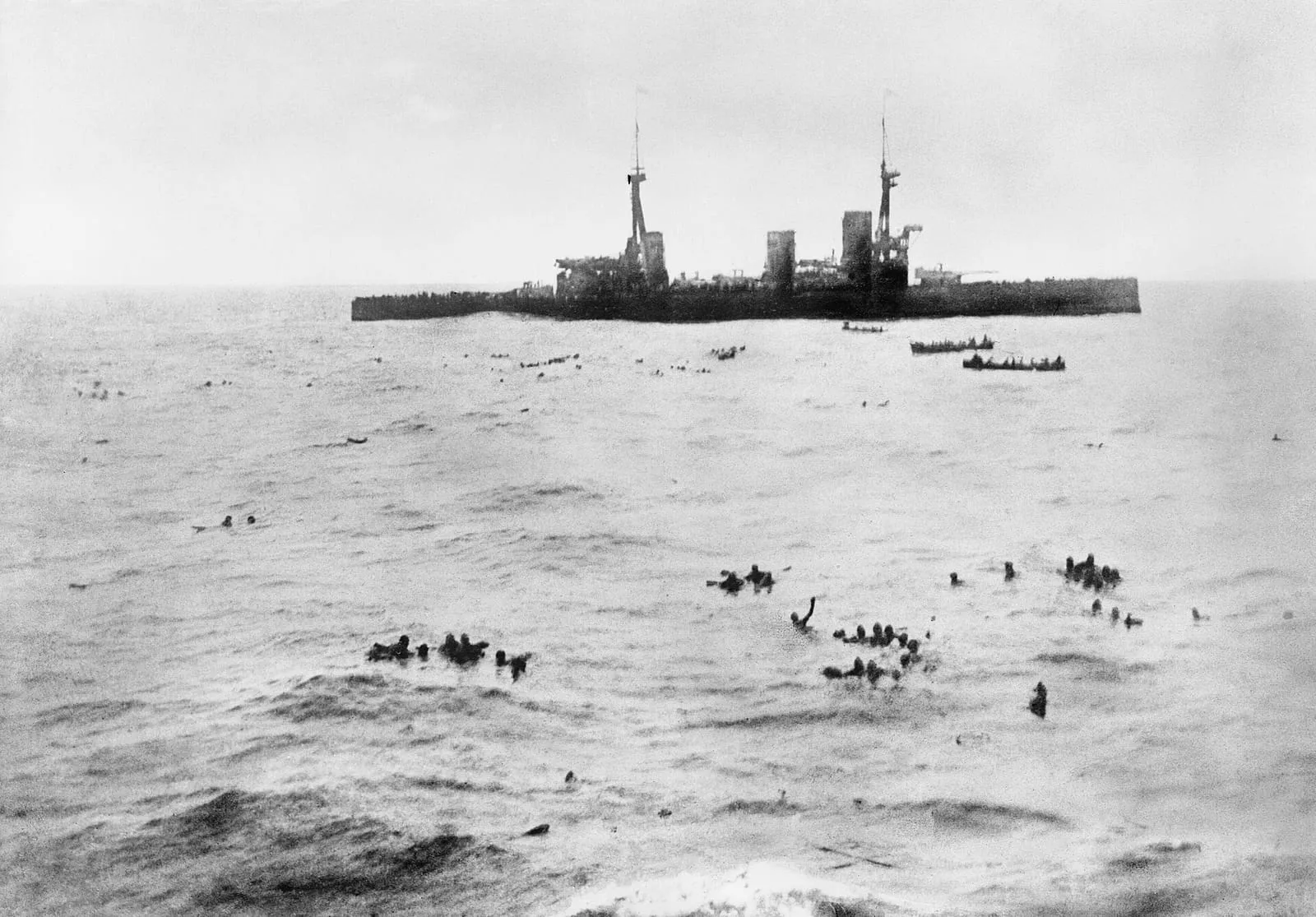
The Battle of the Falkland Islands was fought on 8 December 1914 in the South Atlantic. A British force under Vice-Admiral Doveton Sturdee, led by two modern battlecruisers, caught and destroyed the German East Asia Squadron of Vice-Admiral Maximilian von Spee. Four of the five German cruisers were sunk, and Spee himself and about 1,900 of his sailors were killed. Five weeks after the defeat at Coronel, the Royal Navy took its revenge, and Germany lost the only squadron it had on the oceans of the world.
The answer to Coronel
News of the sinking of Admiral Cradock’s cruisers reached London on 4 November. The First Sea Lord, Admiral John Fisher, back at the Admiralty for only a few days, resolved to finish off von Spee’s squadron once and for all. Two battlecruisers were detached from the Grand Fleet, HMS Invincible and HMS Inflexible. Each of them had eight 12-inch (305 mm) guns and was clearly faster than the German armoured cruisers, armed with 210 mm guns. Command of the force and of the whole South Atlantic and Pacific area was given to Vice-Admiral Sturdee, until then Chief of the Admiralty War Staff.
The ships left Devonport on 11 November, in such haste that dockyard workers were still on board Invincible. They crossed the Atlantic at economical speed to save coal. On 26 November, off the Brazilian Abrolhos islands, they joined the ships of Rear-Admiral Archibald Stoddart: the armoured cruisers Carnarvon, Cornwall and Kent and the light cruisers Bristol and Glasgow, the latter a survivor of Coronel. On the morning of 7 December the whole force put into Port Stanley, today Stanley, the capital of the Falkland Islands, to coal before setting out for Chilean waters. The old battleship Canopus was already there; after Coronel she had been grounded in the harbour as a floating battery.
Admiral von Spee’s decision
After his victory at Coronel, von Spee’s squadron had nowhere to return to. The Japanese and British had taken Tsingtao, and at Coronel the ships had fired off roughly half of their heavy-gun ammunition, which could not be replenished anywhere. Spee decided to pass into the Atlantic and try to break through to Germany. At the end of November he left Chilean waters, on 1 December rounded Cape Horn, and for several days took coal from a captured British collier off Picton Island.
On 6 December the admiral put a new plan to his captains: before heading north, to attack the Falklands and destroy the wireless station and coal stocks there. According to the information available to him, there were no British warships at Port Stanley. Most of the captains were against the raid, which was not necessary, as the squadron already had as much coal as it could carry. Spee, however, stood by his decision. He did not know that at the same time Sturdee was heading for the Falklands.
Morning at Port Stanley
On the morning of 8 December Gneisenau and the light cruiser Nürnberg, sent ahead, approached the Falklands. The weather was exceptionally fine: a cloudless sky, a light wind and excellent visibility. At about 7.50 a.m. they were sighted from land. In the harbour most of the British ships were coaling, Cornwall had her boilers cold, and Bristol had one of her engines dismantled. Only Kent and the armed merchant cruiser Macedonia, on guard duty, had steam up.
At about 9.20 a.m. Canopus, hidden behind a hill, opened fire. Her shells did no damage, but they stopped the Germans. As they approached, the Germans saw in the harbour the characteristic tripod masts that only the newest capital ships had. Spee realised he had fallen into a trap, broke off the attack and made off south-east at full speed with the whole squadron. In doing so he lost the only chance he had: to attack the British ships while they were still in the confined harbour. Sturdee had his crews eat breakfast calmly, and at about 10 a.m. the force put to sea. The Germans had a lead of about 15 miles, but there were still many hours of daylight left.
The armoured cruiser action
The battlecruisers gradually closed the distance. Shortly before 1 p.m. they opened fire at a range of about 15 kilometres, aiming at Leipzig, the last ship in the German line. Spee realised he would not escape. At about 1.20 p.m. he ordered the light cruisers to scatter and flee south, while he himself turned back with Scharnhorst and Gneisenau to give battle and buy them time. Sturdee sent Glasgow, Cornwall and Kent after the light cruisers and took on the armoured ships with Invincible and Inflexible.
The fight lasted more than three hours. Sturdee tried to keep at a range at which his 12-inch guns could hit the enemy while the German 210 mm guns had little chance. Funnel smoke from the British ships obscured their target most of the time, and long-range fire was inaccurate, so the battle dragged on. Spee tried several times to shorten the range to bring his medium-calibre guns into action, but the heavy British shells hit more and more often. Scharnhorst, with her funnels shot away, on fire and with a growing list, sank at 4.17 p.m. Her whole crew, about 860 men, was lost, and the admiral with them. Spee’s last signal ordered Gneisenau to save herself by flight.
Gneisenau fought on for another hour and a half against both battlecruisers and the armoured cruiser Carnarvon. When she had run out of ammunition and lost speed, her crew, according to German accounts, opened the sea cocks. The ship capsized and sank at about 6 p.m. The British pulled about 190 survivors from the cold water, but some of them soon died.
The pursuit of the light cruisers
Meanwhile separate duels were going on to the south. Kent, an older armoured cruiser, caught up with Nürnberg, which according to her crew’s accounts was possible only because even the ship’s wooden fittings were thrown into the boilers. In the evening two boilers exploded on Nürnberg and the cruiser lost speed. She sank at 7.27 p.m. Only a dozen or so survivors were picked up from the water, of whom seven lived. Leipzig, pursued by Glasgow and Cornwall, fought until she had fired her last shell. The burning ship capsized and sank at about 9.20 p.m., some 130 kilometres south-east of the Falklands. Eighteen members of her crew survived.
Bristol and Macedonia intercepted and sank two German supply ships, Baden and Santa Isabel. A third ship, Seydlitz, escaped the pursuit, as did the light cruiser Dresden, which thanks to her superior speed and the weather worsening in the afternoon vanished from the British view.
Losses
The German defeat was complete. About 1,900 German sailors were killed, by some counts as many as 2,200. Among the dead were both of the admiral’s sons: Otto served in Nürnberg and Heinrich in Gneisenau. About 215 survivors, most of them from Gneisenau, were taken prisoner by the British. The British lost no ship. Ten of their sailors were killed and about twenty wounded. Invincible took 22 hits but had no casualties among her crew. One German shell hit her near a magazine but did not explode. Kent suffered most, hit 36 times.
Significance
The Battle of the Falkland Islands wiped out the disgrace of Coronel and restored faith in the power of the British fleet. The East Asia Squadron, the only permanent formation of the German navy outside Europe, ceased to exist. After the earlier destruction of the Emden, cruiser warfare waged by regular ships of the Kaiserliche Marine was essentially over. The trade routes in the South Atlantic and the Pacific were safe again, and the Admiralty could recall home the ships that had until then been scattered across all the oceans in search of Spee. From then on Germany sent only armed merchant ships out onto the oceans.
The victory did not escape criticism. Fisher was displeased with the escape of the Dresden, and Sturdee’s critics accused him of letting the fight with the armoured cruisers last too long and use up most of the battlecruisers’ ammunition. The battle was also largely a matter of chance: had Spee arrived a day earlier, he would not have found Sturdee in the harbour, and had he arrived a day later, the British would already have been looking for him off the coast of Chile. Emperor Wilhelm II noted on the report of the battle that it remained a mystery what had induced Spee to attack the Falklands.
The Dresden hid for another three months among the fjords and islands of southern Chile. On 14 March 1915 British ships cornered her off the Juan Fernández Islands and her crew scuttled their own ship. In the Falklands 8 December is still a public holiday, observed as Battle Day. In 2019 a research expedition found the wreck of Scharnhorst on the ocean floor south-east of the islands.
Spotted a mistake?Report an error